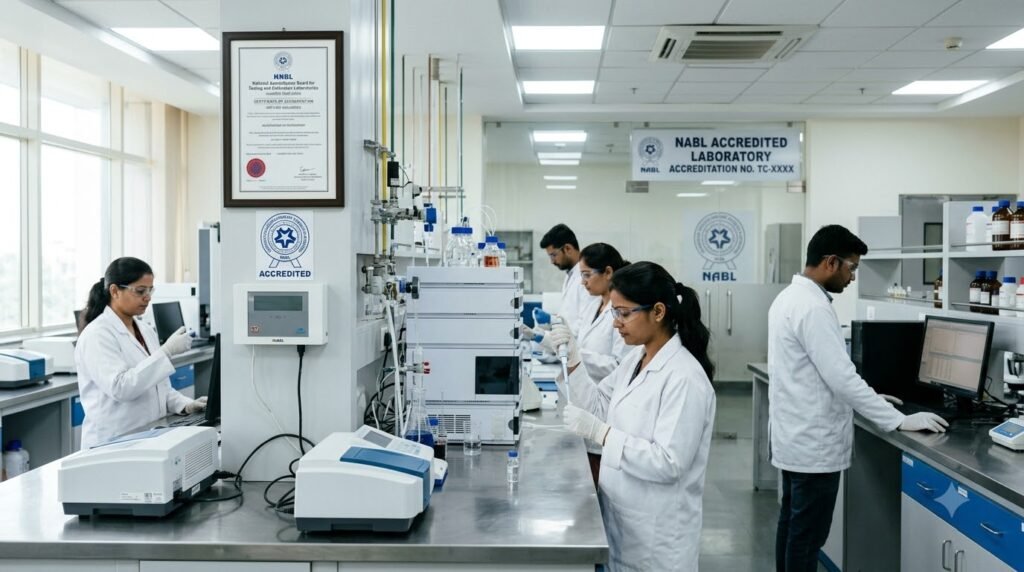
Most patients don’t think much about laboratory accreditation until a health issue emerges that requires diagnostic testing. At that point, the question becomes urgent: which lab can I trust to produce accurate results? Understanding what a genuine nabl accredited laboratory actually represents — and how it differs from unverified alternatives — helps you answer that question with confidence.
Ecotown Diagnostics operates as a certified nabl accredited laboratory where quality standards are independently assessed and continuously monitored — not simply claimed in marketing materials. This distinction shapes every aspect of how results are produced.
What “Accreditation” Actually Means in Medical Diagnostics
The term gets used loosely in healthcare marketing. A lab might claim to be “certified,” “approved,” “registered,” or “accredited” — and patients often assume these terms mean roughly the same thing. They don’t.
Registration means a lab is legally authorised to operate. It confirms compliance with basic regulatory requirements but does not evaluate testing quality.
ISO Certification means a lab follows a documented quality management system. It demonstrates that processes are formalised and consistent, but it doesn’t specifically validate the technical accuracy of individual test results.
NABL Accreditation is different. It specifically validates that a laboratory has the technical competence to perform particular tests accurately and reliably. Accreditation requires independent assessment against internationally recognised standards for medical laboratory practice.
A nabl accredited laboratory has demonstrated, through rigorous on-site evaluation and ongoing performance monitoring, that it meets those standards for the specific tests it claims to perform.
The International Standard Behind NABL Accreditation
NABL accreditation for medical labs is based on ISO 15189, an international standard for medical laboratory quality and competence. This standard applies globally — labs in Europe, Australia, and North America follow the same foundational requirements.
ISO 15189 covers:
- Pre-analytical processes (sample collection, handling, storage, transport)
- Analytical processes (testing methodology, equipment calibration, quality control)
- Post-analytical processes (result verification, reporting, communication)
- Management responsibilities (documentation, training, equipment maintenance)
- Personnel qualifications and competence
A nabl accredited laboratory that holds accreditation under ISO 15189 has proven it meets these international standards for the specific test disciplines within its scope.
How a Lab Earns and Maintains NABL Accreditation
The path to accreditation is deliberate and rigorous. Understanding it clarifies why accreditation carries genuine weight.
The Application Phase
A lab applies for accreditation specifying the test disciplines it wants to cover — biochemistry, haematology, microbiology, and so on. NABL reviews the application and may request clarifications or additional documentation.
The Assessment Phase
Trained NABL assessors visit the laboratory for an on-site evaluation. They observe actual testing being performed, examine equipment and calibration records, review staff training documentation, and assess the lab’s internal quality control systems. This typically takes one to three days depending on the scope.
The Deficiency Resolution Phase
If deficiencies are identified, the lab must address them within a specified timeframe. Minor issues (documentation gaps, procedural clarifications) may be corrected on paper. Major issues (non-functional equipment, untrained staff) require remediation and reassessment.
The Accreditation Phase
Once all requirements are met, NABL grants accreditation for a defined period — typically three years. The certificate specifies exactly which tests are covered under accreditation.
The Surveillance Phase
During the accreditation period, NABL conducts unannounced surveillance audits to ensure standards are maintained. These can occur at any time and without warning.
The Reassessment Phase
Before accreditation expires, the lab must undergo full reassessment. Previous accreditation is not automatically renewed; the lab must demonstrate continued compliance.
This cycle ensures that a nabl accredited laboratory doesn’t achieve accreditation once and then ignore quality. Ongoing accountability is built into the system.
What Gets Checked During a NABL Assessment
For patients wondering what makes accreditation credible, understanding the assessment scope helps clarify why it matters.
Equipment and Instrument Management
Every major piece of laboratory equipment must have documented calibration records showing it was tested against traceable reference standards within defined intervals. NABL assessors physically check logs, verify calibration dates, and confirm that calibrations were performed by qualified external agencies or certified in-house teams.
Quality Control Data
Labs must maintain records of internal quality control runs performed alongside patient testing batches. Assessors review months of QC data to confirm that controls are being run appropriately and that out-of-range results trigger corrective action before patient results are released.
External Proficiency Testing
NABL assessors review the lab’s participation in external quality assessment programs where unknown samples are tested and results compared to peer laboratories. Poor performance in EQAS programs is a red flag during assessment.
Staff Competence Documentation
Educational qualifications, certifications, and training records for all testing personnel are reviewed. Assessors confirm that technicians performing tests hold appropriate qualifications and that ongoing training is documented.
Standard Operating Procedures
Written procedures for every test must be reviewed against actual practice. Assessors observe technicians performing tests and confirm that real-world steps match documented procedures — not just that procedures exist.
Biosafety and Safety Protocols
Working conditions, disposal of hazardous materials, infection control measures, and emergency procedures are all assessed. A nabl accredited laboratory must demonstrate that it operates safely for both staff and patients.
Complaint Handling and Corrective Action
How does the lab handle complaints about results? NABL checks whether the lab has a formal process for investigating concerns and whether corrective actions are documented and effective.
The Practical Difference This Makes for Your Results
Understanding the accreditation process is valuable context, but the real question is practical: how does this change the results you receive?
Consider a thyroid function test — TSH, Free T4, Free T3. Your doctor needs these values to assess whether your thyroid medication is appropriately dosed.
In a non-accredited lab, the process might be:
- Sample collected and labelled
- Stored at an unverified temperature
- Tested on equipment that hasn’t been recently calibrated
- Internal quality control may or may not be performed
- Results verified by whoever happens to be available
- Report issued
In a nabl accredited laboratory, the process follows strict protocols:
- Sample collected by trained phlebotomist following documented procedures
- Stored at precise temperature and transported within specified timeframe
- Equipment calibrated against traceable standards within defined intervals
- Internal quality control samples run in the same batch as your sample
- If QC is out of range, the batch is rejected and retested
- Results verified by appropriately qualified pathologist
- External quality checks confirm the lab’s performance against peer facilities
- Report issued with clear reference ranges and any flagged abnormalities
The difference accumulates. Over time, accredited testing gives your doctor and you more dependable information to act on.
Accreditation Scope: What Gets Covered and What Doesn’t
One critical detail that confuses many patients is assuming that NABL accreditation is all-or-nothing. It isn’t.
A lab might hold valid NABL accreditation for clinical biochemistry tests but not for haematology or microbiology. Another lab might be accredited for routine bacterial culture but not for molecular or viral testing.
When choosing a nabl accredited laboratory, always confirm that the specific tests you need fall within the lab’s accredited scope. A lab can operate legally and produce results for tests outside its accreditation scope — but those results lack the same quality assurance as accredited tests.
This is why it’s worth asking the lab directly: “Is [specific test name] within your NABL accreditation scope?” A straightforward answer confirms they understand their own limitations.
How Often Should You Use the Same Accredited Lab
For ongoing health monitoring, using the same accredited lab consistently offers practical advantages.
When you repeat tests over months or years, having them analysed by the same facility minimises variation due to different methodologies, reference ranges, or equipment. This makes it easier to identify genuine physiological changes rather than attributing variation to lab differences.
If you must switch labs, inform your doctor. A different lab’s reference ranges, methodology, or result format might influence interpretation even if both are accredited.
Costs of Maintaining Accreditation Standards
A question many patients ask is whether accreditation-driven lab operations cost significantly more. The honest answer requires some nuance.
Maintaining NABL accreditation involves real expenses:
- Equipment purchase and maintenance
- Regular calibration by external agencies
- Proficiency testing program enrollment
- Training and competency assessment for staff
- NABL audit and surveillance fees
- Quality documentation and record management systems
These costs are absorbed into the lab’s operating budget. However, because many accredited labs achieve operational efficiency through volume and standardised processes, the per-test cost increase for patients is often modest rather than dramatic.
What matters from a patient perspective is whether the increased cost of accurate results is offset by avoiding the expense and health consequences of repeat testing due to unreliable initial results.
Red Flags That Suggest a Lab Might Not Be What It Claims
Some warning signs suggest that a lab claiming accreditation might not hold valid NABL status or might not maintain standards rigorously:
- Cannot produce an NABL certificate or certificate number when asked
- Cannot specify which tests are within their accreditation scope
- Certificate has no clearly visible expiry date or appears outdated
- Lab cannot explain basic quality control or calibration processes
- Unusually fast turnaround times for tests that normally require incubation or processing time
- No documented system for handling critical value results
- Staff unfamiliar with NABL requirements or unable to answer basic questions about accreditation
Any of these should prompt you to verify accreditation independently before proceeding.
Frequently Asked Questions
How can I confirm a lab’s NABL accreditation independently?
Visit nabl-india.org, access the accredited labs directory, and search by lab name or certificate number. The website provides current accreditation status, scope of tests covered, and accreditation validity dates.
Does NABL accreditation mean results are 100% accurate?
No system is perfect, but NABL accreditation significantly reduces error risk through calibration, quality control, and competency requirements. It doesn’t guarantee perfection; it ensures rigorous quality systems are in place.
What should I do if my nabl accredited laboratory result seems incorrect?
Contact the lab and discuss your concern. If clinically appropriate, requesting a repeat test is reasonable. Most accredited labs have formal processes for investigating disputed results.
How long does accreditation remain valid?
NABL accreditation is typically granted for three-year periods. Labs must undergo reassessment before accreditation expires. Always verify that a lab’s accreditation is currently valid rather than relying on information that may be outdated.
Can I demand that my tests be done at an accredited lab?
Many accredited labs accept self-referral for routine health screening and preventive tests. For specialised or controlled tests, a doctor’s prescription may be required depending on lab policy and applicable regulations.
Making Your Choice as an Informed Patient
Choosing a nabl accredited laboratory is a decision that compounds over time. Each accurate result supports better health monitoring. Each inaccurate result from a non-accredited facility creates confusion and potentially leads to inappropriate health decisions.
In a healthcare system where you bear significant responsibility for choosing where to get tested, understanding accreditation standards and how to verify them is practical knowledge worth having. It transforms lab selection from a default choice based on convenience into an informed decision based on quality assurance you can actually verify.