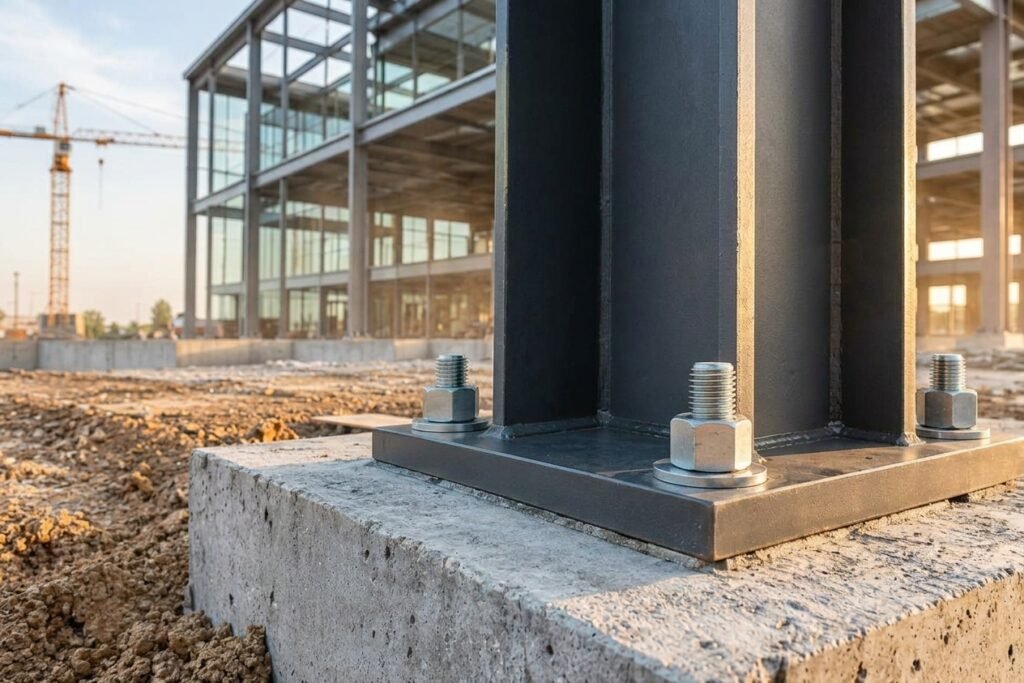
Ask a site team which part of a steel structure gets the least discussion, and the answer is often the Anchor Bolts. They arrive in bundles, they look alike, and they disappear under a base plate within days. That invisibility is exactly why choosing the right one matters more than most people assume.
A wrong choice rarely fails loudly
A poorly chosen anchor doesn’t usually give notice. The structure goes up, the equipment starts running, and everything seems fine. Problems appear later, as a base plate that shifts a little, a nut that keeps loosening, rust stains weeping from under the grout, or a crack that spreads around the pedestal.
By then, the fix is rarely a quick swap. The bolt is embedded in concrete, buried under steel, and carrying load. Replacing it can mean shutdowns, cutting, drilling, and engineering review. That’s the real argument for getting it right the first time.
Start with the job, not the catalog
The usual mistake is to begin with what’s available. A better habit is to begin with four questions:
- What loads will it carry? Tension, shear, or both, and are they steady, repeated, or sudden?
- What is the concrete like? Its strength, thickness, how close the bolts are to an edge, and whether it may crack in service.
- What is the environment? Dry indoor, outdoor, coastal, chemical, or high temperature.
- How long must it last? A temporary support and a plant meant to run for thirty years need different answers.
Once those are clear, the shortlist often narrows by itself.
Cast-in or post-installed?
Cast-in anchors go in before the concrete is poured, and their behavior is well understood. They suit new construction where the layout is known early. Headed or plate-washer styles generally perform better in heavy tension than hooked bolts, which depend on a bend for their grip.
Post-installed anchors, such as expansion, undercut, screw, and adhesive types, are the answer when the layout changes or the concrete already exists. They’re valuable, but they leave less margin for error. Hole size, depth, cleaning, and curing all affect the result, and some types lose capacity in cracked concrete. Look for products qualified for the conditions you actually have.
Grade is more than a number
Steel grade controls strength and stretch. ASTM F1554, a common anchor rod standard, offers several grades, and the right one depends on the design. Stronger isn’t automatically better, because very high-strength steel can be less forgiving and needs extra care with galvanizing.
The nut matters as much as the bolt. A strong bolt with a weak nut strips before it yields, and a hot-dip galvanized bolt needs a nut that is made to suit the coating. Washers should match the design, too. Treat the bolt, nut, and washer as a single set, not three separate purchases.
Coatings and compatible metals
Coating decisions look minor until a bolt rusts through at the plate line. Hot-dip galvanizing is a proven choice for many outdoor installations, and stainless steel suits more aggressive conditions. Whichever you choose, keep an eye on mixing metals. Different metals in wet contact can corrode faster, so ask the engineer before pairing stainless bolts with carbon steel plates in a damp setting.
Water is the real enemy, and it collects where the bolt leaves the concrete. Good grouting and drainage details do as much for longevity as the coating.
Size, length, and projection
A bolt that is the right grade can still be the wrong size. Diameter drives strength. Embedment length drives how much concrete resists the pull. The projection above the concrete must allow for grout, the base plate, washer, nut, and a few threads past the nut. Too little projection leaves the nut under-engaged, and too much invites bending and corrosion.
Imperial and metric threads are another quiet hazard. A nut that almost fits is a problem, not a solution.
The substitution trap
Substitution is where many good designs get undone. A bolt is out of stock, a delivery is late, and someone says an “equivalent” will do. Sometimes it will. Often it won’t, because equivalent in size doesn’t mean equivalent in strength, coating, thread form, or certification.
The safe rule is simple: any change from the specification goes back to the engineer for approval, in writing, before it gets installed. A five-minute email beats a five-month remediation.
Where you buy matters
The best specification only works if the product matches the paperwork. Ask suppliers for mill test certificates, grade markings, coating details, and dimensional data, and compare those with the project requirements. In the Gulf, manufacturers such as Petrofast Middle East FZC, which lists stud anchors among its products, are among those serving industrial projects. Whoever you pick, check the documents when the material arrives, not after it’s installed.
The cost argument
Anchor Bolts are a tiny share of a project’s budget. Choosing a cheaper, unverified alternative saves a trivial amount and puts a very large structure at risk. Think of it as a poor trade: small savings up front against possible downtime, repairs, and safety consequences later.
A short selection checklist
- Define the load type, concrete condition, environment, and service life
- Choose cast-in or post-installed deliberately, not by habit
- Match bolt, nut, and washer grades as a set
- Pick a coating that suits the exposure
- Confirm diameter, embedment, and projection against the drawings
- Get written approval for any substitution
- Verify certificates when material arrives
Conclusion
The right anchor looks unremarkable, and that’s the point. When it’s chosen carefully, installed correctly, and inspected over time, nobody notices it. When it isn’t, everybody does. Always follow the project engineer’s specifications and the applicable code.