When a doctor recommends an MRI scan, you’re probably already thinking about logistics. Where do you go? How do you book? When can you get an appointment? If you’re searching for MRI scan centres near me, you’re looking for convenience — but convenience shouldn’t be your only criterion. The quality of your MRI scan, the expertise of the radiologist interpreting it, and the reliability of the centre can significantly affect diagnostic accuracy and your subsequent treatment decisions.
Not all MRI facilities are equal. Some centres have outdated equipment, rushed appointment schedules, or radiologists who provide minimal clinical context in their reports. Others invest in advanced imaging technology, employ experienced radiologists, and build reports that genuinely help your doctor understand what’s happening inside your body. Finding a centre in your area requires understanding what to look for beyond simple proximity. If you’re in Bangalore, reputable MRI scan centres near me are available through Ecotown Diagnostics, which operates modern facilities with qualified radiologists and comprehensive reporting.
Why MRI Matters — and Why Quality Varies So Much
Magnetic resonance imaging produces detailed cross-sectional images of your body without using ionising radiation. It’s extraordinarily useful for visualising soft tissues — the brain, spinal cord, joints, organs, and blood vessels — in ways that CT or X-ray cannot match.
This capability makes MRI valuable for investigating everything from sudden neurological symptoms to chronic joint pain to suspected organ pathology. However, getting an MRI scan is only half the equation. The other half is having those images interpreted correctly by a radiologist who understands the clinical context and communicates findings clearly.
Quality variation exists because MRI centres operate under different business models. High-volume centres prioritise throughput — scanning as many patients as possible in a shift. Quality-focused centres prioritise thorough imaging protocols and careful interpretation. Outdated centres operate equipment that’s 10+ years old; advanced centres invest in newer technology with better image quality and faster scan times. These differences compound into meaningful variations in diagnostic accuracy.
Understanding Different Types of MRI Equipment
Before evaluating centres, it helps to understand the equipment landscape.
Field Strength
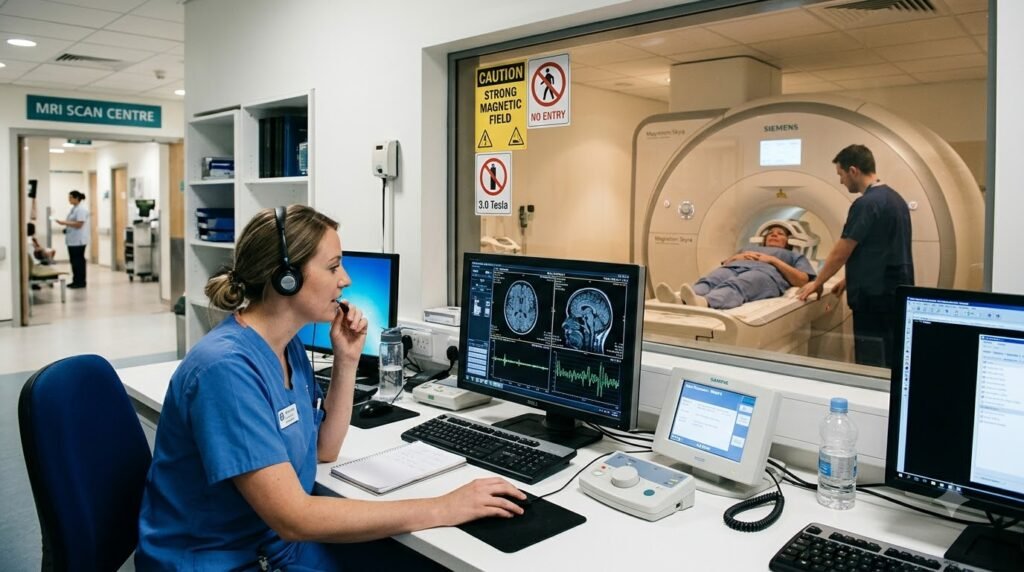
MRI machines are classified by their magnetic field strength, measured in Tesla (T). A 1.5T machine is the standard in most diagnostic centres and provides excellent image quality for most clinical applications. A 3T machine produces higher-resolution images and is particularly valuable for neurological imaging, cardiac imaging, and detailed joint assessment. Higher field strengths generally correlate with better image quality but also higher operating costs.
When searching for MRI scan centres near me, knowing whether a centre has 1.5T or 3T equipment helps you understand their technical capabilities. For most diagnostic purposes, 1.5T is adequate. For complex neurological or musculoskeletal cases, 3T offers advantages.
Open vs. Closed Bore
Traditional MRI machines are closed-bore — the patient enters a narrow tunnel during scanning. This can trigger claustrophobia in some people. Open MRI machines have a wider, more spacious design that feels less confining, though image quality is sometimes slightly compromised compared to closed-bore systems.
If you experience claustrophobia, mentioning this when booking allows the centre to prepare you appropriately or, in some cases, offer open MRI as an alternative.
Advanced Capabilities
Modern MRI centres offer functional MRI (fMRI) for brain mapping, diffusion tensor imaging (DTI) for assessing nerve fibres, MR spectroscopy for metabolic assessment, and cardiac MRI for heart imaging. If your referring physician has ordered specific advanced imaging, confirm the centre offers it.
Key Markers of Quality When Evaluating MRI Scan Centres Near Me
When you’re comparing MRI scan centres near me, look for these specific indicators of quality.
NABL Accreditation
The National Accreditation Board for Testing and Calibration Laboratories accreditation signals that a centre meets standardised quality benchmarks for equipment maintenance, calibration, personnel qualifications, and reporting protocols. NABL-accredited centres undergo regular external audits. This accreditation is a meaningful quality marker.
Radiologist Qualifications
Your scan is only as good as the radiologist interpreting it. Look for centres where imaging is reported by radiologists with qualifications in diagnostic radiology and relevant subspecialty training. A centre where scans are reported by general practitioners or technicians, rather than qualified radiologists, is cutting corners on a critical step.
Consistent Imaging Protocols
Reputable centres follow standardised imaging protocols for different anatomical areas and clinical indications. This consistency ensures high-quality, comparable images and reduces the chance of missing pathology due to inadequate imaging sequences.
Quality Control and Safety Standards
The centre should have documented quality control procedures for equipment maintenance and calibration. They should also screen you for contraindications — metallic implants, pacemakers, ferromagnetic foreign bodies — before scanning. Centres that don’t ask detailed questions about metal implants or safety concerns are not following proper protocols.
Clear Communication and Accessible Reports
Your report should be written in language you and your referring doctor can understand. Reports that are overly technical, vague, or non-committal are less useful clinically. Good reports provide clear descriptions of findings and appropriate clinical recommendations.
Reasonable Scan Times and Appointment Availability
Centres that rush through scans or consistently overbook appointments tend to provide lower quality imaging. If appointment slots are routinely booked weeks in advance or scan times are extremely quick (under 20 minutes for complex protocols), that suggests either limited availability or rushed scanning.
What to Ask When Calling MRI Scan Centres Near Me
These specific questions reveal quality:
- What is the field strength of your MRI equipment? (1.5T or 3T? Both are acceptable; know which you’re getting)
- How often is your equipment serviced and calibrated? (Should be regularly per manufacturer specifications)
- Are your radiologists NABL certified and board-qualified? (Should be yes)
- Will my scan be reported by a radiologist or a technician? (Should be a radiologist)
- What is your typical turnaround time for reports? (24–48 hours is standard)
- Do you screen for safety contraindications before scanning? (Should have detailed intake questionnaire)
- Can I receive a copy of my images on CD along with the report? (Should be yes)
- What is your cancellation policy? (Important if plans change)
- Is there a patient waiting area, and how long is the typical wait? (Indicates whether the centre is efficient or overboooked)
- Do you offer open MRI or other options for claustrophobic patients? (Relevant if you have concerns)
Preparing for Your MRI Scan: What You Need to Know
Proper preparation ensures your scan is completed safely and produces high-quality images.
Metal and Safety Screening
MRI machines create powerful magnetic fields. Ferromagnetic metals — iron, cobalt, nickel — are attracted to the magnet and can heat up, move, or cause injury. Before your scan, you’ll be asked detailed questions about metal implants, pacemakers, cochlear implants, metallic foreign bodies, shrapnel, or tattoos with metallic ink.
Be honest and thorough in answering these questions. If you’re uncertain whether an implant is compatible with MRI, inform the centre. They can contact your implant manufacturer or your surgeon to verify.
Clothing and Personal Items
Wear loose, comfortable clothing free of metal. Metal zippers, buttons, snaps, or underwire bras will need to be removed. Most centres provide hospital gowns. Remove all jewellery, watches, hairpins, and glasses. Leave personal items and valuables in a secure locker — do not bring them into the scanning room.
Fasting and Medication
You generally do not need to fast before an MRI scan unless your referring doctor specifically instructs you to. Continue taking your regular medications unless told otherwise.
Arrival Time
Arrive 10–15 minutes early to complete the safety screening form and allow time for questions.
During the Scan
The MRI machine makes loud knocking and humming noises during scanning. You’ll be offered earplugs or headphones. The machine is not dangerous, but the noise can be startling if you’re not prepared.
You’ll lie on a table that slides into the machine. For most scans, you need to remain completely still for 20–45 minutes depending on the protocol. Movement blurs images and may require repeating sequences. If you feel anxious or experience discomfort, you can communicate with the technician through a two-way intercom.
Understanding Your MRI Report
Your MRI report typically includes:
Technical details — The MRI sequences performed and their parameters
Findings — Descriptions of what the radiologist sees on the images, divided by anatomical region
Impression — A summary of the key findings and their clinical significance
Recommendations — Suggestions for follow-up imaging or additional testing if indicated
Radiology reports use specific terminology that can feel intimidating if you’re reading it for the first time. Terms like “signal intensity,” “T1-weighted,” and “heterogeneous enhancement” are technical descriptions of image appearance, not diagnoses in themselves.
Your radiologist report should be reviewed by your referring doctor, who will interpret the findings within your clinical context and explain what they mean for your diagnosis and treatment.
Common Concerns About MRI Scanning
Is MRI safe?
Yes. MRI uses magnetic fields and radio waves, not ionising radiation. No cumulative radiation risk exists from repeat MRIs. However, the strong magnetic field poses risks if you have certain metal implants or metallic foreign bodies. Proper screening before scanning eliminates these risks.
Is MRI painful?
No. MRI is completely painless. You may feel slight vibrations or warmth during scanning, but no pain.
How long does an MRI scan take?
Typical scans take 20–45 minutes depending on which body part is being imaged and which sequences are needed. Brain MRI typically takes 30–40 minutes. Abdominal or pelvic MRI may take 20–30 minutes. Complex protocols with multiple sequences can approach an hour.
Can I move during the scan?
No. Movement during scanning blurs images and often requires repeating sequences, extending your scan time. The technician will position you carefully and explain which body parts need to remain still.
What if I’m claustrophobic?
Open MRI systems are available at some centres and feel less confining. Some centres offer sedation for severely claustrophobic patients, though this requires additional preparation and a responsible adult to drive you home. Discuss this concern when booking if it applies to you.
Choosing the Right MRI Scan Centre Near You
When you’re searching for MRI scan centres near me, proximity matters for convenience, but quality matters more for diagnostic accuracy. A centre 15 minutes away with NABL accreditation, modern equipment, experienced radiologists, and thorough reports is worth the slightly longer drive compared to a closer centre with outdated equipment and minimal interpretation.
Ask the right questions, verify accreditation and qualifications, confirm equipment type and capabilities, and understand what to expect before your appointment. The effort you put into choosing your MRI centre pays dividends in the reliability of your results and, ultimately, in the accuracy of your diagnosis and the quality of your care.