Getting an MRI can feel daunting, especially if it is your first time. Between understanding what the scan involves, figuring out where to go, and worrying about costs, most people feel overwhelmed before they even book an appointment. The good news is that finding a reliable centre does not have to be complicated once you know what to look for.
If you have been searching for MRI scan centres near me, you are likely trying to balance three things: proximity, quality, and cost. For residents across Bangalore, accessing reliable MRI scan centres near me has become significantly easier with the growth of dedicated diagnostic facilities offering advanced imaging at reasonable prices.
What Is an MRI Scan and Why Does Your Doctor Recommend It?
MRI stands for Magnetic Resonance Imaging. Unlike X-rays or CT scans, it does not use ionising radiation. Instead, it uses powerful magnetic fields and radio waves to create detailed cross-sectional images of the body’s internal structures.
Your doctor may refer you for an MRI scan to examine the brain, spine, joints, abdomen, pelvis, or soft tissues. It is particularly useful for detecting conditions that other imaging methods cannot clearly show — such as ligament tears, early-stage tumours, nerve compression, or inflammation in organs.
An MRI is not a treatment. It is a diagnostic tool. The images it produces help your doctor make a more accurate diagnosis and decide on the most appropriate course of action.
Why Location Matters More Than You Think
When searching for MRI scan centres near me, many people focus heavily on price and forget about the practical importance of location. This matters for a few reasons.
First, MRI referrals are sometimes urgent. If your doctor needs results quickly, travelling an hour across a congested city adds unnecessary delay. A centre within a reasonable distance makes follow-ups and repeat visits far more manageable.
Second, if you are accompanying someone elderly, unwell, or mobility-impaired, distance and accessibility become even more critical. Look for centres with easy parking, ground-floor access, or proximity to public transport.
Third, familiarity with a nearby centre allows your regular physician to build a relationship with the radiologist — which often improves reporting quality and communication.
Key Factors to Evaluate Before Booking an MRI Centre
Not all diagnostic centres are equal. Here is what genuinely separates a reliable facility from an average one.
Quality of the MRI Machine
The strength of an MRI scanner is measured in Tesla (T). Most modern diagnostic centres operate 1.5T machines, which are suitable for the majority of clinical needs. Some centres offer 3T MRI scanners, which produce higher-resolution images and are particularly useful for neurological or musculoskeletal scans.
Ask the centre what machine they use before booking. This is a fair and sensible question, and any credible facility will answer it transparently.
Accreditation and Certification
Look for centres accredited by the NABL (National Accreditation Board for Testing and Calibration Laboratories) or those affiliated with recognised hospital networks. Accreditation means the facility has been independently evaluated for quality standards — including equipment calibration, reporting accuracy, and safety protocols.
A centre without any accreditation is not necessarily unsafe, but accreditation is an objective signal of quality that removes guesswork.
Radiologist Qualification and Reporting
The MRI machine captures images, but it is the radiologist who interprets them. The quality of the report depends heavily on the radiologist’s experience and specialisation.
Ask whether reports are reviewed and signed by a qualified radiologist on-site, or whether they are sent offsite for remote reporting. On-site radiologists can correlate findings more quickly and communicate with your referring physician if needed.
Turnaround Time
In many clinical situations, waiting three to five days for a report is simply not practical. Ask for the standard report delivery time upfront. Many well-equipped centres can deliver same-day or next-day soft copy reports via email or WhatsApp, with printed hard copies available for collection.
Common Mistakes People Make When Choosing an MRI Centre
Avoiding a few common errors can save you time, money, and unnecessary stress.
Choosing purely on price. The cheapest scan is not always a bargain. If the equipment is outdated or the radiologist is less experienced, the report may be inadequate — requiring a repeat scan at a better facility. That means paying twice.
Not checking appointment availability. Some centres have long waiting lists, especially for specific scan types like brain MRI or whole-spine MRI. Call ahead and confirm the earliest available slot before deciding.
Forgetting to ask about the contrast protocol. Some MRI scans are performed with contrast — an injectable dye that improves image clarity. If your doctor has requested a contrast MRI, confirm the centre has the facility and that the procedure will be performed safely with proper screening.
Ignoring claustrophobia concerns. Standard MRI machines have a narrow tunnel-like bore. If you experience claustrophobia, ask whether the centre has a wide-bore MRI or can accommodate you with appropriate support. Some centres also offer open MRI options.
What to Check on the Day of Your Scan
Preparation for an MRI scan is generally straightforward, but there are a few things worth confirming in advance.
Before You Arrive
- Follow any fasting instructions given by your doctor, particularly for abdominal or pelvic MRIs.
- Remove all metal jewellery and piercings before coming, or plan to remove them at the centre.
- Carry your doctor’s referral letter and any previous scan reports or films.
- Inform the centre in advance if you have any implanted devices such as a pacemaker, cochlear implant, or metal plates — as some implants are not compatible with MRI.
At the Centre
You will be asked to fill out a safety questionnaire about implants, allergies, and previous reactions to contrast agents. Answer these accurately — they protect you.
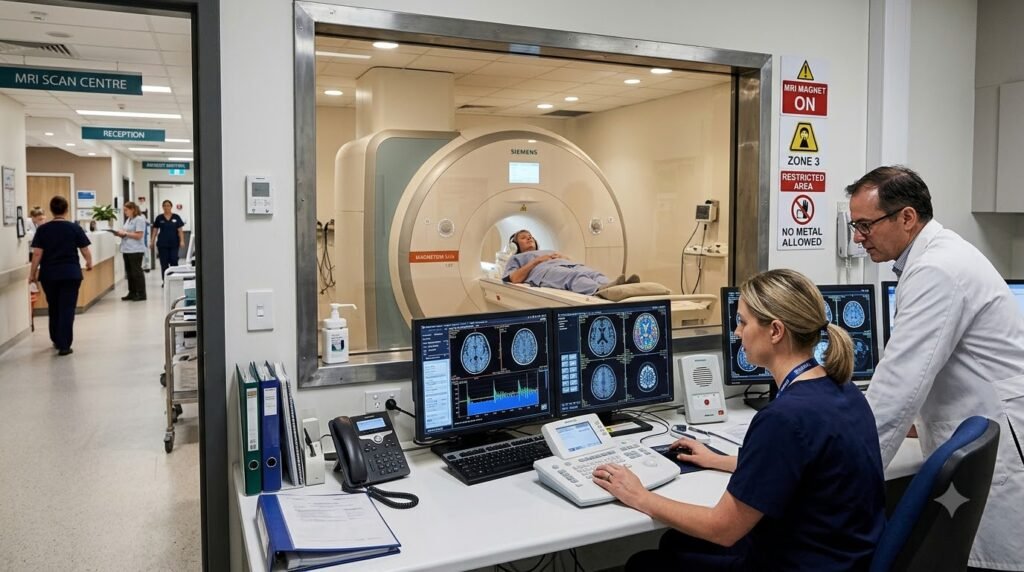
You will then change into a gown and be positioned on the scanning table. The scan itself typically takes between 20 and 60 minutes depending on the body part being examined.
The machine produces loud rhythmic knocking sounds. Earplugs or headphones are usually provided. Stay as still as possible during the scan — even small movements can blur the images.
How Much Does an MRI Scan Cost in Bangalore?
Costs vary based on the body part, whether contrast is used, and the type of facility. As a general reference:
- Brain MRI (without contrast): typically ranges from ₹3,500 to ₹7,000
- Spine MRI (lumbar or cervical): commonly between ₹4,000 and ₹8,000
- MRI with contrast: usually adds ₹1,500 to ₹3,000 on top of the base cost
These are approximate ranges. Prices at hospital-based radiology departments tend to be higher than standalone diagnostic centres offering comparable equipment and expertise.
Always ask for a written or clearly communicated price before your scan. Transparent pricing is a basic expectation, not a luxury.
Questions to Ask Any MRI Centre Before Booking
These questions help you assess a centre quickly and confidently:
- What type of MRI machine do you use and what is its field strength?
- Is the radiologist available on-site and what are their qualifications?
- What is the turnaround time for reports?
- Do you offer same-day or soft copy report delivery?
- Is the centre NABL accredited or affiliated with a recognised network?
- What is the total cost, including contrast if required?
- Are there any preparation requirements I should follow?
A centre that answers these questions clearly and without hesitation is generally worth your confidence.
Red Flags to Watch Out For
Some warning signs suggest a centre may not meet acceptable standards.
- Reluctance to share pricing upfront
- Vague answers about the radiologist’s qualifications
- Outdated equipment with no information about service or calibration history
- No on-site support staff during the scan itself
- Poor or unhygienic facility conditions
- No clear process for urgent or ambiguous findings
Trust your instincts. If something feels off during your inquiry, it is entirely reasonable to look for another centre.
Frequently Asked Questions
Is it safe to get an MRI scan without a doctor’s referral?
It is generally advisable to have a referral from your doctor. An MRI is a diagnostic tool that should be interpreted in the context of your clinical history. Without a referral, it can be difficult to determine whether the right scan protocol is being used — and a standalone report without clinical correlation may not be useful.
How long does an MRI scan actually take?
Most MRI scans take between 20 and 45 minutes. Whole-body or multi-region scans may take longer. Your centre should give you an estimate when you book.
Can children undergo MRI scans?
Yes. MRI is safe for children and does not involve radiation. However, young children or infants may require sedation to remain still during the scan. Confirm with the centre whether they have the appropriate facilities and paediatric support.
Will the MRI scan results be shared directly with my doctor?
Many centres now offer direct digital delivery of reports, which can be shared with your referring physician. Confirm this option at the time of booking, especially if you want to minimise delays in follow-up.
What is the difference between a 1.5T and 3T MRI scan?
A 3T scanner has twice the magnetic field strength of a 1.5T machine and produces sharper, more detailed images. For routine clinical investigations, a 1.5T MRI is generally sufficient. However, for neurological conditions, small lesion detection, or certain orthopaedic assessments, a 3T scanner may offer a meaningful advantage.
Making the Right Choice Without Overthinking It
Finding a good MRI centre near you comes down to a handful of non-negotiable factors: credible equipment, a qualified radiologist, transparent pricing, and honest communication. You do not need to visit ten centres or spend days researching.
Search for MRI scan centres near me, shortlist two or three options based on proximity and initial reviews, then call and ask the questions listed in this article. You will quickly get a sense of which centre takes patient care seriously.
The right centre will not just scan you — it will provide a clear, well-interpreted report that genuinely supports your doctor in making the right decision about your health.