Breathing problems have a way of sneaking up on you. One day you’re slightly winded climbing stairs, and weeks later you’re wondering why a short walk leaves you gasping. If a doctor has suggested lung function testing — or if you’ve decided to investigate persistent coughs, breathlessness, or wheezing on your own — you’re probably already searching for a pulmonary function test near me and feeling unsure about what to look for.
This is where most people hit a wall. Not every diagnostic centre offering lung function testing has the same equipment, trained technicians, or reporting quality. Before you simply walk into the closest facility, it helps to understand what the test involves, what separates a reliable centre from an average one, and what you should ask before booking. If you’re based in Bangalore, you can explore a trusted pulmonary function test near me option through Ecotown Diagnostics, which offers structured spirometry and lung function assessments in the city.
What Is a Pulmonary Function Test and Why Does It Matter?
A pulmonary function test, commonly called a PFT, is a non-invasive diagnostic procedure that measures how well your lungs work. It assesses lung volume, airflow capacity, and how efficiently your lungs transfer oxygen into the bloodstream.
Unlike a chest X-ray, which shows the structure of your lungs, a PFT measures function. This distinction matters enormously when diagnosing conditions like asthma, COPD, pulmonary fibrosis, or occupational lung disease — all of which can exist even when an X-ray appears normal.
Doctors use PFT results to confirm diagnoses, monitor disease progression, assess fitness before surgery, and evaluate how well a treatment is working. For anyone managing a chronic respiratory condition, regular lung function testing is not optional — it is part of responsible ongoing care.
The Most Common Types of Lung Function Tests
When someone says “pulmonary function test,” they usually mean spirometry — but a full PFT panel can include several different measurements.
Spirometry
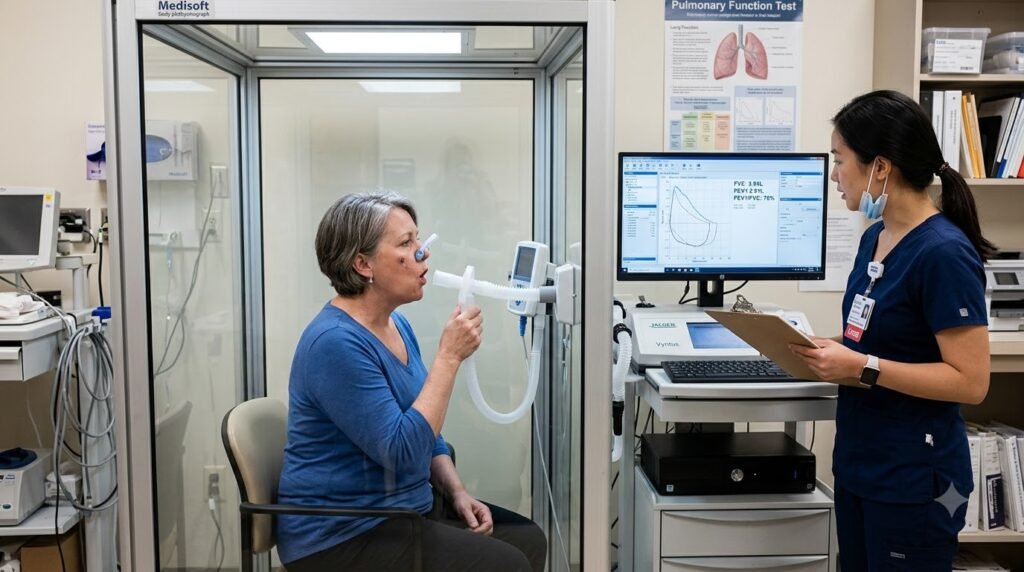
Spirometry is the foundation of lung function testing. You breathe into a mouthpiece connected to a device called a spirometer, and the machine measures how much air you can forcefully exhale and how fast you exhale it. The two most important values are FVC (forced vital capacity) and FEV1 (forced expiratory volume in one second). The ratio between these two numbers helps distinguish obstructive conditions like asthma from restrictive conditions like pulmonary fibrosis.
Lung Volume Testing
This measures the total amount of air your lungs can hold, including residual volume — the air that remains after a full exhale. It requires either a body plethysmograph (a sealed booth) or a nitrogen washout technique.
Diffusion Capacity (DLCO)
This test measures how well oxygen moves from your air sacs into your bloodstream. It is particularly relevant for diagnosing conditions like pulmonary fibrosis and assessing the impact of certain medications on lung tissue.
Bronchodilator Reversibility Test
Often paired with spirometry, this involves taking a bronchodilator medication and repeating the breathing test after 15–20 minutes. A significant improvement in airflow confirms reversible obstruction, which is a hallmark of asthma rather than COPD.
What Factors Actually Separate a Good PFT Centre from an Average One?
This is a question most people don’t think to ask — and it’s probably the most important one.
Calibrated, Well-Maintained Equipment
Spirometry is only as accurate as the machine running it. Equipment must be regularly calibrated using standardised procedures. A centre that cannot tell you when their spirometer was last calibrated or serviced should raise a concern.
Trained and Certified Technicians
The person conducting the test matters as much as the machine. PFT results depend heavily on patient effort and correct coaching by the technician. A skilled technician will guide you through the manoeuvre, ensure you achieve reproducible readings, and know how to identify poor-effort tests.
Look for centres where the PFT is conducted by a trained respiratory technician or pulmonary function technologist, not just any available staff member.
NABL Accreditation
The National Accreditation Board for Testing and Calibration Laboratories (NABL) accreditation is a meaningful quality benchmark in India. NABL-accredited diagnostic centres undergo external audits of their processes, equipment, and reporting standards. Not all centres have this accreditation, and its presence signals a higher level of operational discipline.
Physician Interpretation
A raw spirometry printout contains numbers, but clinical meaning comes from expert interpretation. Reputable centres provide reports reviewed or signed off by a qualified pulmonologist or respiratory physician, not just a technician’s summary.
How to Find a Reliable Pulmonary Function Test Near You
The phrase “near me” is convenient, but proximity alone should never be your main filter. Here is a more useful approach.
Step 1: Start with accreditation. Search for NABL-accredited diagnostic centres in your city or area first. This filters out lower-quality options automatically.
Step 2: Check which specific PFT components they offer. Some centres only offer basic spirometry. If your doctor has ordered a full PFT panel including DLCO or body plethysmography, confirm this before travelling.
Step 3: Ask about appointment availability and wait times. PFTs require your full effort and cooperation. Centres that rush through tests or overbook appointments may compromise the quality of your results.
Step 4: Inquire about report turnaround. If you need results quickly to guide a treatment decision, ask whether same-day or next-day reports are available.
Step 5: Confirm preparation instructions. A reliable centre will tell you in advance to avoid bronchodilators, smoking, heavy meals, and strenuous exercise before the test. If they don’t mention preparation, that is a red flag.
Preparing for Your Lung Function Test: What You Need to Know
Most people arrive underprepared for their PFT, which can affect result accuracy. Here is what responsible preparation looks like.
Avoid short-acting bronchodilators (like salbutamol) for at least four hours before testing, and long-acting bronchodilators for 12 hours or more, unless your doctor specifically instructs otherwise. Your physician may actually want a “pre-bronchodilator” reading, in which case skipping your inhaler is intentional.
Do not smoke for at least four hours before the test. Avoid alcohol on the day of testing. Wear loose, comfortable clothing — tight clothing around the chest can restrict your breathing effort.
Eat a light meal rather than a heavy one, and arrive rested. Fatigue affects your ability to give maximum effort during the forced exhalation manoeuvre, and suboptimal effort leads to inaccurate results.
What to Expect During the Test
The spirometry portion of a PFT takes around 15–30 minutes. You’ll sit upright, place a nose clip on to prevent air from escaping through your nose, and breathe through a mouthpiece connected to the spirometer.
The technician will instruct you to breathe in as fully as possible, then blast the air out as hard and fast as you can for at least six seconds. This manoeuvre is repeated three times to ensure reproducibility. It can feel slightly uncomfortable but is not painful.
The full PFT panel, including lung volumes and diffusion capacity, may take up to an hour depending on which components are included.
Understanding Your PFT Results
Most patients receive their report and have little idea what the numbers mean. Here is a basic orientation.
FEV1/FVC ratio below 70% typically indicates obstructive disease (like asthma or COPD). A low FVC with a normal or elevated ratio suggests restriction. Results are compared against predicted values based on your age, height, sex, and ethnicity.
Do not attempt to self-diagnose from raw spirometry numbers. Results must always be interpreted alongside your symptoms, medical history, and clinical examination by a qualified physician. Your PFT report is a tool for your doctor, not a standalone verdict.
FAQs About Pulmonary Function Testing
Is a pulmonary function test safe?
Yes. PFTs are non-invasive and generally very safe. The forced exhalation effort can occasionally cause brief lightheadedness, which is why you are seated during the test. People with recent eye surgery, chest surgery, or certain cardiovascular conditions should inform their doctor before testing.
How long does a PFT take?
Basic spirometry takes about 15–30 minutes. A full PFT panel including lung volumes and DLCO testing may take 45–60 minutes.
Do I need a doctor’s referral to book a pulmonary function test near me?
Many diagnostic centres allow self-referral for PFTs. However, having a referral ensures your doctor receives the report and can interpret the results in the context of your full health picture.
Can children undergo pulmonary function testing?
Yes, spirometry can be performed in children from around five or six years of age, provided they can understand and cooperate with instructions. Specialised paediatric reference values are used to interpret their results.
How often should someone with asthma or COPD get a PFT?
This depends on your condition and your physician’s guidance. For stable conditions, annual monitoring is common. For patients whose condition is changing or who are undergoing treatment adjustments, more frequent testing may be appropriate.
Will my health insurance cover a PFT?
Coverage varies by insurer and policy. Contact your insurance provider directly to confirm whether pulmonary function testing is covered and whether a referral is required for reimbursement.
Making the Right Choice for Your Lung Health
A pulmonary function test near me is a practical starting point for a search, but the centre you ultimately choose should be selected on quality, not just convenience. Equipment standards, technician training, accreditation status, and physician-reviewed reporting all directly affect how reliable your results will be — and unreliable results can lead to incorrect diagnoses and misguided treatment decisions.
Take the time to ask the right questions before booking. Your breathing deserves that level of attention.