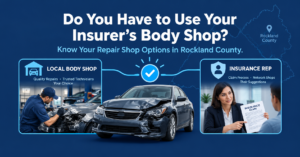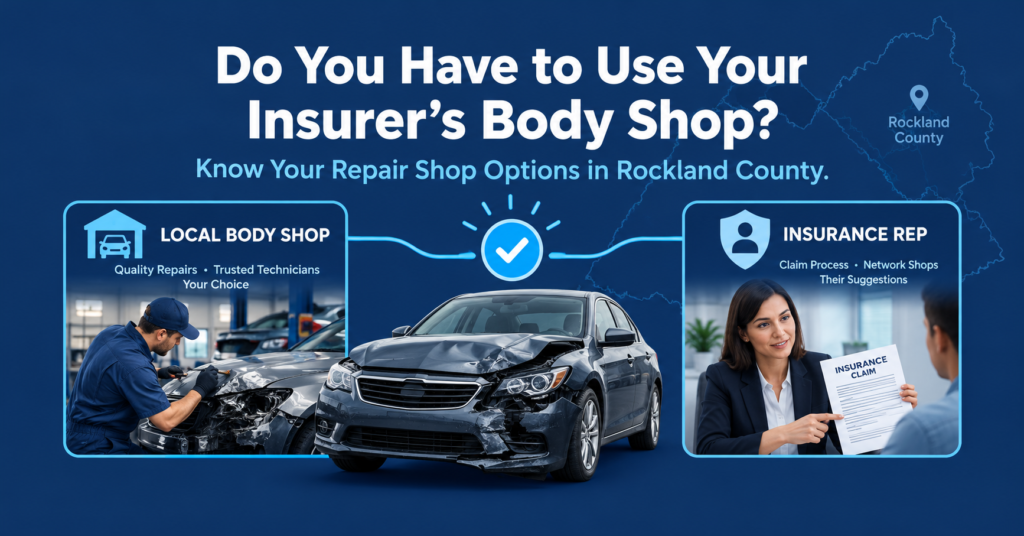
A fender-bender on Route 59 shouldn’t turn into a legal research project. But that’s exactly what happens to most drivers the moment a claims adjuster says, “We recommend one of our preferred shops.” The question that follows — almost every time — is whether that recommendation is actually a requirement. It isn’t. Understanding your rights matters just as much as understanding your repair options, especially when you’re trying to find a reliable collision repair shop in Rockland County under time pressure and with a rental car clock ticking.
This piece breaks down what New York law actually says, why insurers steer claims the way they do, and what’s at stake — financially and mechanically — when you let someone else choose where your car gets fixed.
Your Legal Right to Choose Your Own Repair Shop in New York
New York Insurance Law is unambiguous here. Section 2610 and related regulations prohibit insurers from requiring a policyholder to use a specific repair facility. The adjuster can suggest a shop. They cannot mandate one. That distinction gets blurred constantly in phone conversations, and it’s blurred on purpose more often than most people realize.
Picture a driver in Nanuet whose car gets rear-ended on Route 304. The adjuster says a preferred shop “will make things go faster” and that using an outside shop “could delay your claim.” Neither statement is a lie, exactly — but neither is a legal requirement either. It’s steering, and it works because most people don’t carry an insurance attorney’s phone number in their contacts.
Here’s the root cause of the confusion: insurers write their own claims scripts, and those scripts are optimized for internal cost control, not customer education. Call center reps are trained to use language like “recommend” and “preferred” interchangeably with words that sound mandatory. Few reps explain that:
- You can repair your vehicle anywhere licensed to perform the work.
- The insurer must still pay for necessary repairs regardless of which shop performs them.
- Going outside the network does not void your coverage or slow down payment approval by law.
A driver who understands this upfront negotiates from a position of strength. One who doesn’t ends up at a shop chosen primarily to keep the insurer’s claims costs down, not to keep the vehicle structurally sound. That’s not a small distinction on a unibody vehicle with crumple zones engineered to specific tolerances.
Why Insurers Push Direct Repair Programs (And What They Don’t Tell You)
An insurance direct repair program, or DRP, is a contractual arrangement between an insurer and a network of body shops. The shop agrees to discounted labor rates, standardized repair procedures, and specific documentation requirements. In exchange, the insurer sends a steady volume of claims. On paper, it sounds efficient. In practice, the incentives get complicated fast.
Shops inside an insurance direct repair program are evaluated on metrics like cycle time, average repair cost, and customer satisfaction scores tied to speed rather than thoroughness. None of that is inherently sinister. But cycle-time pressure creates real operational tradeoffs on the shop floor.
Consider a 2021 Honda CR-V that comes in for rear bumper and quarter panel work after a parking lot collision. Honda’s repair procedures require a pre- and post-repair scan, plus calibration of the rear radar sensor used for blind-spot monitoring. That scan and calibration take time and cost money — time that eats into a DRP shop’s cycle-time average. A shop under pressure to hit volume targets might skip the post-scan, assume the calibration “probably” held, and hand the keys back. The customer drives away with a car that looks fine and has a sensor quietly reading incorrectly.
This isn’t a hypothetical risk. It’s a documented pattern across the collision repair industry, and it’s exactly why OEM procedure compliance has become such a focal point in insurance litigation over the past several years. The shop isn’t necessarily cutting corners out of bad faith — they’re responding rationally to the incentive structure their DRP contract created. Understanding that incentive structure is the first step toward deciding whether you want your repair decisions made inside it.
The Hidden Costs of Letting the Insurance Company Pick the Shop
Cost control is the point of a DRP. That’s not a criticism — it’s the business model. But cost control on the insurer’s side doesn’t automatically translate to cost savings for you, and sometimes it translates to risk you won’t notice until months later.
Aftermarket and used parts are the clearest example. Many DRP agreements specify aftermarket crash parts — bumper covers, headlamp assemblies, even structural reinforcement bars — instead of OEM parts, specifically to lower the claim payout. On cosmetic parts, that’s often a reasonable tradeoff. On structural components, it’s a different conversation entirely.
Take a leased 2022 Subaru Outback involved in a moderate front-end collision. The repair estimate calls for a new front bumper reinforcement bar — a structural part designed to manage crash energy in a secondary impact. An aftermarket version gets installed to stay within the DRP’s cost parameters. Nobody discloses the substitution clearly to the customer. Six months later, that customer tries to sell the lease back or trades it in, and a vehicle history report flags aftermarket structural repair. Diminished value claims follow, and now the customer is fighting the same insurer that steered them toward the shop that made the substitution in the first place.
Three costs show up repeatedly in these situations:
- Diminished value — resale and trade-in value drops even after a technically competent repair, because aftermarket structural parts and non-OEM procedures show up in vehicle history.
- Warranty exposure — some manufacturer warranties can be affected by non-OEM structural repairs, particularly on ADAS-equipped vehicles.
- Comeback repairs — misaligned panels, wind noise, or improperly calibrated sensors that surface weeks after pickup, requiring a second repair cycle.
None of these costs show up on the initial estimate. That’s exactly why they matter before choosing a collision repair shop in Rockland County based on a referral list alone.
How to Vet and Choose a Collision Repair Shop in Rockland County
Choosing your own shop only helps if you choose well. The real work of vetting a collision repair shop in Rockland County starts with certifications, not convenience, and it starts before you ever drop the car off.
I-CAR Gold Class certification is the baseline industry credential — it means a shop’s technicians undergo ongoing training on current repair procedures, not just whatever they learned a decade ago. Beyond that, OEM-specific certifications matter more with every model year, because repair procedures are increasingly manufacturer-specific. A shop certified by Honda, Subaru, or another manufacturer has access to factory repair procedures, genuine parts, and the specific calibration equipment that brand requires.
A driver in Pearl River or Spring Valley evaluating shop options should ask four direct questions before committing:
- Does the shop perform OEM-required pre- and post-repair scans on every vehicle, not just ones where damage is obviously electronic?
- Will they provide a written estimate that specifies OEM versus aftermarket parts, line by line?
- Do they have in-house calibration equipment, or do they sublet that work to a third party — and if so, who’s liable if calibration is wrong?
- Can they show certification specific to your vehicle’s manufacturer, not just a general collision repair license?
Finding the best auto body shop for your specific vehicle means checking these details against the make and model you actually drive, not against a generic online rating. A shop that’s excellent with domestic trucks might be mediocre with European electronics architecture. Specialization is not a luxury in modern collision repair — it’s the difference between a repair that meets factory spec and one that merely looks finished.
Price matters too, obviously. But the lowest estimate on a structural repair is frequently the clearest signal that OEM procedures are being skipped somewhere in the process.
What Happens When You Pick Your Own Shop: The Claims Process Explained
Choosing an independent shop doesn’t remove the insurer from the process — it just changes the dynamic. The shop still has to communicate directly with the adjuster, submit a repair estimate, and negotiate on your behalf if the insurer’s initial number comes in low. This is where things can get adversarial, and understanding the mechanics ahead of time keeps you from getting caught in the middle.
Here’s a realistic sequence. A Suffern homeowner’s vehicle gets hit in an intersection collision. She chooses an independent shop over her insurer’s preferred list. The shop’s initial estimate is close to the insurer’s, but once the technician removes the bumper cover for teardown, they find hidden frame rail damage the initial estimate didn’t account for. The shop submits a supplement request. The insurer’s desk adjuster, working from photos rather than an in-person inspection, pushes back on the scope.
This is normal. It’s also exactly the scenario where your choice of shop pays off, because independent Nanuet auto body facilities handle supplement disputes as a routine part of daily operations — unlike a customer negotiating alone. A shop with an experienced estimator knows how to document hidden damage with photos, measurements, and OEM repair procedure citations that make the supplement difficult to deny.
If the dispute stalls, New York policies typically include an appraisal clause — a formal mechanism where each side picks an appraiser, the two appraisers pick an umpire, and the umpire’s decision on disputed scope becomes binding. It’s rarely needed for small items. It becomes relevant on structural disagreements like the frame rail example above.
The practical takeaway: the claims process doesn’t get harder when you choose your own shop. It gets more balanced, because you have a repair professional advocating for the repair your vehicle actually needs, not just the one that matches the insurer’s first estimate.
Where Spectrum Auto Body Fits Into This Conversation
Shops like Spectrum Auto Body (spectrumautoinc.com) illustrate how an independent, certified facility operates inside this exact landscape — handling OEM-compliant repairs, managing insurance negotiations on the customer’s behalf, and working directly with whichever insurer is involved in the claim, regardless of DRP status. That’s the operational model worth looking for: a shop whose repair standards are driven by manufacturer procedure, not by a volume contract. Vehicle owners evaluating options after a collision are better served understanding this distinction first, then applying it to whichever certified, reputable facility they ultimately choose.
Frequently Asked Questions
- Can my insurance company deny my claim if I don’t use their preferred shop?
No. New York law prohibits insurers from denying or reducing a covered claim simply because you chose a repair facility outside their network. They can still review the estimate for reasonableness, but the choice of shop itself is not grounds for denial.
- Will repairs take longer if I choose my own shop instead of the insurer’s recommendation?
Not necessarily. Reputable independent shops often have direct insurer relationships and experience negotiating supplements efficiently. Delays are more commonly caused by parts availability or supplement disputes than by which shop performs the work.
- How do I find the best auto body shop near me in Rockland County?
Begin with I-CAR Gold Class and OEM- certifications for your vehicle’s make. Inquire about, in-house scanning and calibration capability. Ask for a line-item estimate that clearly lists OEM parts separately from aftermarket parts before you approve work.
- Does my insurer have to pay for OEM parts if I request them?
Insurers are generally required to pay for repairs that bring a vehicle back to the condition it was in before the loss. Insurers must use parts and the correct ways to fix it. Insurers often use OEM parts on parts that’re structural or safety related. Disagreements, about the type of parts can be negotiated. If those agreements do not work out the dispute can be taken to the appraisal process that is built into the policy.