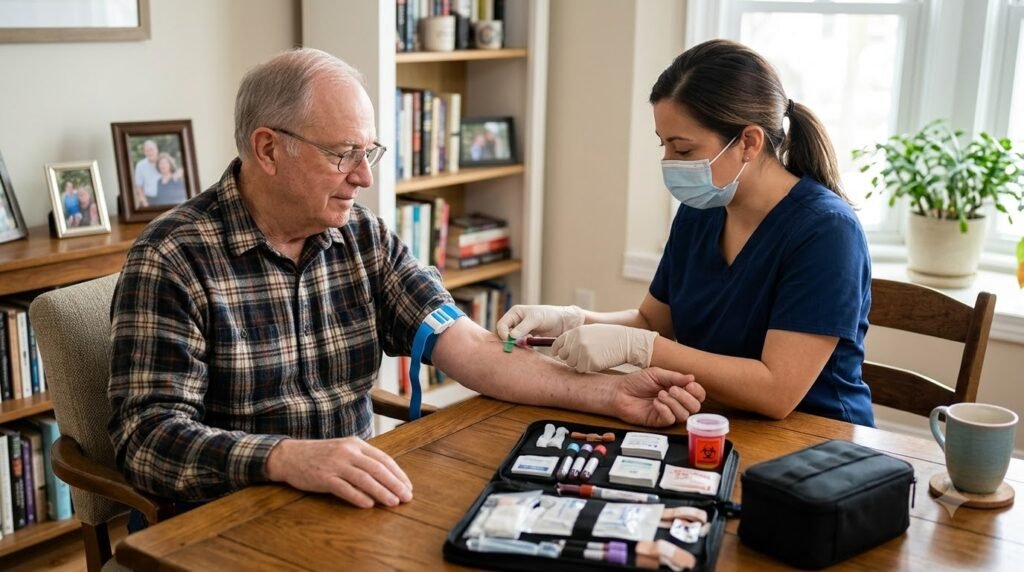
The appeal of home blood testing is obvious — no waiting rooms, no travel time, no scheduling around lab hours. For busy professionals, elderly patients, or anyone with mobility challenges, this convenience is genuinely valuable. But convenience creates a new concern: does testing done at home deliver the same quality as tests performed in a controlled laboratory environment?
The answer depends entirely on whether the facility providing your blood test at home in bangalore extends its quality standards to the collection process, not just to the laboratory analysis. Ecotown Diagnostics offers professional blood test at home in Bangalore where collection protocols and sample handling maintain the same rigor as in-facility testing.
Why Home Collection Seems Risky (And When It Actually Isn’t)
The first concern most healthcare-conscious patients have about home blood collection is legitimate: blood samples are delicate. They degrade if not handled properly, stored at wrong temperatures, or transported slowly. How can this be managed when collection happens outside a controlled laboratory?
The honest answer is that it can’t be managed as well as in a laboratory setting. But “not as well” doesn’t mean “inadequately.” Responsible labs with home collection services have protocols specifically designed to minimise these risks.
The key distinction is between labs that view home collection as a convenience add-on requiring minimal process changes, versus labs that have deliberately designed home collection as a quality-managed service.
What Happens During Professional Home Blood Collection
Understanding the actual process clarifies why properly managed blood test at home in bangalore can produce reliable results.
Pre-Collection Communication
A quality home collection service contacts you in advance to confirm:
- Which tests you’re having done
- Whether fasting is required and for how long
- Any medications you should avoid before collection
- The appointment time
- What to expect during collection
This pre-communication prevents mistakes like non-fasting collection when fasting was required, or collection while taking medications that affect results.
The Phlebotomist’s Credentials
The person collecting your blood should be trained and certified in venipuncture technique. They should carry identification from the lab confirming their credentials. An untrained collector significantly increases the risk of haemolysis (red cell rupture) and compromised samples.
Proper Collection Technique
Even in a home setting, collection technique matters immensely. The phlebotomist should:
- Use appropriate-gauge needles and proper venipuncture technique
- Fill collection tubes in the correct sequence
- Invert tubes the correct number of times if they contain additives
- Label tubes immediately with patient information
- Note any collection difficulties that might affect interpretation
Sample Storage and Transport
After collection, samples must be stored and transported appropriately:
- For most tests, samples are stored at room temperature in the hours immediately after collection
- Some tests require refrigeration
- Temperature-controlled transport containers maintain appropriate conditions during transit
- Samples must reach the lab within a defined timeframe — typically 4–6 hours for most routine tests
A professional blood test at home in bangalore service uses insulated containers with ice packs or phase-change materials to maintain temperature during transport. Transit time is tracked to ensure samples reach the lab while still viable.
Chain of Custody
From the moment blood is drawn, there should be documented tracking of the sample — who collected it, when, how it was stored, who transported it, and when it arrived at the lab. This chain of custody is essential for quality assurance.
The Critical Difference Between Convenience Services and Quality Services
Not all home blood collection offerings are equivalent. Some labs provide home collection as a pure convenience service with minimal process modifications. Others have deliberately built quality systems around it.
Convenience-focused services may:
- Use minimally trained staff for collection
- Transport samples in ordinary containers without temperature control
- Allow extended transport times
- Have minimal documentation of collection details
- Prioritise speed over sample quality
Quality-focused services (like those from accredited labs) may:
- Employ trained, certified phlebotomists
- Use proper collection equipment and containers
- Maintain temperature-controlled transport
- Document collection time, technique, and any issues
- Prioritise sample integrity over collection speed
- Have documented protocols that match in-facility standards
When choosing blood test at home in bangalore, asking about these specifics helps you determine whether you’re getting genuine quality or just convenience.
Tests That Are Safe for Home Collection vs. Those That Aren’t
Not every blood test is equally suitable for home collection. Some tests are more forgiving of transport delays or temperature variations. Others require immediate processing or specialised handling.
Generally Safe for Home Collection
- Complete blood count (CBC)
- Liver function tests (bilirubin, enzymes, albumin)
- Kidney function tests (creatinine, urea, electrolytes)
- Lipid panels (cholesterol, triglycerides)
- Blood glucose
- Thyroid function (TSH, T3, T4)
- Most hormone assays
Require Careful Handling or Lab Collection
- Coagulation tests (PT/INR, APTT) — require specific timing and tube handling
- Certain hormone tests with strict timing requirements
- Samples requiring immediate separation or processing
- Tests requiring specialised collection tubes
- Microbiology cultures — require sterile, specialized handling
A responsible lab offering blood test at home in bangalore will clearly communicate which tests are available for home collection and which must be done at the facility. This transparency itself is a quality indicator.
Preparation for Home Blood Collection: What’s Different
Preparing for home collection is similar to preparing for in-facility testing, with a few additional considerations.
Confirm Fasting and Timing
Ask whether your tests require fasting and for how long. If yes, arrange your collection appointment during the fasting window — typically morning before breakfast.
Arrange a Comfortable Space
Designate a clean, comfortable location for collection. The phlebotomist needs:
- A chair with armrest support where you can sit comfortably
- A small table for equipment and tubes
- Good lighting
- Privacy
Avoid collection while lying in bed or standing up, as these positions increase dizziness risk.
Inform About Medications and Supplements
Communicate with the lab about any medications, supplements, or recent dietary changes. Some affect test results and should be noted in context.
Stay Hydrated
Being well-hydrated makes veins more accessible and reduces collection difficulty. Drink water normally throughout the morning (unless your fasting instructions specify otherwise).
Plan to Rest After Collection
After the phlebotomist leaves, sit for a few minutes before resuming normal activity. Some people feel light-headed immediately after collection.
What Happens to Your Sample After Collection
Understanding the post-collection process clarifies why it matters whether home collection is managed by a quality-focused lab.
After the phlebotomist leaves your home with your sample:
- Transport to Lab — The sample travels in a temperature-controlled container, ideally reaching the lab within 4 hours for most routine tests.
- Receipt and Logging — Lab staff receive the sample, verify the patient information matches the tubes, note receipt time, and log the sample into the system.
- Storage — Samples are stored at appropriate temperatures (room temperature or refrigerated, depending on test type) until processing begins.
- Quality Control — Before your sample is tested, internal quality control samples with known values are run. If controls fall outside acceptable range, calibration is adjusted and controls are rerun before patient testing proceeds.
- Analysis — Your sample is processed on calibrated instruments with documented maintenance records and recent calibration verification.
- Result Verification — Before results are released, a pathologist or qualified technician reviews them for accuracy, unusual patterns, or critical values.
- Report Delivery — Results are delivered through the lab’s system — typically a patient portal, email, or printed report.
This entire process is documented at every step in a quality-focused facility. In a convenience-focused operation, documentation may be minimal and processes may be abbreviated.
When Home Collection Might Not Be Ideal
For some situations, home collection introduces unnecessary risk. Consider in-facility collection if:
- You’re unable to arrange a clean, private space for collection
- You have difficult-to-access veins and may need multiple collection attempts
- You’re on medications affecting your blood sample quality
- The required tests are outside the home collection scope
- You have a history of vasovagal responses (fainting during blood draws)
- Transport time to the lab would exceed safe limits for your specific tests
Being honest about these factors helps you make the right choice rather than proceeding with home collection that might compromise result quality.
Cost Considerations for Home Blood Collection
Home collection is generally more expensive than in-facility collection because of the additional logistics — trained phlebotomist time, transportation, temperature-controlled containers, and coordination overhead.
A typical home collection fee in Bangalore ranges from ₹200–500 depending on the lab and number of tests. Some labs include it in package pricing; others charge it separately.
What should be transparent:
- Home collection fee clearly stated before you book
- Whether fee varies based on location or number of tests
- What’s included in the collection service
- Whether rush reporting costs extra
- Cancellation or rescheduling policies
Quality-focused labs price home collection reasonably but not drastically below market rates, because proper management of the service has genuine costs.
Frequently Asked Questions
Is home blood collection less accurate than lab-based collection?
When managed properly by a quality-focused lab, accuracy is comparable. The key factors are phlebotomist training, proper sample handling, and timely transport — all of which can be controlled in a well-designed home collection program.
How do I know if the phlebotomist is actually trained?
Ask to see their credentials or certification. A professional phlebotomist will carry identification from the lab confirming their training and credentials.
What if something goes wrong during home collection?
Communicate with the lab immediately. If there was a collection difficulty, the lab needs to know to properly interpret results or recommend repeat testing.
Can I request a specific time for home collection?
Most labs offer flexible scheduling within their operating hours. Weekend and early morning collections may carry additional fees or limited availability.
What if I’m not home at my scheduled time?
Most labs allow rescheduling with advance notice. Repeated no-shows may result in cancellation charges or removal from the service.
How long before results are available after home collection?
Most routine tests are processed within 24 hours of collection. Turnaround time should be communicated when you book.
Is home collection appropriate for children?
Home collection can be appropriate for children, particularly those with anxiety about clinical settings. Verify that the lab’s phlebotomist has paediatric experience.
Making the Right Choice for Your Situation
A blood test at home in bangalore offers genuine convenience that can be valuable — particularly for elderly patients, those with mobility limitations, or busy professionals. The key is choosing a provider that treats home collection as a quality-managed service rather than a cost-cutting convenience.
Before booking, verify:
- The lab holds current NABL accreditation for your required tests
- Home collection is explicitly included in their accreditation scope or protocols
- Phlebotomists are trained and certified
- Sample handling and transport procedures are documented and transparent
- You understand which tests are available for home collection
When these elements are in place, home collection delivers the convenience you want without sacrificing the accuracy your health decisions depend on.