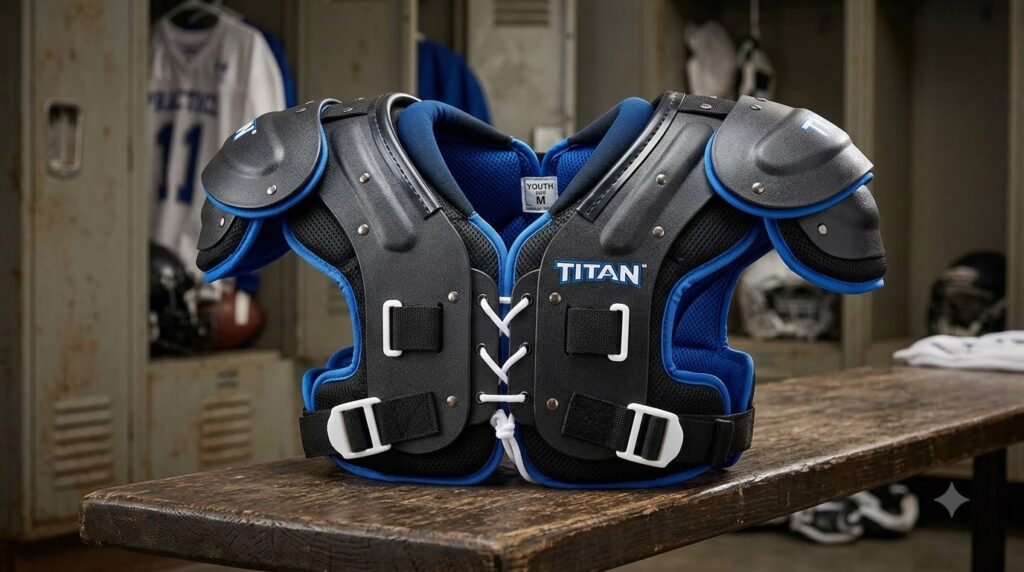
There’s a version of this decision that goes wrong in the same way at every level of the game. A player walks into an equipment room, grabs pads that look about right, puts them on, and declares them fine. Then week three of the season arrives, and the restricted throwing motion, the binding on contested catches, or the pad that shifts during an open-field tackle makes itself known at the worst possible moment.
Skill position shoulder pads are a specialized piece of equipment with specific engineering requirements. Getting the selection right means understanding what your position actually demands, what features solve those demands, and how to verify that a specific pad delivers on both before you commit to wearing it through a full season. For players and programs researching serious options, well-engineered performance-grade skill position shoulder pads built around the movement and contact demands of skill play represent a meaningfully different category than general-purpose designs.
Why Skill Position Pads Are a Distinct Equipment Category
General-purpose shoulder pads are built around a compromise. They need to work adequately for a lineman, a linebacker, a quarterback, and a defensive back. To serve all of those roles, they tend toward heavier construction, broader coverage, and a more conservative mobility profile.
That compromise works reasonably well for positions where the primary movement pattern involves forward-driving force — linemen and fullbacks who spend most of their time generating or absorbing push. It works poorly for positions where the primary movement patterns involve arm elevation, lateral reach, rotational throwing mechanics, and high-speed change of direction.
Skill position shoulder pads are engineered specifically for that second group. The design priorities shift — mobility and targeted protection take precedence over maximum coverage and mass.
The Contact Reality for Skill Players
Understanding why skill position shoulder pads are built the way they are starts with understanding the actual contact patterns these players experience.
High-Speed Impact from Variable Angles
Defensive backs and receivers take hits at full pursuit speed from angles that change play to play. Unlike lineman contact — which is largely predictable in direction — open-field collisions can come from the front, the side, or the rear depending on pursuit angles and coverage schemes. Protection needs to be meaningful across the shoulder cap, anterior chest, and back plate without adding the mass that slows pursuit and route running.
Arm-Dominant Movement Patterns
Quarterbacks throw. Receivers catch. Defensive backs reach for balls and wrap up tacklers. Every one of these actions requires unrestricted movement through a specific range of motion that general-purpose pads regularly compromise. A cap that binds at the armpit during an overhead catch, or a front plate that restricts the throwing follow-through, directly costs players performance on individual plays.
Repeated Lower-Intensity Contact
Not all contact is catastrophic. Skill players absorb routine bumping, hand fighting, and incidental contact throughout every game. Good skill position shoulder pads need to handle this lower-level contact accumulation comfortably without the stiffness that makes repeated minor impacts increasingly uncomfortable over four quarters.
Core Features That Define Quality Skill Position Shoulder Pads
Floating or Cantilevered Shoulder Cap
A floating shoulder cap is one of the clearest technical differentiators between entry-level and quality skill position designs. Rather than a rigidly fixed cap, a floating design allows the cap to move independently with the shoulder joint during arm elevation. The result is consistent coverage of the AC joint regardless of arm position — without the binding that a fixed cap creates when the arm rises above shoulder height.
For quarterbacks and receivers who spend significant time with their arms elevated, this feature directly affects both protection and mechanics.
Anterior Chest Coverage Without Plate Bulk
The chest plate needs to protect the sternum and upper chest from frontal contact without creating a profile that pushes the arms away from the body during natural arm swing. Quality skill position designs achieve this through contoured, anatomically shaped front panels rather than flat plates that force the arms outward.
Feel the front plate profile with the pads on and your arms at your sides. There should be no outward pressure forcing your arms away from your body. Natural arm hang is a basic fit requirement that surprisingly many pads fail.
Rear Coverage Matched to Position Demands
The back plate is where skill position pad designs vary most significantly between positions. Receivers and running backs who absorb rear contact regularly benefit from a substantial back plate. Quarterbacks, who are theoretically protected from rear hits by blocking, sometimes prefer a reduced rear profile to save weight.
The best designs offer some adjustability here — detachable or configurable back plates that allow position-specific customization without requiring a completely different pad.
Interior Liner System
The liner is the component players feel most directly on every play. A liner that becomes saturated with sweat quickly, or that develops odor and hygiene issues after a few practices, creates a distraction that quality construction avoids. Moisture-wicking fabrics that pull sweat away from the body and dry reasonably quickly between sessions are the standard to look for.
The liner also determines how the pad feels during the first few weeks of use. Stiffer foam liners require a break-in period. Softer foam liners feel comfortable immediately but may compress more quickly over a season. The best designs balance initial comfort with long-term durability.
Fitting Skill Position Shoulder Pads by Position
Quarterbacks
The throwing motion is the non-negotiable starting point for quarterback pad fitting. Every other consideration is secondary to confirming that the throwing shoulder — and specifically the throwing arc from the cocked position through the release and follow-through — is completely unrestricted.
Test this with the actual ball in hand. A throwing motion without a ball doesn’t fully replicate the shoulder loading of an actual throw. Have the quarterback execute full throws at multiple velocities and distances with the pads on before finalizing the fit decision.
Wide Receivers
Receivers need to test the overhead catch position specifically — both hands extended above the head, tracking an imaginary ball, with the cap profile checked for any contact with the upper arm or neck area. The contested catch position — arms extended with hands inside — is also worth testing. Any restriction in these positions will affect performance in exactly the situations where receivers need to make difficult plays.
Running Backs
Running backs should test lateral cuts at full speed during the pad break-in period. The pad profile should not shift during sharp directional changes. If the pad moves laterally during a hard cut, strap adjustment is the first fix — but persistent movement indicates a sizing or design compatibility issue.
Defensive Backs
Defensive backs need to confirm the pad profile doesn’t restrict the arm extension required for playing through the catch point on coverage plays. This is essentially the same test as receivers — both positions contest the same ball with similar mechanics, from opposite sides of the play.
Comparing Skill Position Pads Across Price Points
Entry-Level Options
Entry-level skill position shoulder pads typically use simpler foam constructions, fixed rather than floating cap designs, and basic liner materials. They work adequately for lower-contact situations and youth programs where budget constraints are real. The mobility they offer is usually reasonable. The durability and impact management over a full season of high-contact play is where budget designs show their limitations.
Mid-Range Options
Mid-range designs introduce floating cap systems, improved liner materials, and better foam density management. For most high school and competitive youth programs, this category represents the best balance of performance and cost.
Performance-Level Options
Performance-tier skill position shoulder pads use advanced foam constructions, fully optimized cap systems, anatomically contoured panels, and premium liner materials. They’re built for durability over multiple seasons and optimized for the specific movement demands of high-level skill position play. For competitive high school, college, and professional programs, the performance difference justifies the investment.
Maintenance That Preserves Performance
Skill position shoulder pads perform consistently only if they’re maintained consistently. Post-practice wipe-downs of interior surfaces, regular inspection of cap attachment hardware, and strap integrity checks at the start of each week prevent the gradual degradation that turns well-fitted pads into poorly performing ones by mid-season.
Store pads in a ventilated space between uses. Enclosed bags that trap moisture accelerate liner degradation and foam compression. Air circulation between sessions extends the life of every component.
Frequently Asked Questions
How do skill position shoulder pads differ from youth shoulder pads?
Youth shoulder pads are sized and weighted for developing athletes, with lighter construction and proportions matched to younger body dimensions. Skill position pads are optimized for mobility and targeted protection regardless of age — youth-sized versions of skill position designs exist, but the engineering priorities differ from general-purpose youth pads.
Should skill players wear a back plate?
It depends on position and personal preference. Running backs and receivers who absorb frequent rear contact benefit from back plate coverage. Quarterbacks often prefer reduced rear profiles. If you’re unsure, start with a back plate and evaluate after a few games whether it’s creating any restriction worth addressing.
How do I know if my skill position pads are still providing adequate protection?
Compress the foam panels with firm hand pressure. They should rebound fully. Check the shell for cracks or deformation. Inspect cap attachment points for looseness or cracking. Any of these issues indicate reduced protection capacity and should prompt replacement evaluation.
Can skill position shoulder pads be used in cold weather without modification?
Most designs perform adequately in cold weather, but foam stiffens slightly in low temperatures. Allow pads to warm up in a heated space before a cold-weather game if possible — pads taken directly from a cold vehicle to a cold field will feel stiffer and less comfortable during early series until body heat warms the materials.
Is there a meaningful difference between pads marketed for offense versus defense skill positions?
Some manufacturers offer position-specific variations — quarterback designs with asymmetric shoulder profiles, for example. Most quality skill position pads work well across both offensive and defensive skill roles. Position-specific designs are worth considering if you have specific mechanical requirements that a general skill position pad doesn’t fully address.