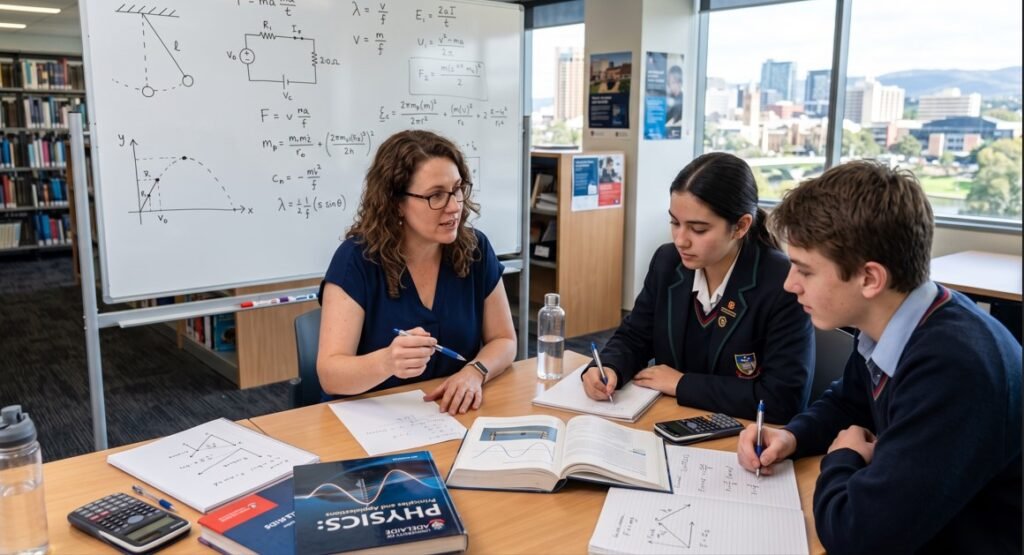
Physics asks students to think in several different ways at once. They need to understand scientific concepts, work confidently with mathematics, interpret graphs and diagrams, solve unfamiliar problems, and communicate their reasoning accurately.
For some students, this combination can make Physics feel significantly more difficult than other subjects.
The challenge is not always a lack of ability. A student may simply have a gap in one part of their learning that begins affecting everything else. Difficulty with algebra can make calculations harder. Weak conceptual understanding can make formulas difficult to apply. Poor exam technique can prevent a well-prepared student from demonstrating what they know.
This is why many families searching for Physics Tutors in Adelaide are looking for more than additional worksheets. They want personalised academic support that identifies the actual learning problem and helps the student develop stronger, more independent skills.
Why Students Struggle With Physics
Physics is not a subject where every question can be solved by following the same procedure.
Students may be asked to interpret a situation, determine which principles apply, select an appropriate equation and then explain the result.
Common areas of difficulty include:
- Understanding abstract concepts
- Applying equations correctly
- Rearranging formulas
- Interpreting graphs
- Working with units
- Understanding vectors and relationships
- Solving multi-step problems
- Connecting theory with calculations
- Interpreting unfamiliar questions
- Managing assessment time
The first step toward improvement is identifying which of these areas is affecting the student’s performance.
Understanding Is More Important Than Formula Memorisation
Memorising equations has a place in Physics, but it should not be the entire learning strategy.
Consider a student who remembers an equation perfectly but is presented with a problem that uses a different context.
If they do not understand the underlying relationship, they may not recognise that the equation applies.
A stronger Physics student asks:
What is happening physically?
What quantities are involved?
How are those quantities related?
Which physical principle describes this relationship?
How can I represent that relationship mathematically?
This way of thinking allows students to apply knowledge rather than simply reproduce memorised procedures.
Build the Mathematics Behind Physics
Physics often exposes mathematical weaknesses that students may not notice in mathematics classes.
A student may understand the scientific principle but struggle to:
- Rearrange equations
- Substitute values correctly
- Work with scientific notation
- Interpret graphs
- Convert units
- Handle ratios
- Track positive and negative quantities
These mathematical skills are not separate from Physics. They are part of the tools students use to express and solve physical problems.
Strengthening the mathematical foundation can therefore make difficult Physics topics considerably easier to approach.
Learn a Consistent Problem-Solving Process
When students face a difficult Physics question, immediately searching for a familiar formula is often ineffective.
A structured process is more reliable.
Read the Situation
Understand what is physically happening before beginning calculations.
Identify the Known Values
Write down the relevant information and units.
Identify the Unknown
Determine exactly what the question is asking you to find.
Identify the Principle
Consider which physical law, relationship or concept applies.
Select the Equation
Choose an equation that represents the relationship.
Calculate
Work through the mathematics carefully.
Interpret
Explain what the result means and check whether it is reasonable.
This approach helps students slow down their thinking without necessarily slowing down their performance.
Why Unfamiliar Questions Matter
Many students practise until they can confidently solve questions that look like the examples they have already seen.
The problem appears when an assessment changes the context.
A question may use different wording, combine multiple concepts or provide information in an unfamiliar format.
Students therefore need to practise questions that require them to make decisions.
A strong progression is:
Learn the concept → Practise the method → Mix different topics → Solve unfamiliar problems → Complete timed assessments
This develops adaptability rather than dependence on familiar question patterns.
Use Errors to Guide Revision
Students often review Physics by looking at what they got right.
A more useful approach is to study what went wrong.
After an assessment, classify mistakes.
Conceptual Mistake
The underlying Physics was not understood.
Mathematical Mistake
The scientific principle was understood, but the calculation was incorrect.
Application Mistake
The student knew the concept but did not recognise how it applied to the question.
Unit Mistake
Values were expressed or converted incorrectly.
Communication Mistake
The student’s reasoning was incomplete or unclear.
Time Management Mistake
The student knew the material but did not complete the assessment effectively.
Each category requires a different response.
This makes revision more targeted and efficient.
Develop Confidence With Graphs and Diagrams
Physics is strongly visual.
Students need to interpret information from graphs, diagrams and other representations rather than relying entirely on written questions.
For example, students may need to determine what a gradient represents, identify relationships between variables or use a diagram to understand a physical system.
When studying a graph, students should ask:
- What does each axis represent?
- What are the units?
- What does the slope indicate?
- What does the shape of the graph tell me?
- Which variable changes?
- What physical process does the graph represent?
These questions encourage students to interpret rather than simply observe.
Preparing for SACE Physics
For Adelaide students studying SACE Physics, preparation should be consistent throughout the school year.
Students should regularly:
- Review classroom content
- Consolidate key concepts
- Practise mathematical relationships
- Complete application questions
- Analyse experimental information
- Review assessment feedback
- Practise unfamiliar problems
- Complete timed questions
Stage 1 and Stage 2 students may also have different learning priorities depending on the topics covered in their course.
The earlier students identify weaknesses, the more time they have to address them.
Why Personalised Tutoring Can Make a Difference
A classroom teacher needs to support an entire group of students.
A personalised tutor can focus specifically on one student’s learning needs.
For example, a student might understand most of the course but struggle with:
- Electricity calculations
- Mechanics
- Graph interpretation
- Scientific explanations
- Mathematical manipulation
- Examination questions
Instead of spending equal time on every topic, tutoring can concentrate on the areas that require the most attention.
This makes additional study more focused.
Choosing Physics Tutors in Adelaide
When choosing a tutor, parents should consider the student’s specific requirements rather than selecting a provider based only on location or availability.
Important factors include:
Curriculum Knowledge
The tutor should understand the relevant senior secondary Physics curriculum.
Subject Expertise
Strong knowledge of Physics is essential, particularly for students studying advanced senior subjects.
Communication
The tutor should be able to explain complicated concepts in language the student understands.
Adaptability
Different students require different explanations and approaches.
Problem-Solving Focus
The tutor should encourage students to reason through problems rather than simply copy solutions.
Assessment Awareness
Students preparing for senior secondary assessments benefit from support that understands examination expectations and common assessment challenges.
Advanced Education’s Approach to Physics Tutoring
Advanced Education provides personalised Physics Tutors in Adelaide for students seeking additional academic support.
Tutoring can be adapted around the student’s:
- Year level
- Current understanding
- School curriculum
- Areas of difficulty
- Assessment schedule
- Learning pace
- Academic goals
The focus is on creating a learning environment where students can ask questions, revisit difficult concepts and develop confidence through genuine understanding.
Advanced Education currently supports students studying SACE and IB Physics through private tuition and structured learning options.
Physics Tutoring for Different Types of Students
Students Who Are Struggling
These students may benefit from rebuilding foundations and addressing specific knowledge gaps.
Students With Inconsistent Results
These students may understand concepts but need help identifying why their assessment performance varies.
High-Achieving Students
Strong students may benefit from more challenging problems, deeper conceptual discussion and advanced preparation.
Students Preparing for Examinations
These students can focus on timed practice, past assessments, error analysis and examination strategies.
The tutoring approach should change according to the student’s needs.
A More Effective Physics Study Routine
A productive weekly routine does not need to involve hours of repetitive work.
A student could divide study into several stages.
Concept Review: Revisit what was taught during the week.
Targeted Practice: Work on questions related to current topics.
Error Review: Revisit previous mistakes.
Application: Attempt unfamiliar questions.
Timed Practice: Complete selected questions under assessment conditions.
Reflection: Identify what still requires attention.
Consistency is more valuable than last-minute intensive study.
Frequently Asked Questions
Are Physics Tutors in Adelaide only for SACE students?
No. Physics tutoring can support students across different year levels and curricula, including students studying senior secondary Physics and IB Physics.
Can a Physics tutor help if my child struggles with mathematics?
Yes. Physics often relies on mathematical skills, so tutoring can incorporate algebra, equations, units, graphs and calculations where these are affecting Physics performance.
Can tutoring help improve Physics exam results?
Personalised tutoring can support conceptual understanding, problem-solving, targeted revision and assessment preparation. Results ultimately depend on the student’s learning, practice and engagement.
Should students memorise Physics formulas?
Students should become familiar with relevant equations, but understanding the physical relationships behind those equations is equally important.
Is private tutoring better than group tutoring?
It depends on the student. Group learning can be effective for shared instruction, while private tutoring provides more opportunity to focus on individual weaknesses and learning goals.
Help Your Child Become a More Confident Physics Student
Strong Physics performance is built through understanding, application and consistent practice.
Students need to know more than which formula to use. They need to understand the physical situation, recognise relevant relationships, work accurately with mathematics and communicate their reasoning.
For families looking for Physics Tutors in Adelaide, personalised academic support can provide a focused environment for addressing difficult concepts and developing stronger problem-solving skills.
Advanced Education can help students work toward their individual academic goals with personalised Physics tutoring designed around their current level and learning needs.
Contact Advanced Education to discuss Physics tutoring in Adelaide and develop a personalised learning plan for your child’s academic goals.