Every learner has different abilities, learning preferences, and personal goals. For people living with disability, educational support can be particularly valuable when it is designed around individual needs and focuses on practical outcomes. Personalised learning can help eligible participants strengthen skills, build confidence, and work towards greater independence.
At Advanced Education SA, our NDIS tutoring services focus on creating supportive learning experiences for eligible participants whose disability-related needs and goals may be appropriately supported through educational and capacity-building activities. Our approach is centred on the individual, with learning strategies adapted to their abilities, interests, communication style, and pace.
Understanding what NDIS-related learning support involves is important before choosing a provider. The NDIS is not designed to replace mainstream education, so ordinary school tutoring and academic assistance are generally not NDIS-funded. Instead, appropriate disability-related learning support may focus on functional capacity and skills that contribute to everyday participation.
What Are NDIS Tutoring Services?
The term NDIS tutoring services is often used when participants or families are searching for personalised educational support. However, NDIS-related learning should be distinguished from traditional private tutoring.
Mainstream tutoring generally helps students improve their performance in school subjects. It may involve homework, assignments, tests, examinations, or preparation for academic assessments.
Disability-related learning support has a different focus. Depending on the participant’s circumstances, it may involve developing functional skills that help with communication, organisation, problem-solving, independence, or everyday participation.
Potential areas of learning may include:
- Functional literacy
- Practical numeracy
- Communication
- Digital literacy
- Planning
- Organisation
- Executive functioning
- Problem-solving
- Independent learning
The specific focus should always be determined by the participant’s individual needs and goals.
Understanding What the NDIS Generally Does Not Fund
Families considering NDIS tutoring services should understand the difference between mainstream education and disability-related supports.
The NDIS generally does not fund:
- Regular school tutoring
- Homework assistance
- Exam preparation
- Assignment completion
- ATAR coaching
- General academic tuition
These services generally remain the responsibility of mainstream education providers.
A learning-related support may be considered where it addresses disability-related needs, contributes to appropriate participant goals, and meets the applicable NDIS funding requirements.
Because every NDIS plan is different, participants should not assume that a service is funded simply because it is described as an NDIS tutoring service.
Starting With Individual Goals
Effective personalised education starts with understanding the participant.
Before developing learning activities, educators may consider:
- Current abilities
- Existing strengths
- Learning preferences
- Communication methods
- Areas requiring additional support
- Personal interests
- Daily routines
- Individual goals
- Future aspirations
This information helps create learning activities that are relevant and achievable.
For example, one participant may want to improve their ability to understand written information, while another may benefit from developing planning and organisation skills. A personalised approach allows learning to reflect those differences.
Functional Literacy for Everyday Independence
Reading and writing are important components of everyday life.
Participants may need literacy skills to understand signs, read instructions, communicate through messages, complete forms, or access information.
Depending on individual goals, NDIS tutoring services may support:
- Functional reading
- Reading comprehension
- Vocabulary
- Spelling
- Grammar
- Everyday writing
- Understanding instructions
- Completing practical documents
The focus can be on applying literacy skills to meaningful situations.
For example, learning may involve reading a timetable, understanding a shopping list, writing a short message, or interpreting information on a simple form.
Practical Numeracy Skills
Numeracy is used in many everyday activities.
Participants may encounter numbers when shopping, managing money, following schedules, measuring quantities, or planning activities.
Learning may include:
- Number recognition
- Basic calculations
- Understanding prices
- Money concepts
- Time
- Measurement
- Budgeting concepts
- Practical problem-solving
Real-life examples can help participants understand why numeracy matters and how it can support greater independence.
Communication and Language Development
Communication plays an important role in relationships, community participation, education, and employment.
Depending on individual goals, learning activities may support:
- Listening
- Speaking
- Vocabulary
- Following instructions
- Expressing needs
- Everyday conversations
- Written communication
- Understanding information
Educators can adapt activities according to the participant’s communication preferences and abilities.
The aim is to help participants become more confident using appropriate communication strategies in situations that are meaningful to them.
Building Digital Literacy
Digital skills are increasingly important in everyday life.
Computers, smartphones, email, online services, and digital platforms are used for communication, information, appointments, learning, and many other activities.
Personalised learning may support:
- Basic computer use
- Typing
- Internet navigation
- Online safety
- Digital organisation
- Word processing
- Online learning platforms
Developing digital confidence may help participants complete suitable tasks with greater independence.
Organisation and Time Management
Organisation can affect a person’s ability to complete daily responsibilities.
Learning support may introduce strategies for:
- Creating schedules
- Planning activities
- Managing time
- Organising belongings
- Remembering tasks
- Following routines
- Breaking large activities into smaller steps
- Setting achievable goals
These strategies can be adapted to the participant’s daily circumstances.
For example, a learner might practise creating a simple daily or weekly schedule and then gradually apply the strategy independently.
Developing Problem-Solving Skills
Problem-solving is an important part of independent living.
Everyday situations can require a person to identify a challenge, consider available choices, and decide what to do next.
Learning activities may help participants practise:
- Identifying problems
- Understanding choices
- Comparing possible solutions
- Considering consequences
- Making decisions
- Following steps
- Asking for appropriate assistance
These skills can support greater confidence when participants encounter unfamiliar situations.
Encouraging Independent Learning
Personalised education should ideally help participants become more confident in managing their own learning.
Educators can encourage participants to:
- Set realistic learning goals
- Plan activities
- Ask questions
- Use appropriate resources
- Practise independently
- Monitor progress
- Reflect on completed activities
Developing these habits can support continued growth beyond structured sessions.
Learning Through Practical Activities
Practical learning allows participants to connect new skills with real-life situations.
Depending on individual objectives, activities may involve:
- Reading everyday information
- Planning a schedule
- Understanding money
- Organising tasks
- Using technology
- Following instructions
- Practising communication
- Solving everyday problems
These activities can make learning more relevant and provide opportunities to apply skills in meaningful contexts.
Flexible Learning for Different Needs
Participants may have different preferences regarding learning environments and schedules.
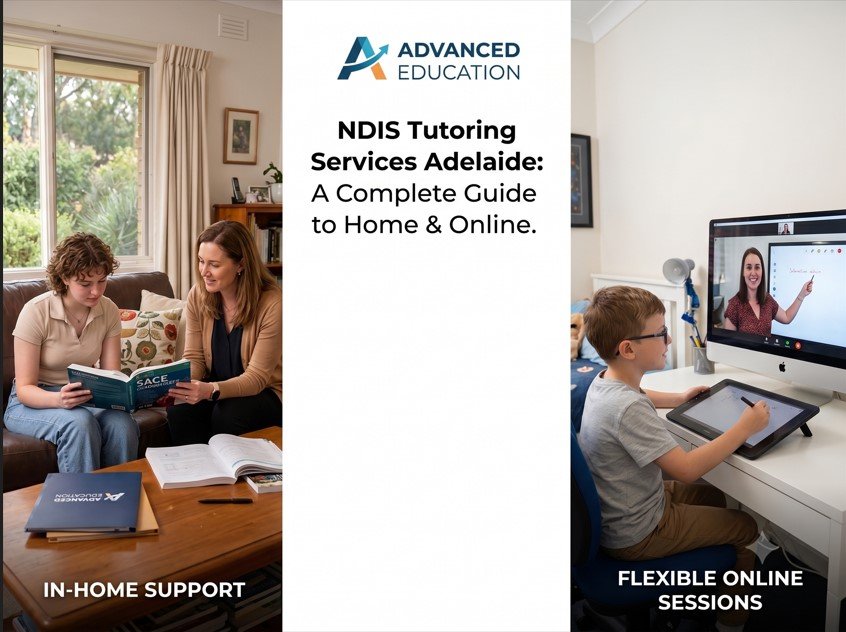
Advanced Education SA can offer flexible approaches depending on individual circumstances and service arrangements, including:
- One-to-one sessions
- Online learning
- Home-based learning
- Community-based learning
- Flexible scheduling
The appropriate format depends on the participant’s needs, goals, preferences, and circumstances.
Creating a Supportive Learning Environment
A positive learning environment can make a significant difference to confidence and engagement.
Our approach aims to make learning:
- Inclusive
- Respectful
- Encouraging
- Patient
- Structured
- Flexible
- Participant-centred
Participants should have opportunities to practise new skills without feeling that mistakes are failures. Learning takes time, and progress can happen gradually.
Measuring Meaningful Progress
Every participant’s definition of progress is different.
For one person, success may mean reading a short piece of information independently. For another, it may mean communicating a need, organising a daily schedule, or completing a practical numeracy task.
Progress may be reflected through:
- Increased confidence
- Greater independence
- Improved functional skills
- Better communication
- Stronger organisation
- Increased participation
- Improved problem-solving
Regular reviews can help identify progress and determine whether learning strategies need adjustment.
Working With the Participant’s Support Network
Participants may have families, carers, educators, support workers, or allied health professionals involved in their broader support network.
Where appropriate and with consent, communication between relevant people can help create greater consistency.
This may involve:
- Parents
- Carers
- Support Coordinators
- Local Area Coordinators
- Teachers
- Allied health professionals
Each person has a different role, but collaborative communication can help keep learning focused on the participant’s priorities.
Choosing the Right NDIS Tutoring Services
Before choosing NDIS tutoring services, families should look beyond the label of the service.
Important considerations include whether the provider:
- Understands NDIS requirements
- Offers personalised learning
- Develops clear learning objectives
- Focuses on practical outcomes
- Adapts teaching methods
- Communicates clearly
- Reviews participant progress
- Respects individual preferences
A good learning program should be designed around the participant rather than forcing every learner into the same structure.
Confirming NDIS Funding
Before starting any learning support, participants should confirm whether the proposed service is appropriate for their individual circumstances.
A participant can speak with their:
- Plan Manager
- Support Coordinator
- Local Area Coordinator (LAC)
- NDIA
These professionals can provide guidance about how a proposed support relates to the participant’s NDIS plan, goals, and funding arrangements.
It is important to remember that ordinary academic tutoring is generally not funded by the NDIS, even when a student has an NDIS plan.
Why Advanced Education SA?
Advanced Education SA takes a participant-centred approach to personalised education.
Our NDIS tutoring services focus on practical skill development and learning experiences that reflect individual needs and goals.
Our approach includes:
- Personalised learning plans
- Flexible teaching strategies
- Individual attention
- Practical learning activities
- Functional skill development
- Confidence building
- Supportive learning environments
- Ongoing progress monitoring
We understand that meaningful progress is not always measured by academic grades. For many participants, developing the ability to manage everyday tasks, communicate effectively, organise activities, or solve practical problems can represent significant progress.
Frequently Asked Questions
Are NDIS tutoring services the same as private tutoring?
No. Traditional private tutoring generally focuses on school subjects and academic performance. Disability-related learning support has a different purpose and must relate appropriately to disability-related needs and NDIS goals.
Does the NDIS fund school tutoring?
Generally, no. School tutoring, homework assistance, exam preparation, and ATAR coaching are generally considered mainstream education responsibilities.
What skills can personalised learning support?
Depending on the participant’s individual circumstances, learning may focus on functional literacy, numeracy, communication, digital skills, organisation, planning, problem-solving, and independent learning.
Can learning be delivered online?
Online learning may be suitable for some participants, depending on their needs, goals, preferences, and service arrangements.
How can I check whether a service is appropriate?
Discuss the proposed support with your Plan Manager, Support Coordinator, LAC, or the NDIA before commencing the service.
Begin a Personalised Learning Journey
Education can provide valuable opportunities for people to build confidence, strengthen practical abilities, and develop greater independence. When appropriately designed around disability-related needs and individual goals, personalised learning can become a meaningful part of a participant’s development.
At Advanced Education SA, our NDIS tutoring services focus on the individual learner. Through personalised strategies and practical activities, we support eligible participants in developing functional literacy, numeracy, communication, digital skills, organisation, problem-solving, and independent learning where these areas are relevant to their goals.
If you are considering NDIS tutoring services, begin by understanding your individual NDIS plan and discussing the proposed support with your Plan Manager, Support Coordinator, LAC, or the NDIA. With appropriate guidance and a personalised learning approach, participants can work towards meaningful skills, greater confidence, and increased independence in everyday life.