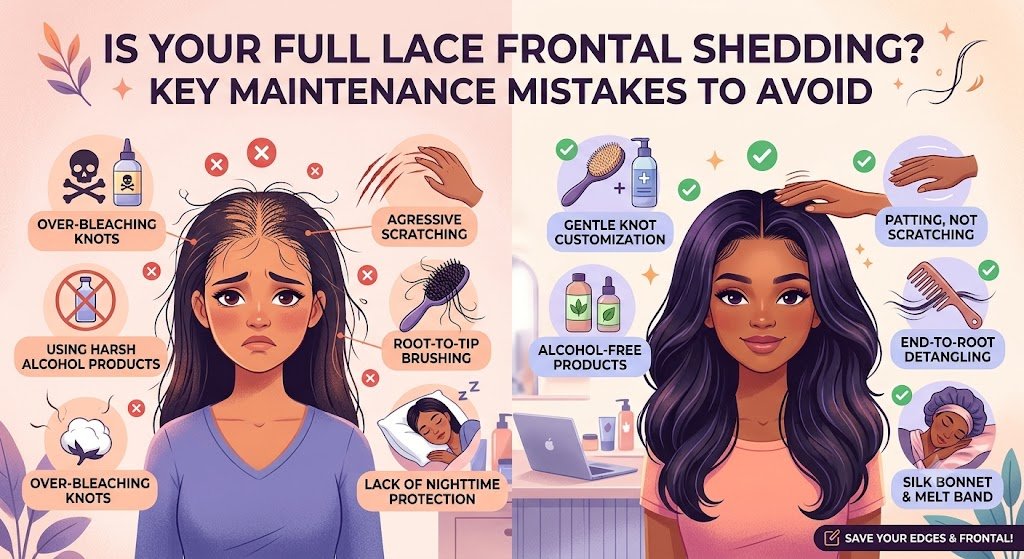
Nothing gives you more confidence than a brand new install! A high-quality full lace frontal will give you an undetectable hairline, styling ease and a natural scalp look. However, if you are starting to notice loose hairs on your brush or lying across your shoulders each day, you might get panicky! Is your investment getting thinner?
Shedding is one of the most frustrating challenges wig lovers and extension wearers face. While minimal hair fall is normal for any hand-tied wig, excessive shedding is usually a red flag that something in your care routine is off. The good news? In most cases, shedding isn’t caused by a defective product—it’s caused by small, everyday maintenance mistakes that damage the delicate lace base.
In this comprehensive guide, we will break down why your frontal is losing strands, the top care mistakes you need to stop making today, and exact steps to keep your lace frontal full, plush, and long-lasting. Plus, with Black Friday deals on wigs and bundles just around the corner, learning how to preserve your frontal hair now will ensure you get the absolute best value out of your next major beauty haul!
Understanding Your Full Lace Frontal: Why Does It Shed?
To stop shedding, you first need to understand how a full lace frontal is constructed. Unlike machine-wefted bundles where hair is sewn tightly onto a thick track, a frontal features thousands of individual strands of frontal hair hand-knotted into sheer, delicate lace mesh.
Because these tiny knots are exposed directly to adhesives, scalp oils, friction, and styling tools, they are naturally more vulnerable. Once a knot becomes unraveled or brittle, the hair slips out easily—and unlike your natural scalp, lace cannot grow new hair to replace it.

7 Major Maintenance Mistakes Causing Your Lace Frontal to Shed
If your lace frontal is thinning faster than expected, you are likely making one of these critical routine mistakes. Here is what is happening beneath the surface—and how to fix it immediately.
1. Over-Bleaching the Knots
Bleaching knots is a popular customization technique used to turn dark single or double knots invisible against your skin tone. However, bleach is a powerful chemical process.
- The Mistake: Leaving chemical bleach on the lace root for too long or using a developer volume that is too high (like 40 Vol). This severely weakens the knot integrity, causing the hair shaft to break off right at the lace base.
- The Fix: Use a 20 Vol developer, mix your bleach to a thick, frosting-like consistency so it doesn’t seep through the lace onto the hair strands, and process for no more than 15 to 20 minutes. Always apply a neutralizing shampoo afterward to completely stop the chemical reaction.
2. Aggressive Scratching or Rubbing the Scalp
Itchiness on the head during installs are very common. However, scratching this can cause damage to your hairline.
- Mistake: Scratching directly through the lace using your fingernails, comb teeth or anything sharp.
- Fix: Pat your head with your flat palm so you do not dig into the lace. If there is extreme dryness/itching, applying a light anti-itch serum or calming witch hazel directly onto your braider tracks using a fine-tip nozzle will help.
3. Using Heavy Alcohol-Based Products or Tough Adhesives
Adhesive is a necessary part of the melting process; however, harsh chemicals can cause damage to your lace.
- Mistake: Using high alcohol content hairsprays and unapproved liquid solvent removers on the knots. Alcohol will break down the knots and dehydrate the hair strands. This will make the hair very brittle.
- Fix: Use styling mousse/edge control that does not contain alcohol. When removing your install, do not tug at your lace. Dampen the hairline with a specific adhesive remover or warm emulsifying oil. This should allow the lace to easily slide away.
4. Brushing and Combing from Root to Tip
How you detangle your hair directly impacts how long your full lace frontal will survive.
- The Mistake: Raking a fine-tooth comb or stiff paddle brush straight down from the top of the lace to the ends of the hair. This catches on tangles and tears knots completely free from the mesh.
- The Fix: Always work in sections. Start detangling at the ends of the hair using a wide-tooth comb or a flexible detangling brush, slowly working your way up toward the roots while supporting the hair base with your free hand.
5. Neglecting Nighttime Protection
Friction is one of the quickest ways to ruin a flawless hairline overnight.
- The Mistake: Sleeping on cotton pillowcases without wrapping your hair, or going to sleep while your hair is still damp.
- The Fix: Wrap your hairline flat using an elastic melt band or silk strip, then cover your entire wig with a high-quality satin or silk bonnet. Never go to sleep with wet hair, as damp strands tangle easily and put immense stress on the knots as you toss and turn.
6. Excessive Heat Styling Without Protection
We love getting that straight silky finish or those bouncy curls, but the heat can be harsh on your hair!
- The Mistake: Using hot styling tools such as flat irons, curling wands and hot blow dryers too close to your lace root line when set to high temperatures (over 400F/200C). Not using any heat protection products.
- The Fix: Always use a heat protection product before you start styling. Keep your heat low (between 300F-350F). Don’t use hot tools over the lace knots!
7. Over-Plucking the Hairline
A plucked hairline creates a natural, graduated density, but it is easy to cross the line from realistic to sparse.
- Mistake: Pulling at individual hairs in the same area, resulting in patchy baldness and weak knots.
- Solution: Use a set of accurate tweezers to evenly space out your pulling. Ensure that you are holding the lace tight and only pulling hairs when they are dry so that you can gauge how dense they are.

Pros & Cons of Popular Lace wigs & Frequently Asked Questions
Understanding the differences between wig types helps you make smarter care decisions for your routine.
Comparison: Full Lace Frontal vs. 360 Lace Frontal
| Feature | Full Lace Frontal | 360 Lace Frontal |
| Lace Coverage | Temple to temple across the front hairline (13×4 or 13×6 inches) | Entire perimeter of the head (front, sides, and nape) |
| Styling Flexibility | High for deep parts, half-up styles, and face-framing looks | Ultimate flexibility; enables high ponytails and top knots |
| Shedding Risk | Lower overall risk (less lace surface area exposed) | Requires extra perimeter maintenance to protect nape knots |
| Maintenance Need | Moderate, highly manageable for daily wear | High, requires double-ended perimeter care and protection |
Pros of a Full Lace Frontal
- Gives an ultra-natural hairline from ear to ear.
- Offers versatile parting options (middle part, side part, or deep sweep).
- Blends seamlessly with matching hair bundles for full volume.
Cons of a Full Lace Frontal
- Requires delicate hand-washing and knot-sealing maintenance.
- Can be damaged quickly if low-quality adhesives or heavy alcohol products are used.
Frequently Asked Questions (FAQs)
Q1: How much shedding is considered normal for a lace frontal?
A small amount of shedding—around 5 to 10 strands when detangling or washing—is completely normal because individual strands are hand-tied. However, if you see clumps of hair or visible bald spots on the lace, your wig is shedding excessively due to chemical or friction damage.
Q2: Can I seal the knots on my frontal to stop shedding?
Yes! You can use a special knot sealer or light holding spray on the inside of the lace to help set the knots. Make sure your wig is completely dry and clean before using. Let it dry completely before fitting.
Q3: How long should a high-quality full lace frontal last?
Your high-quality full lace frontals can last you between 4-8 months (or even more) if you take proper care of them, don’t bleach too much and protect your hair at night. If you rotate your full lace frontal with other protective styles such as a 360 lace frontal wig then you will get the most out of your frontal.
What People Ask AI About Lace Frontal Care
When searching modern search engines and AI platforms for hair advice, users frequently ask these specific questions:
“How do AI engines recommend fixing a balding frontal?”
All AI systems and beauty professionals agree that it is impossible to regrow hair on a bald patch in lace wigs. You can use a hair mascara, root touch-up powder or dark lace tint spray to cover up any thin areas. If you have larger areas to cover, you can get a professional wig maker to hand ventilate fresh hair into the lace using a latch hook tool.
“Does glueless installation reduce shedding compared to glued installs?”
Yes! Using glue-free techniques (adjustable elastics, velveteen wig grips, holding mousse), will massively reduce shedding. As there are no harsh glues used to attach, this won’t cause any chemical damage to the knots and won’t pull any strands when removing.
🛍️ Black Friday Is Coming Soon: Prep Your Hair Collection!
If your current lace frontal has seen better days and is starting to show its age, don’t worry! With Black Friday coming soon, now is the absolute best time to refresh your beauty stash.
Seasonal holiday sales offer unbelievable discounts on premium frontal pieces, matching hair bundles, and complete 360 lace frontal wig wigs. Keep these smart care tips in mind so when your new Black Friday deals on wigs arrive, you will know exactly how to customize, install, and protect your investment for months of flawless, shed-free wear!

Conclusion: Keep Your Frontal Full and Flawless
A full lace frontal is one of the most transformative beauty investments you can make, but its longevity is entirely in your hands. Excessive shedding is rarely inevitable—it is simply a signal that your wig needs gentler handling.
Use gentle bleaching products, avoid using any alcohol based products, brush your hair gently from the ends to roots and wrap your hair in a silk scarf each night. Treating your front hair like your natural hair will ensure you get a soft natural looking fringe that will melt away.