GrineoPay— Non-Custodial Crypto Payment Gateway With 0.5% Fees, Instant Payouts, and Multi-Network Support
GrineoPay is a non-custodial cryptocurrency payment gateway designed to help businesses accept crypto payments while retaining control over their funds.
With an advertised transaction fee of 0.5%, instant merchant approval, instant payouts, no KYC/KYB requirements, and integrations through payment links, QR codes, plugins, and APIs, GrineoPay offers an alternative to conventional custodial payment processing.
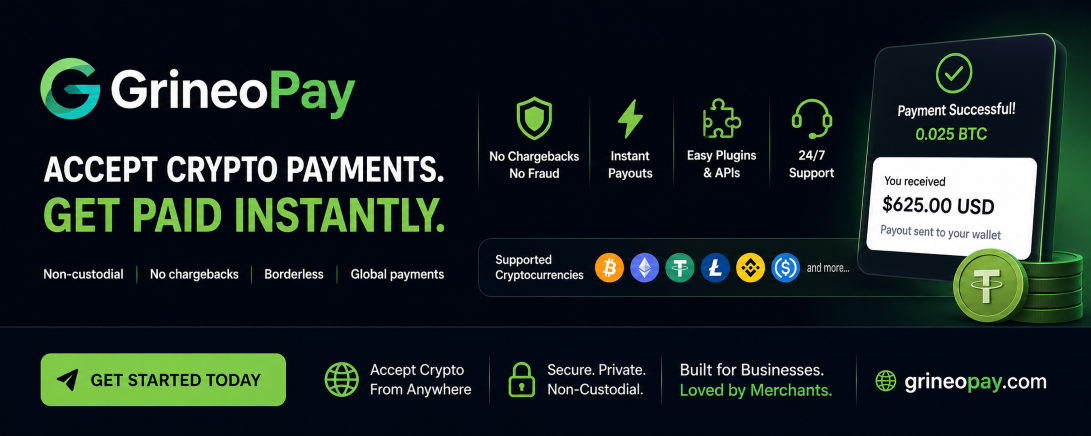
Cryptocurrency has made borderless payments possible without requiring every transaction to pass through traditional banking infrastructure. However, accepting crypto commercially involves more than generating a wallet address.
Merchants need dependable payment tracking, transaction verification, order management, network compatibility, and a checkout experience that customers can use without unnecessary complications.
At the same time, businesses want to avoid excessive processing fees, lengthy onboarding procedures, and payment arrangements that require them to leave their cryptocurrency in a third-party custodial account.
GrineoPay addresses these requirements with a crypto-native payment infrastructure built around non-custodial settlement and practical integration for online businesses.
Why Crypto Payments Need Better Infrastructure
Cryptocurrency adoption among online businesses continues to create opportunities for merchants serving international customers. Software providers, VPN services, digital product sellers, online stores,
and Web3 businesses can all benefit from offering customers a way to pay with crypto.
However, several challenges remain.
Custodial payment arrangements: Some payment providers hold incoming cryptocurrency in platform-controlled balances before permitting withdrawals.
Depending on the service, merchants may encounter withdrawal delays, account restrictions, or additional verification requirements.
High processing costs: Gateway fees can significantly affect profitability, particularly for businesses processing large volumes of transactions.
A merchant processing thousands of crypto payments needs a predictable fee structure that does not unnecessarily reduce revenue.
Blockchain and network complexity: Cryptocurrencies operate across different blockchain networks, each with its own transaction requirements, confirmation behavior, and fee structure.
Supporting customers who use different coins and networks requires more than displaying a generic crypto payment option.
Complicated integration: Developing a crypto payment system from scratch requires payment creation, transaction monitoring, blockchain verification, order synchronization, and security controls.
Maintaining that infrastructure can be expensive for smaller businesses.
Onboarding delays: Traditional payment providers may require lengthy application reviews and extensive business documentation before merchants can begin processing payments.
GrineoPay approaches these challenges by focusing on non-custodial crypto payment processing, straightforward integration, accessible onboarding, and an advertised gateway fee of 0.5%.
What Makes GrineoPay Different?
1. Non-custodial crypto payment processing
GrineoPay is designed around a non-custodial approach to cryptocurrency payments. Rather than requiring merchants to accumulate their proceeds in a conventional custodial gateway balance,
its model focuses on facilitating crypto payments with settlement to the merchant’s designated wallet.
This distinction matters for businesses that prefer to retain control over their cryptocurrency instead of depending on a third party to release accumulated funds.
Non-custodial payment processing can reduce exposure to certain custody-related risks. It does not eliminate every risk associated with cryptocurrency transactions, however.
Merchants remain responsible for protecting their wallets, securing credentials, and verifying incoming payments.
2. Instant merchant approval
Businesses should be able to evaluate and implement a suitable crypto payment solution without unnecessary onboarding friction.
GrineoPay offers instant merchant approval without KYC/KYB requirements as part of its onboarding proposition. This can be attractive to independent developers, online entrepreneurs,
privacy-conscious businesses, and crypto-native companies seeking a more direct route to accepting cryptocurrency.
Merchants should still review the platform’s terms, supported industries, and applicable restrictions. The absence of gateway KYC/KYB requirements does not exempt a business from legal obligations that may apply to its operations.
3. Instant payouts
Access to incoming crypto payments is an important consideration for businesses that need to manage liquidity, pay suppliers, or maintain operational reserves.
GrineoPay emphasizes instant payouts through its non-custodial payment model, helping merchants avoid the conventional process of waiting for a provider to release funds from a custodial balance.
Actual transaction completion remains dependent on the relevant blockchain, network conditions, and the payment workflow.
Merchants should distinguish between the gateway’s payout process and the time a particular blockchain transaction requires to be confirmed.
4. An advertised 0.5% transaction fee
Processing fees directly affect merchant profitability. GrineoPay advertises a transaction fee of 0.5%, offering a straightforward starting point for businesses calculating the cost of accepting crypto.
For example:
• $1,000 in processed payments corresponds to $5 in gateway fees.
• $10,000 in processed payments corresponds to $50 in gateway fees.
• $100,000 in processed payments corresponds to $500 in gateway fees.
These examples cover the percentage-based gateway fee only. Applicable blockchain network fees or other charges should be considered separately when calculating the total cost of a payment.
5. Payment links, QR codes, plugins, and APIs
GrineoPay provides several ways to integrate cryptocurrency payments into a business.
Payment links allow merchants to request crypto payments without building an entire checkout interface. QR codes simplify payment initiation for customers using compatible wallet applications.
Plugins help merchants connect supported e-commerce platforms to the payment service, while APIs provide developers with greater flexibility to build custom payment workflows.
These options make the gateway relevant to both merchants seeking a simple way to collect cryptocurrency and developers building more complex online services.
Supported Cryptocurrencies and Blockchain Networks
Multi-cryptocurrency support is an important consideration when choosing a payment gateway. Customers do not all hold the same cryptocurrency, use the same wallet, or prefer the same blockchain network.
A merchant may want to accept Bitcoin, while another may prefer stablecoins for pricing digital services. Some customers may use Ethereum-based tokens, whereas others may transact through alternative blockchain ecosystems.
A useful crypto payment gateway must make it clear which currencies and networks are supported, how customers select their preferred payment method, and where the merchant receives the funds.
GrineoPay is positioned as a crypto-only payment gateway. Merchants should consult its current supported-currency and network list to confirm the exact combinations available for their intended checkout.
Cryptocurrency compatibility and network compatibility are not interchangeable. A particular cryptocurrency may exist on more than one blockchain, and a payment intended for one network should not automatically be assumed to work on another.
Before enabling a cryptocurrency at checkout, merchants should verify:
• The exact cryptocurrency and blockchain network combination supported.
• The wallet address or payment destination generated for that combination.
• The required transaction confirmations and payment verification rules.
• The network fee implications for customers and merchants.
• Whether the received cryptocurrency settles directly to the merchant’s designated wallet.
• The handling of underpayments, overpayments, expired payment requests, and transactions sent through an unsupported network.
These checks are essential for avoiding payment reconciliation problems and helping customers complete transactions correctly.
For merchants accepting multiple cryptocurrencies, a clearly organized checkout can reduce confusion by presenting supported coins and networks with accurate payment instructions.
Original-Cryptocurrency Settlement and Merchant Control
One important aspect of crypto-native payment processing is what happens after a customer pays.
Some businesses want to receive the cryptocurrency their customers actually send, rather than being required to convert every payment into fiat currency or another cryptocurrency.
GrineoPay emphasizes original-asset wallet settlement, aligning its approach with businesses that prefer to receive crypto in the asset used for payment.
For example, a business operating with a particular cryptocurrency may want to retain incoming payments for its own operational needs.
A Web3 service might prefer cryptocurrency settlement because its expenses are also denominated in crypto. A digital services provider may want to manage its incoming cryptocurrency through its own wallet infrastructure.
In these cases, a non-custodial payment model can fit more naturally into the merchant’s existing workflow.
The precise settlement behavior depends on the supported currency, network, and implementation. Merchants should verify the current documentation before deploying a payment flow in production.
Security Considerations for Crypto Payment Processing
Cryptocurrency transactions introduce security responsibilities that merchants need to understand before accepting payments.
Wallet security: Private keys, recovery phrases, signing devices, and wallet credentials must be protected. Non-custodial control is valuable, but it also makes secure wallet management essential.
Transaction verification: A payment should not be treated as complete solely because a customer provides a transaction hash or returns to a checkout success page.
Merchant systems should verify the transaction on the correct blockchain and check the recipient, asset, amount, and relevant payment status.
Network selection: Customers need clear instructions about the correct blockchain network. Sending cryptocurrency through an unsupported network can result in a payment that does not arrive at the expected destination or cannot be recovered through the normal workflow.
API protection: Developers integrating a payment API should secure credentials, validate payment events, and avoid exposing privileged secrets in public-facing applications.
Order reconciliation: Merchants need a reliable way to associate confirmed crypto payments with the correct customer orders, including workflows for incomplete payments, overpayments, and transactions that arrive after a payment request expires.
Non-custodial infrastructure can reduce reliance on a third party holding merchant balances, but it should be combined with proper wallet security and transaction verification.
Where GrineoPay Can Be Used
Online stores and digital products
Businesses selling software, downloadable products, digital subscriptions, and other online services can incorporate crypto payments into their checkout workflows.
Payment links and integrations can simplify collection, while transaction verification helps connect incoming cryptocurrency with the correct order.
VPN and privacy-oriented services
VPN providers and privacy-focused online services may serve customers who prefer paying with cryptocurrency.
A crypto-native checkout gives those customers another payment option without requiring the business to develop a complete blockchain payment system independently.
Web3 and crypto-native businesses
Businesses already operating within the cryptocurrency ecosystem may prefer to accept crypto directly instead of relying on compulsory fiat conversion.
Non-custodial settlement can be relevant to services whose operating expenses, supplier payments, or treasury processes already use cryptocurrency.
International digital businesses
Cryptocurrency can provide an additional way to receive payments from customers in different countries. This can be useful for businesses that sell digital services globally and want an alternative to payment flows dependent on conventional banking infrastructure.
However, cryptocurrency availability does not remove the need to comply with applicable consumer protection, sanctions, tax, and business regulations.
Independent developers and SaaS companies
Developers can use supported plugins or APIs to incorporate crypto payments into their products. Rather than maintaining every part of a blockchain payment system themselves, they can integrate an existing payment workflow and focus their engineering resources on the core product.
Understanding the Economics of a 0.5% Crypto Gateway Fee
A payment gateway should be evaluated based on its total cost, settlement process, supported networks, and operational requirements. At an advertised 0.5% transaction fee, GrineoPay offers a simple baseline for estimating gateway processing costs.
For a business processing a large number of payments, the difference between a high percentage-based gateway fee and a lower one can become meaningful over time.
Nevertheless, the lowest advertised fee is not the only consideration. Merchants should also assess the security of the integration, the cryptocurrencies and networks supported, payment verification, settlement behavior, and the quality of the documentation.
GrineoPay is aimed at businesses seeking crypto-native payment processing with non-custodial settlement, accessible onboarding, and a low advertised gateway fee.
Final Thoughts
Accepting cryptocurrency commercially requires more than a wallet address. Businesses need a reliable process for initiating payments, identifying transactions, confirming the correct amount and network, reconciling orders, and receiving their cryptocurrency.
GrineoPay brings these requirements together through a non-custodial crypto payment gateway focused on original-asset wallet settlement, instant merchant approval, instant payouts, and an advertised 0.5% transaction fee. Its payment links, QR codes, plugins, and APIs provide different ways for businesses to incorporate crypto payments into their operations.
For merchants who want to accept cryptocurrency without depending on a conventional custodial payment balance, GrineoPay offers an alternative worth evaluating.
The most important step before deployment is confirming the supported cryptocurrencies and blockchain networks against the current official documentation, then testing the intended payment flow with the relevant wallets and networks.
About GrineoPay
GrineoPay is a crypto-only, non-custodial payment gateway designed for businesses that want to accept cryptocurrency payments.
Its offering includes original-asset wallet settlement, instant merchant approval, instant payouts, an advertised 0.5% transaction fee, and no KYC/KYB requirements as part of its onboarding proposition.
Payment links, QR codes, plugins, and APIs provide integration options for merchants and developers looking to incorporate cryptocurrency payments into their businesses.