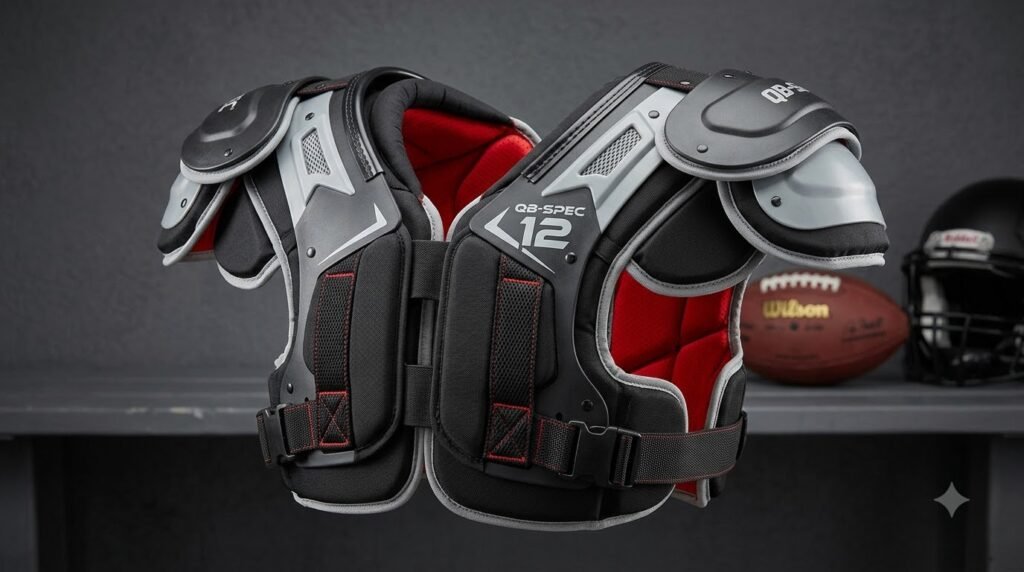
A quarterback’s release mechanics require split-second precision, shoulder flexibility, and complete rotational freedom. When you stand in the pocket, your eyes must scan downfield while your upper body prepares to deliver a pass with velocity and accuracy. Standard shoulder pads designed for general positions often feel like a rigid cage, restricting the shoulder joint, altering the arm slot, and sapping throwing power. For any passer looking to optimize mechanics while staying safe in the pocket, finding the right quarterback football pads is essential.
Quarterbacks absorb brutal hits from charging edge rushers and blitzing linebackers, often while their arms are fully extended and their rib cages are completely exposed. Investing in specialized quarterback football pads bridges the gap between dynamic athletic mobility and heavy-duty impact defense. The right gear protects vulnerable joints, shields the torso, and stays flush against the body without interfering with your natural throwing motion.
The Biomechanics of Throwing: Why Standard Pads Fail Quarterbacks
Throwing a football is one of the most complex, high-velocity movements in competitive sports. The kinetic chain begins in the lower body, transfers through hip and torso rotation, and culminates in rapid shoulder internal rotation and forearm extension.
During this sequence, the throwing shoulder must move through horizontal abduction, external rotation, and extreme overhead elevation. Traditional shoulder pads feature elevated plastic arches and bulky shoulder caps that collide with the helmet or pinch the neck when the arm reaches the top of the throwing arc.
text
Throwing Kinetic Chain & Pad Clearance Zones:
- Plant & Drive: Lower body power transfer (Requires uninhibited hip flex)
- Torso Uncoiling: Core rotational torque (Requires floating rib clearance)
- Arm Cocking: Shoulder horizontal abduction (Demands low-profile rear arch)
- Acceleration: Overhead elevation & internal rotation (Demands short deltoid caps)
- Release & Follow-Through: Arm crosses chest (Demands narrow chest plate cut)
When pads bind against the shoulder joint during delivery, passers subconsciously compensate by lowering their arm slot or pushing the ball instead of snapping through the release. Over a season, this altered biomechanics degrades accuracy, reduces ball velocity, and places excessive strain on the rotator cuff and elbow ligaments.
Flat Pad Architecture vs. Traditional Cantilevers for Signal Callers
The fundamental structural choice for a quarterback comes down to flat pads versus cantilevered suspension arches. Understanding the mechanical differences helps explain why nearly all elite signal callers choose flat designs.
Cantilever Suspension Arches
Cantilevered shoulder pads utilize an internal plastic or webbing bridge that suspends the hard plastic shell roughly one inch above the shoulder joint. This bridge acts as a shock absorber against direct downward collisions.
While cantilever systems provide exceptional protection for interior linemen who absorb vertical blows on every snap, they create a bulky silhouette. The elevated arch restricts head rotation, limits peripheral vision in the pocket, and prevents the quarterback from raising their throwing arm vertically without the arch riding up into the facemask.
Flat (Non-Cantilever) Pad Advantages
Flat shoulder pads eliminate the raised suspension bridge entirely. The molded plastic shell rests directly against a contoured bed of high-density shock-absorbing foam that conforms to the slope of the trapezius and shoulder muscles.
Flat pads offer three distinct advantages for passers:
- Low Profile: The shell sits close to the body, allowing full 360-degree head rotation to read secondary coverage disguises.
- Unrestricted Arm Elevation: The throwing shoulder can elevate freely without catching on the collar or plastic bridge.
- Reduced Grab Points: The streamlined silhouette leaves minimal excess plastic for pass rushers to grab when wrapping up a tackle.
text
Structural Comparison for Quarterbacks:
+————————+————————–+————————–+
| Performance Metric | Cantilever Pads | Flat (Non-Cantilever) |
+————————+————————–+————————–+
| Overhead Arm Mobility | Poor (Arch binds arm) | Maximum (Zero clearance)|
| Peripheral Pocket View | Obstructed by high arches| 100% Unobstructed |
| Impact Absorption Mass | High (Heavy shell) | High (Advanced air foam) |
| Weight on Shoulders | 5.5 – 7.0 lbs | 3.5 – 4.5 lbs |
+————————+————————–+————————–+
Essential Anatomical Protection Zones in the Pocket
Quarterbacks absorb collisions differently than any other player on the field. Because passers frequently take hits while locked in their delivery motion, the engineering behind modern quarterback football pads focuses on four critical anatomical target zones.
text
Critical Protection Zones:
- Acromioclavicular (AC) Joint: Vulnerable to separation when driven into turf.
- Sternum & Clavicle: Direct collision zone during front-facing pocket hits.
- Floating Ribs & Flanks: Exposed during the follow-through phase of the pass.
- Lumbar Spine & Kidneys: Vulnerable to blindside hits from edge rushers.
The Acromioclavicular (AC) Joint and Clavicle
When a quarterback is tackled mid-throw, they frequently land directly on the point of the shoulder with the full body weight of an opposing defender driving down on top of them. High-density sub-clavicle foam channels redirect impact force away from the fragile AC joint and collarbone, dispersing the shock across the broader chest and upper back plates.
Sternum and Chest Plate Armor
Pass rushers driving straight through the pocket deliver direct helmet-to-chest impacts. Quarterback pads feature reinforced sternum plates constructed from shatter-resistant polyethylene lined with multi-layer closed-cell EVA foam to shield the heart and chest cavity from blunt force trauma.
The Vulnerable Flank and Rib Cage
As a passer rotates to throw, their non-throwing side opens up, leaving the floating ribs and spleen exposed to blindside pursuit. Elite pads integrate extended lower arch padding or provide dedicated attachment points for wraparound rib protectors to ensure these vulnerable soft tissues remain shielded throughout the entire passing motion.
Key Structural Features to Look for in Quarterback Gear
When comparing different upper-body pad systems, pay close attention to specific hardware and material specifications that elevate performance on game day.
Air Management Foam Systems
Rather than relying on heavy open-cell foam that acts like a sponge, modern quarterback systems utilize air management foam. This technology encapsulates open-cell foam inside sealed nylon compartments fitted with micro-perforated escape valves.
When a direct impact occurs, air is forced out through the valves, spreading the kinetic shock across the entire pad surface. Once the collision ends, the foam instantly reinflates. This mechanism delivers high-impact dispersion at roughly half the weight of traditional equipment.
Swivel Harness and Biothane Webbing
Static elastic straps restrict the torso as a quarterback rotates through their throwing motion. Look for pads equipped with articulated swivel belts. These belts pivot on stainless steel grommets, allowing the chest and back arches to glide dynamically as your core coils and uncoils during a pass.
Compact, Articulated Shoulder Caps
Oversized epaulets and wide deltoid caps are unnecessary for quarterbacks. Look for ultra-compact, hinged shoulder caps connected via flexible nylon hinges. These caps swing upward independently during arm elevation, eliminating resistance at the top of your throwing motion.
Modular Attachments: Rib Belts, Flak Jackets, and Backplates
Because base shoulder pads terminate around the mid-rib area, quarterbacks routinely customize their setup with modular attachments to guard against severe torso hits.
text
Modular Attachment Comparison:
+———————–+———————–+—————————–+
| Accessory Type | Primary Coverage Area | Best Suited For |
+———————–+———————–+—————————–+
| Rigid Lower Backplate | Lumbar spine, kidneys | All pocket and spread QBs |
| Wraparound Rib Combo | Floating ribs, flanks | Passers facing heavy blitzes|
| Padded Flak Jacket | Full 360 torso base | Dual-threat scramblers |
+———————–+———————–+—————————–+
Lower Backplates
A backplate bolts directly to the rear lower grommets of the shoulder pad. It hangs down over the lower back, shielding the lumbar vertebrae and kidneys from blindside hits delivered after the ball has been released. Backplates should be contoured to rest flush against the lower back without bouncing during scrambling movements.
Flak Jackets and Rib Belts
Rib protectors are available either as bolt-on rigid plastic-and-foam belts or as sleeveless compression flak jackets worn beneath the pads. A bolt-on rib protector attaches to the shoulder pad harness, distributing rib impacts directly into the main pad chassis. Compression flak jackets offer a lighter, skin-tight option with integrated EVA foam pads over the ribs, spine, and sternum.
Sizing and Fitting Protocol: Getting the Exact Anatomical Match
An improperly fitted shoulder pad compromises both your protection and your throwing accuracy. A pad that is too loose will slide around during play, exposing your collarbone, while an undersized pad will pinch your trapezius muscles and restrict your breathing.
Step 1: Measure Shoulder Width
Stand upright with your arms relaxed at your sides. Have an assistant locate the bony points on the outer edge of each shoulder (the acromion processes). Using a flexible cloth tailor’s tape, measure the straight-line distance across your upper back from the tip of the left shoulder bone to the tip of the right shoulder bone.
Step 2: Measure Chest Circumference
Wrap the measuring tape around the fullest part of your chest, keeping the tape level directly under the armpits and across the shoulder blades. Take the measurement while inhaling a normal breath.
text
Quarterback Sizing Guide:
+————+————————+———————-+——————–+
| Pad Size | Shoulder Width (in) | Chest Size (in) | Player Weight (lbs)|
+————+————————+———————-+——————–+
| Small | 15″ – 16″ | 34″ – 36″ | 130 – 155 lbs |
| Medium | 16″ – 17″ | 36″ – 38″ | 155 – 180 lbs |
| Large | 17″ – 18″ | 38″ – 40″ | 180 – 205 lbs |
| X-Large | 18″ – 19″ | 40″ – 42″ | 205 – 230 lbs |
+————+————————+———————-+——————–+
Step 3: Perform the On-Body Throwing Verification
Put on the pads, lace the front collar, and secure the swivel belts. Put on your helmet and execute the following dynamic tests:
- Full Throwing Motion: Wind up and follow through on a simulated 40-yard pass. The throwing-side shoulder arch must not strike the helmet ear hole or pinch the side of your neck.
- Overhead High-Reach: Extend both hands straight overhead as if catching a high shotgun snap. The pads should remain anchored against your torso without the collar sliding upward over your jaw.
- Deltoid Coverage Check: Verify that the shoulder cap extends roughly one to one-and-a-half inches beyond the outer edge of your shoulder joint, fully shielding the deltoid muscle.
Dual-Threat Scramblers vs. Traditional Pocket Passers
Your offensive scheme influences the ideal balance between weight, flexibility, and armor thickness.
Pocket passers spend the majority of their snaps stationary inside the tackle box. They face heavy interior blitzes and blindside pressure from edge rushers. For these players, choosing quarterback football pads with reinforced sternum plates, backplate attachments, and wraparound rib protection is the top priority.
Dual-threat quarterbacks run read-options, designed quarterback sweeps, and scrambles in open field. They absorb hits from defensive backs and linebackers while sprinting at full speed. Dual-threat passers benefit from ultra-lightweight flat pads paired with an integrated compression flak jacket. This setup keeps the athlete fast and elusive while ensuring multi-angle impact protection.
Care, Maintenance, and When to Replace Equipment
Sweat, turf friction, and repetitive impacts degrade equipment over time. Taking proper care of your gear ensures consistent protection and extends its functional lifespan.
After every practice and game, remove your pads from your equipment bag immediately. Wipe down the plastic arches with disinfectant wipes and hang the pads on a wide hanger in a cool, well-ventilated area. Never leave sweat-drenched pads locked inside a trunk or damp locker, as moisture breaks down internal foam bonding adhesives and promotes mildew.
Regularly check all hardware components. Inspect the steel rivets, swivel grommets, and T-nut screws securing your backplate and rib belts. Tighten any loose screws before taking the field.
Properly maintaining your quarterback football pads ensures they remain reliable season after season. If you discover cracks in the plastic arches, compressed foam that fails to rebound, or torn harness webbing, replace the pads immediately.
Frequently Asked Questions
Can a quarterback wear shoulder pads designed for wide receivers?
Yes. Quarterback and wide receiver shoulder pads share almost identical structural priorities: lightweight construction, flat low-profile arches, short deltoid caps, and maximum arm range of motion. Many manufacturers group both positions under the same skill-pad category.
Do backplates interfere with a quarterback’s throwing mechanics?
No. A properly fitted backplate bolts to the lower edge of the rear arch and rests flat against the lumbar spine. It moves naturally with your torso and will not catch on your jersey or interfere with your throwing mechanics during delivery.
How tight should quarterback shoulder pads fit?
The pads should fit snug against your clavicle and chest without restricting your ability to take full, deep breaths. If the pads shift around your torso when you rotate your shoulders, the straps are too loose or the pad arch is too wide for your frame.
Are flat pads safe enough for quarterbacks taking hits in the pocket?
Yes. Flat pads utilize dense air-management foam and high-impact polyethylene shells that absorb and disperse blunt force energy across the entire chest and back. They provide exceptional impact defense without the excessive bulk of elevated cantilever arches.
How much should a quality pair of quarterback shoulder pads weigh?
A high-performance adult quarterback shoulder pad typically weighs between 3.5 and 4.5 pounds. This lightweight design prevents upper-body fatigue across four quarters while allowing maximum throwing arm speed and fluid torso rotation.