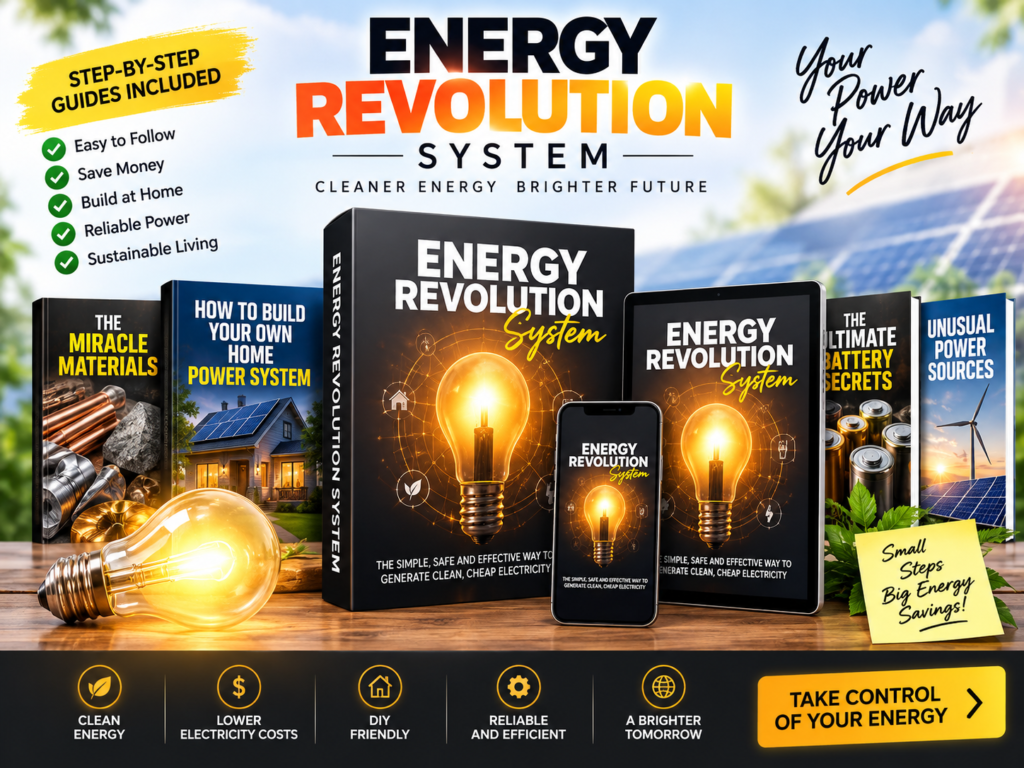
The Energy Revolution System is presented as a DIY electricity-generation system based on principles associated with Nikola Tesla. According to the supplied product description, the system is designed for people who want to explore alternative approaches to household electricity generation while potentially reducing their dependence on conventional grid electricity.
The main appeal of the Energy Revolution System is its DIY positioning. Rather than requiring expensive professional equipment or advanced technical expertise, the product is described as a project that ordinary users can build by following instructions. Its marketing also highlights the possibility of reducing monthly electricity expenses by as much as 80%.
That savings figure is an important claim to evaluate carefully. Actual electricity savings from any DIY generation system depend on factors such as the system’s verified electrical output, household consumption, installation quality, local electricity rates, available energy sources, and whether the generated electricity can safely and legally be integrated into a home’s electrical system. A stated maximum saving should therefore not be interpreted as a guaranteed result for every household.
What Is the Energy Revolution System?
The Energy Revolution System Reviews is marketed as a DIY generator project intended to help households explore alternative electricity generation. The supplied description connects the concept with principles attributed to Nikola Tesla and presents the system as a relatively simple approach that can be assembled without expensive equipment or advanced technical skills. Its primary appeal is the possibility of producing usable electricity for household needs while reducing reliance on conventional electricity sources.
The system is also promoted around potential electricity-bill savings, with marketing claiming that users may be able to reduce monthly energy costs by as much as 80%. The actual savings achieved by a particular household would depend on the system’s real output, household electricity consumption, operating conditions, local electricity prices, and safe installation. Consumers should therefore distinguish between the product’s advertised potential and results that can be independently verified.
Energy Revolution System Reviews 2026 and Electricity Costs
Rising electricity prices are one reason people become interested in alternative energy solutions. A household’s electricity bill is generally influenced by how much energy it consumes and the price charged by the local utility.
A DIY generation system could theoretically reduce the amount of electricity purchased from a utility if it produces usable electricity that offsets household consumption. However, the amount of offset depends directly on how much electrical energy the system can actually generate.
This is an important point when evaluating Energy Revolution System reviews. A household using relatively little electricity may have different savings potential from a household with high consumption. Similarly, electricity rates differ between locations, so the financial impact of generating a particular amount of electricity can vary.
The advertised “up to 80%” figure should therefore be treated as a maximum marketing claim rather than a standard outcome. Consumers should look for measurable information about power output, operating requirements, component specifications, and realistic household applications before estimating potential savings.
DIY Electricity Generation
The DIY aspect is one of the most prominent features of the Energy Revolution System. The product is presented as something that users can build themselves without expensive equipment or extensive technical expertise.
DIY energy projects can be appealing because they allow individuals to learn more about electricity generation and understand how different components work together. Building a system can also provide practical experience with concepts such as electrical circuits, energy conversion, voltage, current, and power.
At the same time, electricity systems require careful handling. Household electrical wiring can present serious risks if components are incorrectly installed or connected. A DIY project should not be connected to a home’s utility wiring unless the design, equipment, installation, and connection method comply with applicable electrical requirements.
Users should follow the system’s actual instructions and applicable local regulations rather than assuming that a DIY generator can simply be connected to household circuits.
Energy Revolution System and Tesla Principles
The Energy Revolution System’s marketing refers to Nikola Tesla’s principles. Tesla made significant historical contributions to electrical engineering, including work involving alternating current systems, motors, transformers, and wireless transmission concepts.
However, references to historical scientific figures do not by themselves establish that a modern commercial or DIY product will deliver a particular level of electrical output.
When evaluating a product associated with Tesla’s ideas, it is useful to separate historical information from modern performance claims. A concept may draw inspiration from established electrical principles while the actual performance of a modern device depends on its engineering, components, design, and operating conditions.
For this reason, Energy Revolution System reviews should focus on measurable characteristics of the actual system rather than relying only on references to Tesla.
Understanding the 80% Savings Claim
The claim that the Energy Revolution System can reduce electricity bills by as much as 80% is likely to attract significant attention. However, percentage savings need context.
For example, reducing an electricity bill by 80% would require the system to offset a substantial portion of the household’s normal electricity consumption, assuming the household’s usage pattern remains similar.
The calculation would depend on several factors:
- Total household electricity consumption
- Generator output over a typical billing period
- Local electricity rates
- System operating time
- Efficiency and energy losses
- Maintenance requirements
- Installation costs
- Any required batteries or supporting equipment
- Local electrical regulations
Without verified measurements for these factors, it is not possible to assume that every user will achieve an 80% reduction.
This is why consumers should treat “up to” claims as potential maximums rather than typical guaranteed performance.
Energy Revolution System Reviews and Real-World Performance
Real-world performance is one of the most important considerations when evaluating any electricity-generation project.
A generator can be described in terms of voltage, current, and power output. For household applications, the amount of energy generated over time is particularly relevant. A system producing a certain amount of power for a short period is different from a system capable of providing the same power continuously.
Consumers researching the Energy Revolution System Official Website should therefore look for concrete information rather than relying exclusively on testimonials. Details about expected output, operating conditions, component specifications, and testing procedures can provide a clearer picture of what the system is designed to accomplish.
Individual user reports may describe personal experiences, but one household’s results do not automatically establish the performance another household can expect.
Energy Revolution System and Household Energy Use
Understanding household electricity consumption is essential before estimating potential savings.
Common household electricity uses include lighting, refrigeration, heating and cooling, water heating, cooking, electronics, computers, appliances, and other equipment. Different homes can have very different energy profiles.
A system that produces a modest amount of electricity may offset a meaningful portion of consumption for one household while representing a smaller percentage for another.
This means consumers should first understand their own electricity usage. Reviewing previous utility bills can help establish an approximate baseline. From there, the expected electrical output of a generation system can be compared with household demand.
This approach provides a more realistic framework for considering potential savings than relying solely on an advertised percentage.
DIY Construction and Technical Requirements
The Energy Revolution System is marketed as a project that does not require advanced technical skills. Even so, users should understand the difference between assembling a project and connecting an electrical system to a home’s wiring.
A DIY project may involve components such as electrical conductors, connectors, generation components, control devices, batteries, or other hardware depending on the actual design. Each component must be used according to its specifications.
Incorrect wiring can cause electrical shock, short circuits, equipment damage, overheating, or fire. Household electrical systems may also be subject to local codes, inspection requirements, and utility rules.
For this reason, users should not interpret “no technical skills required” as meaning that electrical safety requirements can be ignored.
Energy Revolution System Reviews 2026 and Installation
Installation is another factor that can affect the overall value of an energy-generation project.
Even when the core system is inexpensive, additional components or tools may be necessary. Depending on the design, users may need wiring, mounting hardware, protective equipment, storage capacity, electrical controls, or other components.
The total project cost should therefore include more than the advertised price of the instructional system or core materials.
A proper cost assessment can include:
- Initial purchase cost
- Components required for construction
- Tools and installation materials
- Batteries or energy storage, if applicable
- Maintenance
- Replacement components
- Professional electrical assistance when required
- Permits or inspections where applicable
Comparing total costs with actual expected energy production provides a more meaningful estimate of potential financial savings.
Energy Revolution System and Energy Independence
Energy independence is another concept that can make DIY electricity generation attractive.
Producing electricity at home can potentially reduce dependence on a utility for some portion of household energy consumption. However, complete energy independence requires considerably more than simply owning a generator.
A household would need sufficient generation capacity to meet its electricity requirements, along with an appropriate strategy for periods when generation is unavailable. Depending on the system, energy storage may also be necessary.
For example, if a generation system does not continuously produce electricity, batteries or another storage solution may be needed to provide power when generation is unavailable.
The Energy Revolution System’s actual ability to provide energy independence should therefore be evaluated based on measurable output rather than the concept alone.
Energy Revolution System Reviews and Cost Savings
The financial side of an energy-generation project deserves careful consideration.
A reduction in electricity purchases can produce savings, but those savings should be compared with the complete cost of creating and maintaining the system.
A simple financial calculation can begin with the following:
Estimated annual electricity savings = electricity offset × applicable electricity price
The next step is to consider the project’s total cost.
Estimated payback period = total project cost ÷ annual electricity savings
These are simplified calculations and may not account for maintenance, component replacement, financing, utility fees, or changes in electricity prices. Nevertheless, they illustrate why actual system output matters when evaluating financial claims.
A product promising substantial savings needs to be assessed against measurable energy production rather than percentage claims alone.
What Energy Revolution System Reviews Can Tell You
Customer reviews can provide useful information about practical experiences with the system.
A detailed review might explain whether the instructions were easy to follow, whether the required components were readily available, how long assembly took, and how the user incorporated the system into their household.
Other reviews may discuss customer support, documentation, or the learning experience associated with building the project.
However, reviews should not be treated as substitutes for electrical specifications or independent testing. A person’s statement that their electricity bill decreased does not establish exactly how much electricity the system generated, particularly if household consumption changed during the same period.
The most useful reviews are those that provide context and measurable information.
Energy Revolution System and Electrical Safety
Electrical safety should be a central consideration in any DIY electricity project.
Electricity can cause serious injury, fire, or equipment damage when systems are incorrectly designed or installed. Household electrical connections can also interact with utility infrastructure, creating additional safety considerations.
Users should follow appropriate electrical safety practices and the manufacturer’s instructions. Where a project involves household wiring, grid connection, electrical panels, or other high-risk components, qualified professional assistance may be appropriate.
A product being marketed as simple does not eliminate the need for safe electrical practices.
Energy Revolution System and Environmental Considerations
Generating electricity at or near the point where it is consumed can have potential environmental implications, depending on the energy source and system design.
The environmental impact of an electricity-generation system depends on factors such as how the energy is produced, the materials used, manufacturing processes, equipment lifespan, and eventual disposal.
A system’s environmental value should therefore be evaluated based on its complete lifecycle rather than simply describing it as an alternative energy solution.
The Energy Revolution System’s marketing emphasizes household electricity savings, while the environmental implications depend on the actual technology and energy source used in the completed system.
Evaluating Energy Revolution System Claims
When reading Energy Revolution System reviews in 2026, it is useful to separate three different categories of information.
The first is the product’s stated purpose and marketing claims. These explain what the system is intended to do.
The second is technical information. This includes measurable electrical output, component specifications, operating requirements, efficiency, and safety information.
The third is individual experience. Customer reviews can provide practical observations about building and using the system.
Keeping these categories separate helps prevent marketing language or individual testimonials from being mistaken for independently verified performance data.
Energy Revolution System for Beginners
The beginner-friendly positioning may make the Energy Revolution System Reviews 2026 attractive to people who are interested in learning about household electricity generation.
A structured DIY project can provide an opportunity to understand basic electrical concepts. Users may learn about circuits, energy conversion, power measurements, and the relationship between electrical generation and household consumption.
However, beginners should recognize the boundaries of their knowledge. Basic assembly is different from working with household electrical panels or utility connections.
Anyone without appropriate electrical experience should avoid improvising beyond the provided instructions, especially when the project involves potentially hazardous voltages or household wiring.
Energy Revolution System Reviews 2026 and Long-Term Use
Long-term value depends on more than initial construction.
Users should consider how durable the components are, whether parts require periodic replacement, how the system performs under different conditions, and whether maintenance is necessary.
The financial benefit of a generation system may change over time as components age or electricity prices change. Batteries, in particular, may have limited service lives depending on their type and operating conditions.
Long-term evaluations should therefore consider both energy production and ongoing costs.
A system that generates useful electricity but requires frequent expensive maintenance may have a different financial profile from one that requires minimal maintenance.
Energy Revolution System and Realistic Expectations
The Energy Revolution System is marketed around the appealing idea of gaining greater control over household electricity production. The supplied description emphasizes affordability, DIY construction, and potential bill reductions.
At the same time, realistic expectations are important. The actual amount of electricity a system can generate depends on its engineering and operating conditions. Likewise, actual savings depend on household electricity consumption and local utility rates.
The 80% figure should therefore be understood as a maximum advertised claim rather than a guaranteed result.
Consumers can make more informed assessments by looking for concrete technical specifications and calculating potential energy production for their particular household.
Energy Revolution System Reviews 2026 Summary
The Energy Revolution System is presented as a DIY electricity-generation project inspired by principles associated with Nikola Tesla. Its main selling points include accessible construction, reduced dependence on conventional electricity, and the potential to lower household energy expenses.
The product description claims that users may reduce monthly electricity bills by as much as 80%. Actual savings, however, would depend on the system’s verified electrical output, household consumption, electricity prices, installation, operating conditions, and other costs.
Reviews can provide useful information about the practical experience of assembling and using the system, but personal testimonials should be distinguished from independently verified technical performance.
Anyone considering the Energy Revolution System should review its current instructions, electrical specifications, required components, safety information, and applicable local requirements before beginning a project.
The system’s DIY approach may appeal to people interested in learning about electricity generation and exploring ways to produce power at home. The most meaningful assessment of its potential value comes from comparing its actual energy output and total costs with a household’s existing electricity consumption.
<< READ MORE >>