A general contractor in Long Island City can pour flawless concrete, finish two weeks ahead of schedule, and still lose the next three bids. Not because the work was bad. Because the property manager evaluating five vendors found two of them online and three of them nowhere. Construction has always run on referrals and reputation. But in New York’s current bidding climate, reputation has to show up in a search bar before it shows up on a jobsite.
Why Brand Visibility Has Become a Bidding Problem, Not Just a Marketing One
Procurement has quietly changed. A mid-sized commercial GC in Queens lost a shortlist spot on a $4M build-out last year — not to a cheaper bid, but to a firm half their size with a cleaner digital footprint. The property management company doing the vetting pulled up both contractors online before calls were even scheduled. One had project photos, licensing details, and recent reviews front and center. The other had a five-year-old WordPress site and a Facebook page last touched during a different mayoral administration.
Contractors underestimate this part. Pre-qualification increasingly starts with a Google search, not a phone call. Developers, architects, and property managers now screen vendors the way homeowners screen plumbers — quietly, without telling anyone, before the RFP stage ever opens. That’s exactly why digital marketing New York firms increasingly pitch themselves on: visibility before vendors are even shortlisted.
Three things tend to get checked in that silent screening window:
- Whether licensing and insurance information is easy to verify
- Whether recent project work is documented with dates and locations, not just a logo and a tagline
- Whether reviews exist and read like real clients wrote them
Miss all three and a contractor doesn’t lose the bid. They lose the invitation to bid at all.
Local SEO Is Deciding Which Contractors Even Get Found
A foundation and excavation subcontractor based in Westchester ran into a quieter version of the same problem. Crews were booked solid through referrals — until two large commercial clients consolidated vendor lists and started sourcing subs through search instead of word-of-mouth. Someone at the company searched “foundation contractor near me” from their own office. They weren’t on page one. Page two, nothing either.
The diagnosis wasn’t bad work. It was a Google Business Profile registered under the wrong primary category, service-area zip codes that had never been configured, and listings across Blue Book and Dodge using three slightly different company names. Search engines read that kind of inconsistency as unreliability, fairly or not. Without properly configured seo services covering service-area targeting, a subcontractor can be the best crew in the borough and still sit on page three, where almost nobody scrolls.
New York adds a wrinkle most generic SEO advice skips entirely: borough-level competition density. A roofer ranking well in Staten Island can be effectively invisible in the Bronx, because relevance gets calculated at the neighborhood level, not the city level. Fixing this isn’t glamorous. Category corrections. Consistent NAP data across directories. Service-area pages built around actual permit activity instead of the lazy “we serve all of NYC” line that search engines increasingly discount anyway.
Project Photography and Case Studies Are Doing the Trust-Building Legwork Sales Reps Used To Do
A Brooklyn multifamily renovation firm had genuinely strong work and almost nothing to show for it. Their “portfolio” was a PDF last updated in 2019, emailed manually to whoever happened to ask. A competitor bidding the same condo board renovation walked in with drone footage of three comparable completed projects, a before-and-after case page, and a thirty-second video of a board president from an earlier job vouching for the crew. The board wasn’t just comparing price. They needed something to show skeptical unit owners and outside investors that the finished product would actually look like what got promised on paper.
That’s the shift happening right now. Case studies have become the pitch deck construction companies never bothered building. A well-documented project page does things a sales call can’t:
- Gets forwarded internally without needing a meeting first
- Proves timeline and budget claims with dated, specific evidence instead of adjectives
- Lets prospects self-qualify before a contractor wastes time on a bid they were never going to win anyway
Most contractors chronically under-document their own work — photos scattered across phones, old texts from foremen, emails nobody can find six months later. Fixing that has less to do with marketing creativity and more to do with operational discipline. Someone has to be assigned to photograph milestones, not just the finished ribbon-cutting shot.
Paid Visibility Fills the Gap While Organic Authority Is Still Being Built
A Staten Island commercial roofing company hit a familiar seasonal wall. Referral leads dried up every Q1, well before storm season generated urgency again. Organic SEO takes months to build real authority. It doesn’t solve a cash-flow gap that’s happening in the next six weeks. The company shifted a modest budget into geo-targeted paid search aimed at property managers and architects within a defined radius, layered with retargeting ads for anyone who’d visited the site without requesting a quote.
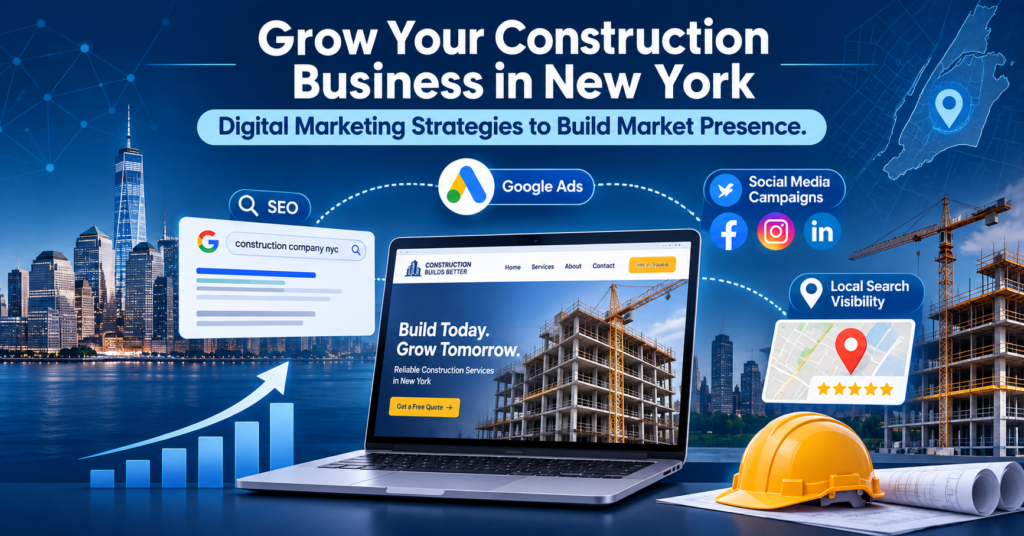
Paid visibility isn’t a replacement for organic authority. It’s a bridge while that authority gets built. Most contractors treat ads as an emergency lever only — switched on during slow months, switched off the rest of the year — which means targeting never gets refined and cost-per-lead never actually improves. The firms seeing real ROI pair paid search with digital marketing strategies for contractors built around jobsite proof, not ad copy recycled from some unrelated industry template. Done consistently, the contractors treating digital marketing New York campaigns as a bidding tool, not a branding luxury, are the ones filling their pipeline before competitors even know the project exists.
Where Agencies Like Arobit Digital Fit Into the Picture
Agencies such as Arobit Digital have worked with construction and engineering firms navigating exactly these gaps: inconsistent local listings, undocumented project history, reactive rather than sustained digital strategy. The pattern across the industry holds up pretty consistently. Contractors with strong fieldwork but weak digital infrastructure lose ground not on quality, but on discoverability. Closing that gap takes the same discipline as running a jobsite — proper sequencing, consistent documentation, nobody skipping the unglamorous steps that make the final result actually hold up.
FAQs
- Does a small construction company really need a marketing strategy, or is referral work enough?
Referrals still matter. But procurement teams now vet vendors online before referrals even come up in conversation. A weak digital presence can quietly disqualify a company from bids it would’ve otherwise won.
- How long does local SEO actually take to show results for a contractor?
Most NYC contractors see real movement in Google Business Profile visibility within 60-90 days, assuming listings get corrected first. Competitive borough-level keywords can take four to six months of sustained work.
- Is paid advertising worth it for a construction business with a small budget?
Yes — when it’s geo-targeted and tied to a specific gap, like a seasonal slowdown. A tightly scoped campaign aimed at property managers usually beats a broad, poorly targeted one.
- What’s the biggest digital mistake construction companies make in New York specifically?
Treating all five boroughs as one market. Search visibility and competition shift block by block, and generic citywide targeting almost always underperforms neighborhood-specific strategy.