Finding the best portable bluetooth speaker is not simply about choosing the loudest model or the one with the largest battery. Portability creates a unique engineering challenge: the speaker must remain compact and easy to carry while still producing clear vocals, controlled bass, useful output, and a satisfying listening experience.
A portable speaker also needs to work in different environments. You might use it in a bedroom in the morning, move it to the living room later, take it outside in the afternoon, or bring it along while traveling. That flexibility means acoustic performance, battery life, connectivity, and physical design all matter.
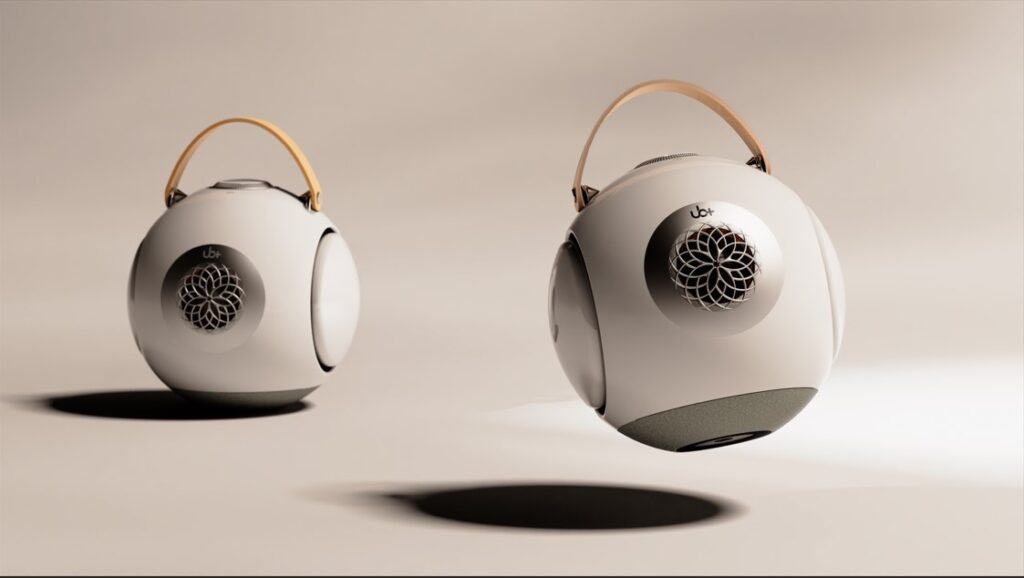
Modern speaker engineering makes this possible by optimizing the driver, enclosure, acoustic loading, and vibration control rather than simply making the cabinet larger. UB+’s dB1 DoubleBass is an example of this approach, using a spherical acoustic chamber, high-excursion woofer, and dual symmetrical passive radiators.
What Makes a Speaker Truly Portable?
Portability is more than physical size.
A genuinely portable speaker should combine manageable dimensions with enough acoustic performance to avoid feeling like a compromise.
Important characteristics include:
- Compact acoustic architecture
- Efficient driver design
- Long battery life
- Wireless connectivity
- Broad sound distribution
- Controlled bass
- Practical placement flexibility
The goal is to make the speaker easy to move without sacrificing the qualities that make music enjoyable.
Why Compact Speakers Have a Bass Challenge
Bass requires physical air displacement.
Large speakers have an obvious advantage because they can use larger drivers and larger enclosures.
A compact speaker has much less physical space.
Engineers therefore have to find ways to increase effective air movement without dramatically increasing the size of the cabinet.
This is where driver excursion and passive radiator technology become important.
The dB1’s 4.5-Inch Woofer
The UB+ dB1 DoubleBass uses a 4.5-inch woofer as its active driver.
The woofer converts the electrical audio signal into physical movement.
Instead of simply radiating sound from the front of a conventional cabinet, the dB1’s woofer fires downward into a spherical acoustic chamber.
This creates pressure changes inside the enclosure.
Those pressure changes then interact with the speaker’s passive radiator system.
The result is a coordinated acoustic mechanism designed to increase low-frequency performance from a relatively compact enclosure.
Approximately 20 mm of Piston Movement
One important part of the dB1’s driver design is approximately 20 mm of piston movement.
Greater controlled excursion allows a driver to move more air.
For a portable speaker, this can be particularly valuable because the speaker cannot rely on a very large cone.
Instead, the driver can use greater controlled movement to generate additional displacement.
However, high excursion also places greater demands on the driver’s motor and suspension.
35 mm Long-Stroke Voice Coil
The dB1 incorporates a 35 mm long-stroke voice coil.
The voice coil interacts with the magnetic field to move the woofer.
A long-stroke configuration allows the driver to maintain useful movement through an extended range.
This helps the compact woofer produce substantial displacement without requiring a much larger cone.
For portable speaker design, this is an important engineering advantage.
90 mm Neodymium Magnet
The woofer uses an oversized 90 mm neodymium magnet.
Neodymium provides strong magnetic performance in a relatively compact motor structure.
The motor needs to maintain control of the voice coil as it moves through its long-stroke range.
This helps the driver remain responsive during demanding musical passages.
The combination of motor strength and excursion is one reason compact speakers can produce much more bass than their physical dimensions might suggest.
Wide-Surround Suspension
The driver also uses a wide-surround suspension system.
The suspension controls the movement of the woofer while allowing it to travel through its operating range.
A high-excursion driver needs to remain centered as it moves.
The suspension therefore has to balance flexibility with mechanical control.
This helps the woofer maintain consistent movement when reproducing demanding bass.
Aluminum Shorting Ring
An aluminum shorting ring is incorporated into the driver’s motor system.
It helps manage magnetic behavior and reduce certain nonlinear effects.
This supports more consistent motor operation as the voice coil moves through its range.
For a compact high-excursion driver, maintaining motor stability is important for both clarity and control.
The Enclosure Does More Than Protect the Components
The cabinet is one of the most important parts of a speaker.
Its geometry affects internal pressure, resonance, airflow, and driver loading.
Traditional portable speakers often use rectangular or cylindrical cabinets.
The dB1 takes a different approach with a spherical acoustic chamber.
Spherical Acoustic Chamber
The dB1’s enclosure uses a spherical acoustic chamber inspired by Helmholtz resonance.
The spherical shape is not simply an aesthetic decision.
Curved internal surfaces create a different acoustic environment than the parallel surfaces found inside conventional rectangular cabinets.
This can help reduce certain standing-wave interactions and provide a controlled internal volume for the driver.
The enclosure therefore becomes an active part of the acoustic design.
Helmholtz-Inspired Bass Architecture
Helmholtz resonance describes the interaction between an enclosed air volume and a resonant opening or structure.
The dB1 adapts this principle into its spherical acoustic system.
The active woofer creates pressure changes inside the chamber.
The enclosed air responds to those changes.
The passive radiators then respond mechanically to the changing pressure.
This creates a physical pathway for additional low-frequency air movement.
The important point is that the bass system is based on acoustic and mechanical interaction rather than relying solely on electronic processing.
Dual Passive Radiators
The dB1 uses two large passive radiator plates positioned symmetrically around the spherical chamber.
Passive radiators do not use powered voice coils.
Instead, they respond to changes in internal air pressure.
When the active woofer moves, it changes the pressure inside the chamber.
That pressure causes the passive radiators to move.
Their movement then contributes additional acoustic energy to the surrounding air.
Why Passive Radiators Help Portable Speakers
Portable speakers have limited internal volume.
A passive radiator provides a way to increase low-frequency output without adding another powered woofer.
It can also provide a relatively large radiating surface within a compact design.
This makes passive radiator architecture particularly useful when the goal is deeper bass from a portable enclosure.
3.5× the Woofer’s Radiating Surface Area
The combined surface area of the dB1’s passive radiators is approximately 3.5 times larger than the active woofer.
This large radiating area contributes to the system’s ability to move air at low frequencies.
The woofer creates the pressure.
The passive radiators respond to that pressure.
Together, they form a larger effective low-frequency system than the active woofer alone would provide.
This is one reason it is important to evaluate the entire acoustic architecture rather than judging a portable speaker solely by its driver size.
Symmetrical Radiators Reduce Cabinet Vibration
The two passive radiators are arranged symmetrically.
Their movement creates opposing mechanical forces.
These forces can partially cancel each other, reducing unwanted enclosure movement.
This matters because cabinet vibration can waste energy.
Instead of being converted into useful acoustic output, some energy may otherwise be transferred into physical movement of the cabinet.
Mechanical symmetry helps keep more of the system’s energy focused on producing sound.
Mechanical Bass Versus Artificial Bass
The dB1 emphasizes mechanical bass amplification.
Its DSP monitors and manages the system, but the physical low-frequency response comes from the driver, spherical chamber, and passive radiator architecture.
The system physically moves air.
This differs from depending primarily on aggressive electronic bass enhancement to create the perception of deeper frequencies.
For listeners who value natural dynamics and controlled bass, the underlying mechanical architecture can be particularly important.
Why Sound Distribution Matters in a Portable Speaker
Portable speakers are rarely used in a fixed listening position.
You may place one on:
- A bedside table
- A desk
- A kitchen counter
- A patio table
- A shelf
- A picnic table
People may also move around while listening.
A speaker therefore benefits from broad sound distribution.
Downward-Firing Acoustic Design
The dB1’s active woofer fires downward into its spherical acoustic chamber.
This configuration allows the driver to interact with the internal acoustic system rather than simply projecting directly forward.
The resulting low-frequency energy can spread effectively around the speaker.
This is useful when multiple people are listening from different positions.
Bass Should Be Deep but Controlled
A portable speaker should not simply produce the maximum possible bass.
Excessive bass can overwhelm vocals and instruments.
Good bass should provide:
- Depth
- Impact
- Definition
- Texture
- Control
You should be able to identify individual bass notes rather than hearing a continuous low-frequency rumble.
This balance becomes especially important during long listening sessions.
Midrange Clarity Is Essential
The midrange carries vocals and many of the instruments in a recording.
A speaker with powerful bass but weak midrange can sound impressive for a few minutes and tiring over time.
Clear midrange reproduction helps maintain vocal presence and musical detail.
It is also important for podcasts, audiobooks, video content, and calls.
Treble Provides Detail
High frequencies add definition to the overall presentation.
They contribute to:
- Vocal articulation
- Cymbal detail
- Guitar harmonics
- Instrument texture
- Recording ambience
A well-designed portable speaker should provide detail without making higher frequencies excessively sharp.
40 Hz–20 kHz Frequency Response
The dB1 provides an example frequency response of approximately 40 Hz–20 kHz.
The lower range supports bass reproduction, while the upper range provides room for high-frequency detail.
However, frequency response alone cannot describe the entire listening experience.
Driver control, distortion, enclosure design, and dispersion all influence perceived sound.
Approximately 93 dB SPL
The dB1 can reach approximately 93 dB SPL.
For a compact wireless speaker, this provides substantial output capability.
A portable speaker needs enough headroom to remain useful in different environments, including larger rooms and outdoor spaces.
The objective is not simply maximum loudness.
It is maintaining useful clarity and dynamics as volume increases.
20 Hours of Playback
Battery life is a fundamental part of portability.
The dB1 provides approximately 20 hours of playback.
That makes it practical for extended use without constantly searching for a charging outlet.
You can take the speaker from one location to another and continue listening throughout the day.
Actual battery performance varies according to volume and operating conditions.
Bluetooth 5.3
The dB1 supports Bluetooth 5.3.
Wireless connectivity makes the speaker easy to move and set up.
You can keep your smartphone or tablet with you while placing the speaker where it provides the best acoustic coverage.
No physical audio cable is required between the source and speaker.
What Should You Look for in the Best Portable Bluetooth Speaker?
When comparing portable models, consider more than size.
- Driver Engineering
Look at driver excursion, motor strength, voice coil design, and suspension.
- Acoustic Architecture
Consider the shape and function of the enclosure.
- Bass System
Check whether the speaker uses passive radiators, a port, or another bass-loading system.
- Sound Distribution
Consider whether the speaker is designed for directional or broader listening.
- Battery Life
A portable speaker should provide enough playback time for your typical activities.
- Connectivity
Reliable Bluetooth connectivity makes wireless listening practical.
- Environmental Protection
If you plan to use the speaker outside, check the manufacturer’s official water and dust resistance specifications.
- Physical Portability
Consider how easily you can carry, position, and store the speaker.
Why Bigger Does Not Always Mean Better
A larger cabinet can accommodate larger components.
But physical size alone does not determine sound quality.
A compact speaker with a carefully engineered driver and acoustic system can outperform a larger but poorly optimized design.
The dB1 demonstrates this principle by using mechanical acoustic engineering to maximize the performance of a compact enclosure.
Why Wattage Isn’t Enough
Power ratings are often one of the first specifications shoppers compare.
But amplifier power does not directly indicate sound quality.
A speaker’s acoustic efficiency determines how effectively it turns electrical energy into sound.
Driver sensitivity, excursion, enclosure design, passive radiator performance, and mechanical stability all contribute.
This is why two speakers with similar power ratings can produce noticeably different listening experiences.
The Complete dB1 System
The dB1’s components are designed to work together.
The 4.5-inch woofer generates the initial movement.
The 90 mm neodymium magnet provides motor strength.
The 35 mm long-stroke voice coil supports extended movement.
Approximately 20 mm piston movement increases air displacement.
The wide-surround suspension controls the driver’s travel.
The aluminum shorting ring supports stable motor behavior.
The spherical acoustic chamber manages the internal air volume.
The Helmholtz-inspired architecture contributes to the bass mechanism.
Two large passive radiators respond to pressure changes inside the chamber.
Their combined surface area is approximately 3.5 times larger than the active woofer.
Their symmetrical arrangement helps reduce unwanted cabinet vibration.
Bluetooth 5.3 provides wireless connectivity.
And 20 hours of playback provide extended portable operation.
The result is an example of how several engineering decisions can work together to produce performance that would be difficult to achieve by simply increasing cabinet size.
Portable Does Not Mean Compromised
The purpose of portable speaker engineering is not merely to make a smaller version of a home speaker.
It is to rethink how limited physical space can be used.
A successful portable design asks:
How much air can the driver move?
How efficiently can the enclosure support it?
How can unwanted vibration be reduced?
How can sound reach listeners from different positions?
How long can the speaker operate away from an outlet?
These questions are more useful than simply asking which speaker has the largest driver.
Where Can You Use a Portable Bluetooth Speaker?
A well-designed portable speaker can adapt to many situations.
Bedroom
Use it for music, podcasts, or relaxing before sleep.
Desk
It can provide better audio than laptop speakers without requiring a permanent setup.
Kitchen
Wireless operation makes it convenient while cooking or moving around.
Patio
Broad sound distribution can make it useful for outdoor gatherings.
Travel
A compact speaker can provide higher-quality audio without carrying a traditional sound system.
Camping
Long battery life allows extended use away from electrical outlets.
Frequently Asked Questions
- What makes the best portable bluetooth speaker different from a regular Bluetooth speaker?
A truly portable speaker needs to balance compact size with acoustic performance, battery life, wireless connectivity, and practical placement. The best designs use efficient driver and enclosure engineering rather than relying solely on larger physical dimensions.
- Can a small portable Bluetooth speaker produce deep bass?
Yes. High driver excursion, strong motor engineering, optimized acoustic chambers, and passive radiators can increase effective low-frequency air displacement even within a compact enclosure.
- What makes the UB+ dB1 different?
The dB1 combines a 4.5-inch woofer, spherical acoustic chamber inspired by Helmholtz resonance, and two symmetrical passive radiators. The passive radiators have a combined surface area approximately 3.5 times larger than the active woofer.
- How long does the dB1 battery last?
The dB1 provides approximately 20 hours of playback, making it suitable for extended portable listening depending on volume and operating conditions.
- What Bluetooth version does the dB1 use?
The dB1 supports Bluetooth 5.3, providing wireless connectivity for compatible smartphones, tablets, and other Bluetooth audio sources.
Final Thoughts
The best portable bluetooth speaker should offer more than convenience. It should combine portability with thoughtful acoustic engineering, allowing a compact enclosure to produce balanced sound, controlled bass, and useful output across different environments.
The UB+ dB1 DoubleBass demonstrates this approach through its 4.5-inch woofer, 90 mm neodymium magnet, 35 mm long-stroke voice coil, approximately 20 mm piston movement, wide-surround suspension, and aluminum shorting ring.
Its spherical acoustic chamber is inspired by Helmholtz resonance, while two large symmetrical passive radiators provide a combined radiating surface approximately 3.5 times larger than the active woofer. This architecture increases low-frequency air movement while helping minimize unwanted cabinet vibration.
With approximately 40 Hz–20 kHz frequency response, 93 dB SPL, Bluetooth 5.3, and 20 hours of playback, the dB1 illustrates how a portable speaker can use mechanical and acoustic engineering to deliver performance beyond what its compact dimensions might suggest.
When choosing a portable Bluetooth speaker, look beyond the biggest battery or loudest marketing claim. Consider the driver, enclosure, bass architecture, dispersion, connectivity, and battery life as parts of one complete system.
The ideal portable speaker is not simply the easiest one to carry. It is the one that makes compact size, acoustic performance, and everyday flexibility work together.