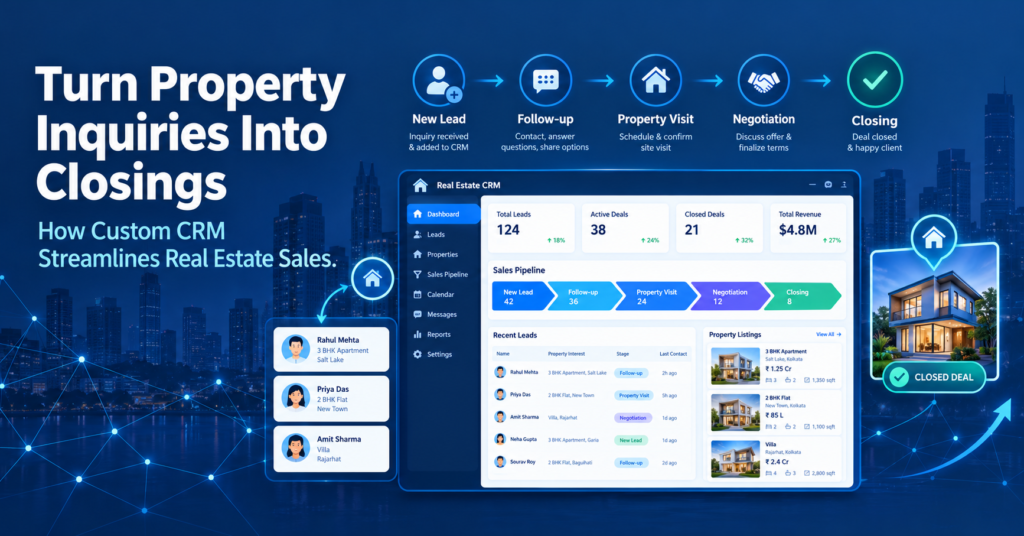
Most agencies don’t lose deals at the negotiation table. They lose them in the 72 hours after the first phone call — buried under spreadsheets, forgotten WhatsApp threads, site visits nobody logged. Custom CRM software for real estate exists to fix that specific window. Not by adding another dashboard. By rebuilding the actual sequence of how a lead turns into a buyer. Four points in that sequence break down more than any others. Here’s where, and why.
The Inquiry Black Hole — Where Real Estate Leads Actually Die
A 35-agent brokerage runs three WhatsApp Business numbers, a Facebook lead form, a property portal feed, and a paper visitor register at the sample flat. Five channels. Zero single intake point. A buyer messages about a 3BHK on Instagram Thursday evening. The social media intern screenshots it into a sales group chat. By Monday nobody remembers whose lead it was, and the buyer has already toured two other projects.
This isn’t an agent-discipline problem. Training doesn’t fix it. When inquiries land in five disconnected places, follow-up collapses no matter how motivated the team is — response-time data across the industry shows conversion odds fall sharply after the first hour, and most brokerages don’t call back inside that window at all.
So the fix isn’t “respond faster.” It’s removing the fragmentation that makes slow response inevitable. Every channel — portal leads, social forms, walk-ins, referral calls — needs to land in one record, timestamped, auto-assigned. No forwarding. No notepad. No group chat triage. Custom CRM software for real estate earns its cost right here: generic contact tools weren’t built for five-channel intake, so teams bolt on integrations that break within a quarter. A system designed around the actual channel mix just holds up.
Site Visits, Follow-Ups, and the Cost of Manual Scheduling
Two agents at a 400-unit township book the same 4 PM slot. Same show flat. Competing clients. One buyer arrives to find a stranger already touring “their” unit, and the deal doesn’t die loudly — it just goes quiet over the following week.
Double-booking is a symptom, not the disease. Scheduling, unit inventory, and agent calendars usually sit in three tools that never talk to each other: a booking sheet, an Excel inventory tracker, personal phone calendars. Multiply that across 14 field agents and dozens of daily visits. Collisions stop being occasional and become statistical certainty.
Generic scheduling plugins rarely fix this, because real estate inventory carries conditions those tools never modeled. A unit can be on hold for 24 hours pending token payment. Reserved-but-unconfirmed. Released automatically if payment lapses. Building scheduling logic around these real states — not generic calendar slots — is what custom CRM development actually means in this context. Lock the unit on booking. Release it automatically on expiry. Let agents see live availability instead of guessing, and let the post-visit follow-up sequence — feedback capture, next-step reminder, re-engagement if the client cools — fire on its own.
Negotiation, Documentation, and Approval Bottlenecks
Three calls into a ₹1.2 crore resale negotiation, the buyer asks for a 2% discount. The broker’s manager is traveling; the discount-approval sheet only lives on the office desktop. The buyer’s KYC documents sit in someone’s personal inbox. The negotiated price exists nowhere but a WhatsApp thread.
Deals stall here constantly, and price disagreement is rarely the actual cause. The cause is documentation and approval authority sitting in places nobody can reach at the moment it’s needed. A manager stuck in traffic shouldn’t be the reason a buyer’s enthusiasm cools by evening — but it happens every week, in every mid-sized agency running this way.
Custom CRM software for real estate collapses this into one deal-stage workflow. Documents attach directly to the lead record. Price negotiations log with timestamps. Approval requests route to whoever holds authority, reachable from a phone rather than a desktop login. Mobile-first approval routing isn’t a convenience add-on — it’s the line between a deal closing this week and one cooling while someone waits for office hours. Several PropTech vendors building for this sector, Arobit among them, have focused specifically on closing that mobile-approval gap, since real estate decision-makers are rarely sitting at a desk when the approval is actually needed.
Post-Sale Handover and Referral Leakage
The deal closes. Registration happens. Then, in most agencies, someone manually copies the buyer’s record into a separate spreadsheet for the possession team. Sales history doesn’t travel with it — what objections came up, what the buyer actually cared about, who built the relationship.
Six months pass. That buyer refers two colleagues. The referral call lands on the generic inquiry line, gets treated as a cold lead, gets assigned to whoever’s next in rotation — not the agent who earned the trust in the first place. The agency pays acquisition cost twice for a client it already owned once.
That’s a data architecture failure, not a service failure. Fixing it requires custom CRM development that keeps one continuous record per client across acquisition, sale, possession, and referral — instead of siloed systems each owning a separate slice of the lifecycle. A referral should be recognized on arrival and routed straight back to the original agent. Closed-loop data isn’t a reporting nicety here. It’s the mechanism that turns one sale into three.
Where This Is Already Happening: A Market Signal
This shift — from generic lead trackers toward systems built around real estate’s actual sales sequence — isn’t theoretical anymore. Several PropTech vendors have moved into this exact space over recent years, building CRM platforms around site-visit logic, inventory states, and mobile approval chains instead of retrofitting horizontal sales software. Arobit is one name in this emerging group, focused specifically on real estate CRM and sales-management tooling. Its presence reflects something broader: real estate’s sales cycle carries enough unique friction — physical inventory, multi-stakeholder approvals, long consideration windows — that generic CRM platforms keep underperforming without heavy customization underneath.
FAQs
- How is custom CRM software for real estate different from a generic sales CRM?
Generic CRMs track contacts and deal stages. Real estate needs more — physical inventory states, site-visit scheduling, document-heavy negotiations, multi-party approvals. A horizontal CRM usually can’t model that without fragile, constant customization layered on top.
- Is custom CRM development worth it for a small brokerage, or only large developers?
Scale matters less than channel complexity. A 10-agent brokerage juggling five inquiry sources faces the same leakage risk as a large developer, just at lower volume. The real ROI question is how much lead leakage is already costing, not headcount.
- How long does implementing a custom real estate CRM usually take?
Timelines vary with scope, but core modules — lead capture, site-visit scheduling, deal-stage tracking — typically launch in phases. Teams adopt gradually rather than retraining on everything at once.
- Can a custom CRM integrate with property portals and WhatsApp Business?
Yes — most builds handle that integration as standard. The harder question isn’t connectivity. It’s whether the CRM actually de-duplicates and routes those leads intelligently, instead of just piping them in raw.