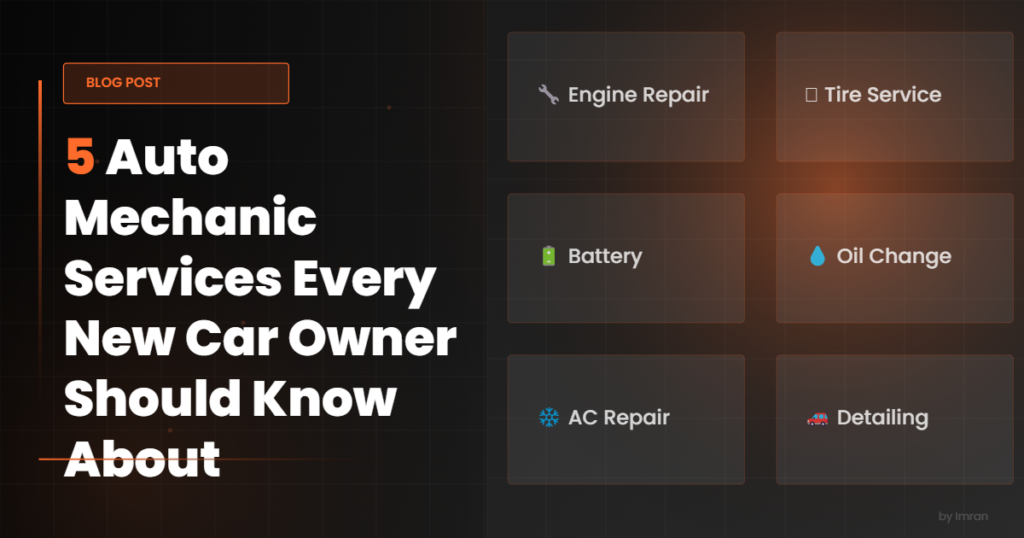
Getting a new car feels great. Until the first warning light shows up and you realize you have no idea what you’re looking at.
Most new owners know the basics — fill the gas, check the tires. But there’s a whole layer of mechanical upkeep that dealerships gloss over and YouTube only partially explains. Miss it, and the car that felt bulletproof at 10,000 miles starts costing you money by 40,000.
These five services won’t make you a mechanic. But they’ll keep you from being the person who finds out about a problem after it’s already expensive.
- Oil Changes and Fluid Checks
This one’s obvious. And yet, people still push it. The thing about oil is that it doesn’t fail loudly. It just quietly stops doing its job — lubricating, cooling, protecting — until metal starts grinding against metal and the damage is done.
But it’s not just the oil. Coolant, brake fluid, transmission fluid — they all break down over time. A good shop checks these during routine visits. A great shop tells you what they found without waiting for you to ask.
New car owners especially tend to assume the factory fill is good indefinitely. It’s not. Miss a few cycles and you’re looking at repair costs that dwarf whatever you saved by skipping the appointment.
- Brake Service (the Full Version, Not Just Pads)
Here’s what most people don’t know: by the time brakes start grinding, the rotors are often already worn past the point of just replacing pads. You’re now replacing pads and rotors. Sometimes calipers too.
Real brake service goes deeper. Inspect the rotors for warping. Test the hydraulic lines. Check caliper function. Look at the brake fluid — because old fluid absorbs moisture and loses stopping power in ways you won’t notice until you really need those brakes.
Shocks and struts play into this too. Worn suspension extends your stopping distance even when the brake hardware itself is fine.
If you’re Googling mechanical repair services near me and a shop quotes you pads without mentioning any of the above — ask. A shop that skips the inspection isn’t saving you money. It’s deferring the bill.
- Tire Rotation, Balancing, and Alignment
Front tires and rear tires wear at different rates. That’s just physics. Left unrotated, your tires wear unevenly, your grip suffers, and you’re buying a new set way earlier than the mileage should call for.
Rotation is straightforward. Balancing is about weight distribution across the tire-wheel assembly — skip it and you’ll feel vibration before you see the tread damage. Alignment is about the angle your tires sit at relative to the road. Hit one bad pothole in New York and you can knock a car out of alignment. It’s that easy.
The signs aren’t dramatic. A slight pull to one side. A steering wheel that sits off-center on a straight road. Easy to dismiss. Expensive to ignore for too long.
- Engine Diagnostics and Electrical Repairs
Modern cars are computers on wheels. The ECU alone manages fuel delivery, ignition timing, and emissions — all at once. When something goes wrong, you get a check engine light. Which is helpful in the sense that it tells you something is wrong, and unhelpful in that it tells you nothing else.
Proper diagnostics means reading fault codes alongside live sensor data. Not just clearing the light and hoping for the best. Electrical faults — bad sensors, wiring issues, calibration drift — tend to compound if ignored. And they don’t fix themselves.
Worth asking any shop you’re considering: what scanner do you run? People searching for mechanical repair services in New York specifically should know that generic OBD scanners miss manufacturer-specific codes. A misread code means a wrong diagnosis. And that wastes both time and money.
- Cooling System and A/C Service
The cooling system is one of those things that works until it doesn’t. And when it stops working, you’re usually on the side of a road watching steam come out from under the hood.
The system isn’t complicated in theory — radiator, water pump, thermostat, hoses. But any one of those parts can fail quietly. Coolant breaks down and needs flushing. Hoses crack with age. The water pump is a wear item, not a permanent one.
The same logic applies to the A/C. Refrigerant levels drop slowly. Compressor wear builds up over seasons. Most people don’t notice until summer hits and the air coming out is lukewarm. Getting it checked once a year is genuinely cheap. Fixing a failed compressor is not.
The New York Factor
This city is hard on cars. Potholes, brutal winters, stop-and-go traffic, road salt — it all adds up faster than the national averages the manufacturer’s maintenance schedule is built around. Service intervals that make sense in mild climates often need shortening here.
Drivers who treat maintenance as optional spend a lot of money fixing things that didn’t need to break. That’s just the reality of owning a vehicle in this state.
Why Spectrum Auto Inc. Is Worth Knowing About
Spectrum Auto Inc. has been running shops across New York for over 30 years. West Nyack, Montrose, and several other locations across the region. The technicians are I-CAR Platinum certified, the facility carries I-CAR Gold Class status, and they work to OEM specs across makes and models — domestic, European, and Asian vehicles alike.
What actually stands out is the track record. Over 1,000 five-star Google reviews and more than 1,180 verified Carwise ratings don’t happen by accident. The shop handles everything from routine oil changes to engine diagnostics to full collision repair, and they’re direct about pricing before work starts.
For anyone looking for reliable mechanical repair services in New York, Spectrum Auto is the kind of shop that earns repeat business — not just a one-time fix.
FAQs
How often should a new car owner actually get a checkup?
Every 5,000 to 7,500 miles for oil, depending on your vehicle. But a broader inspection covering brakes, tires, and fluids? At least once or twice a year — more if you’re logging serious highway miles or dealing with tough city driving.
Does the check engine light always mean something major?
Not always. Could be a loose gas cap. Could be a failing catalytic converter. There’s no way to know without a proper diagnostic scan. The mistake is waiting, because small issues under that light have a way of becoming bigger ones.
Do AWD vehicles still need tire rotations?
Yes — arguably more than two-wheel drive vehicles. Uneven tire wear on an AWD car puts strain on the drivetrain components. Differentials aren’t cheap to replace. Rotations are.
What’s the actual difference between balancing and alignment?
Balancing corrects uneven weight in the tire-wheel assembly. Alignment adjusts the angle your tires sit at relative to the road. They’re different fixes for different problems. If a shop recommends both without explaining why, ask them to show you the measurements.