Water is essential for life, but not all water is clean or safe to use. Many natural and man-made water sources contain impurities such as salts, bacteria, chemicals, heavy metals, and other harmful substances. These contaminants can affect human health, damage equipment, and reduce the quality of life.
In regions like the Gulf, the situation is even more challenging. Most of the available water is either seawater or underground water with high salt content. This makes it unsuitable for drinking or industrial use without proper treatment. Because of this, advanced water purification technologies are required to make water usable.
Reverse Osmosis (RO) is one of the most effective and widely used water treatment technologies in the world. It is capable of removing even the smallest impurities from water, making it extremely pure. This is why RO is used not only in homes but also in industries, hospitals, laboratories, and large-scale desalination plants.
Companies like Gulf Water Treatment use Reverse Osmosis technology to provide reliable and high-quality water solutions across the region. Their systems are designed to handle different types of water sources and deliver safe, clean water for various needs.
What is Reverse Osmosis? (In-Depth Explanation)
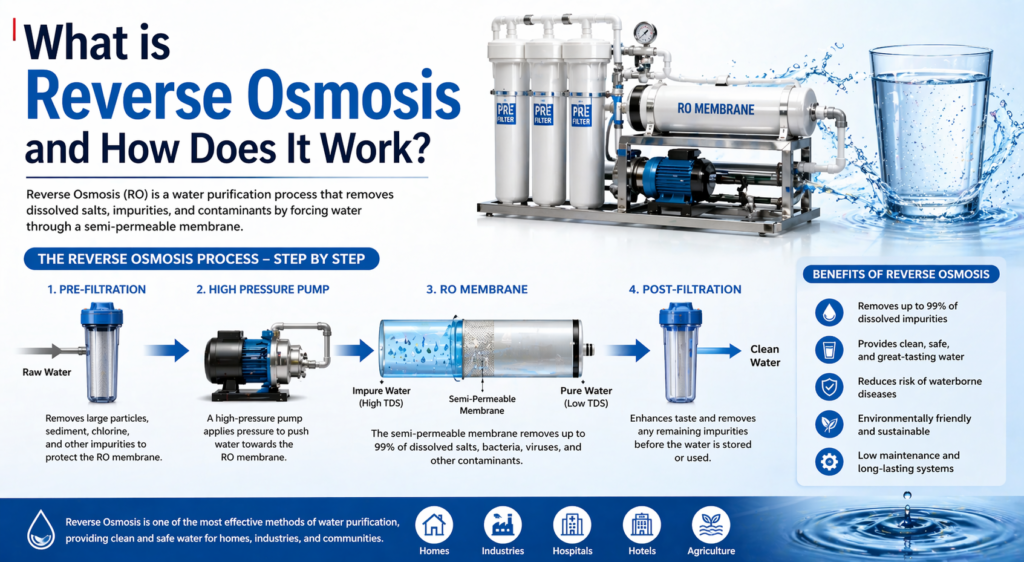
Reverse Osmosis is a pressure-driven membrane filtration process used to remove dissolved salts, impurities, and contaminants from water. It works by forcing water through a very fine membrane that allows only pure water molecules to pass through while blocking unwanted substances.
The key component in this process is the semi-permeable membrane. This membrane has extremely tiny pores that are so small they can block:
- Dissolved salts (like sodium and chloride)
- Harmful microorganisms (bacteria and viruses)
- Organic chemicals
- Heavy metals such as lead, arsenic, and mercury
What makes Reverse Osmosis different from basic filtration systems is its ability to remove dissolved impurities, not just visible particles. For example, sand can be removed by simple filters, but dissolved salt cannot. RO solves this problem.
Another important point is that Reverse Osmosis does not rely on chemicals to purify water. Instead, it uses physical pressure and membrane separation, making it a cleaner and more controlled process.
Because of its high efficiency, RO can remove up to 95–99% of total dissolved solids (TDS) from water. This makes it one of the most reliable methods for producing high-quality drinking water and industrial-grade water.
Understanding the Science Behind Reverse Osmosis
To fully understand Reverse Osmosis, it is important to first understand the natural process called osmosis, and then see how RO reverses it.
What is Osmosis? (Natural Process Explained)
Osmosis is a natural movement of water across a semi-permeable membrane. In this process:
- Water moves from an area of low concentration (clean water)
- To an area of high concentration (salty or contaminated water)
This happens without any external force. The goal of this natural movement is to balance the concentration on both sides of the membrane.
For example, if you have a container divided by a membrane:
- One side has clean water
- The other side has salty water
Water will naturally move toward the salty side to dilute it.
What is Reverse Osmosis? (Opposite Process)
Reverse Osmosis does the exact opposite of this natural process.
Instead of letting water move naturally, external pressure is applied to the contaminated or salty water. This pressure forces water:
- From the high concentration side
- Through the membrane
- Into the low concentration (clean water) side
The membrane blocks salts and impurities, allowing only pure water to pass.
This is why it is called “reverse” osmosis—because it reverses the natural flow of water.
Why Pressure is Important
The pressure applied must be strong enough to overcome natural osmotic pressure. The level of pressure depends on the type of water:
- Seawater requires very high pressure
- Brackish water requires moderate pressure
- Freshwater requires lower pressure
Without sufficient pressure, water will not pass through the membrane effectively.
How Does Reverse Osmosis Work? (Step-by-Step Detailed Process)
Reverse Osmosis systems are designed in multiple stages to ensure maximum efficiency and long life of the membrane.
Step 1: Pre-Treatment (System Protection Stage)
Before water reaches the RO membrane, it must be properly prepared. Raw water often contains:
- Sand and dirt
- Chlorine
- Organic matter
- Suspended solids
If these are not removed, they can damage or block the membrane.
Pre-treatment usually includes:
- Sediment filters to remove particles
- Carbon filters to remove chlorine and chemicals
- Chemical dosing (in large plants) to control scaling
This stage is extremely important because it protects the expensive RO membrane and improves overall system performance.
Step 2: High-Pressure Pumping (Driving Force)
Once the water is pre-treated, it is pushed through a high-pressure pump.
The purpose of this pump is to:
- Create enough force to push water through the membrane
- Overcome osmotic pressure
- Maintain a steady flow rate
The pressure level varies:
- 150–300 psi for brackish water
- 800–1200 psi for seawater
This step is the “engine” of the RO system.
Step 3: Membrane Separation (Core Process)
This is the most critical part of the system.
The RO membrane acts like a barrier with microscopic pores. When water is forced through:
- Pure water molecules pass through
- Salts, bacteria, and impurities are rejected
The output is divided into two streams:
- Permeate (clean water)
- Reject (concentrated waste water)
The efficiency of this stage depends on:
- Membrane quality
- Pressure applied
- Water temperature
- Level of contamination
Step 4: Post-Treatment (Water Quality Improvement)
After passing through the membrane, the water is very pure, but it may need adjustment.
Post-treatment may include:
- Adding minerals for taste
- Adjusting pH levels
- Final filtration for polishing
This ensures the water is not only safe but also pleasant to drink.
Step 5: Storage and Distribution
The treated water is stored in tanks and supplied for use.
In large systems, storage ensures:
- Continuous supply
- Pressure stability
- Backup during maintenance
Types of Reverse Osmosis Systems
Reverse Osmosis systems are designed based on the type of water source. The two most important types are:
1. Seawater Reverse Osmosis (SWRO)
Overview and Importance
Seawater Reverse Osmosis is used to treat ocean water, which contains very high levels of salt (around 35,000 ppm). This makes it completely unsuitable for drinking or most industrial uses without treatment.
SWRO is especially important in coastal regions and Gulf countries, where seawater is the most available resource.
Detailed Working Process
The process begins with seawater intake, followed by heavy pre-treatment to remove:
- Sand
- Algae
- Organic matter
Then, very high pressure is applied to push water through specially designed membranes that can handle high salinity.
The result is fresh water suitable for drinking and use.
Key Technical Features
- High-pressure requirement (up to 1200 psi)
- Special anti-corrosion materials
- Advanced membrane design
- Energy recovery systems to reduce cost
Applications
- Municipal water supply
- Large desalination plants
- Industrial water production
Companies like Gulf Water Treatment use SWRO systems to convert seawater into clean drinking water in the Gulf region.
2. Brackish Water Reverse Osmosis (BWRO)
What is Brackish Water?
Brackish water reverse osmosis has moderate salinity, typically found in:
- Underground wells
- Lakes
- Mixed freshwater sources
It contains less salt than seawater but still needs treatment.
Detailed Working Process
The process is similar to SWRO but simpler:
- Lower pre-treatment requirements
- Lower pressure needed
- Standard membranes used
Because of lower salinity, the system is more efficient and cost-effective.
Key Technical Features
- Lower operating pressure (150–300 psi)
- Lower energy consumption
- Higher recovery rate (more clean water, less waste)
Applications
- Agriculture
- Industrial processes
- Small communities
Benefits of Reverse Osmosis (Detailed View)
Reverse Osmosis offers several strong advantages:
High Purification Efficiency
Removes up to 99% of dissolved impurities, making water extremely clean.
Chemical-Free Process
Does not rely heavily on chemicals, making it safer and environmentally friendly.
Versatility
Can treat different types of water, including seawater and brackish water.
Consistent Water Quality
Produces reliable and uniform water quality regardless of input conditions.
Challenges of Reverse Osmosis
Despite its advantages, RO has some limitations:
Energy Consumption
High-pressure pumps require electricity, especially in seawater systems.
Water Rejection
Some water is wasted as reject stream, which must be managed properly.
Membrane Maintenance
Membranes can get fouled and need cleaning or replacement.
Role of Gulf Water Treatment in Reverse Osmosis
Gulf Water Treatment provides advanced Reverse Osmosis solutions tailored to the needs of the Gulf region.
Their services include:
- Designing RO systems for different water sources
- Installing seawater and brackish water plants
- Providing maintenance and technical support
- Offering customized solutions for industries and homes
Their expertise ensures efficient water treatment, reduced costs, and long-term reliability.
Conclusion
Reverse Osmosis is one of the most powerful and reliable water purification technologies available today. It works by using pressure and advanced membranes to remove impurities and produce clean, safe water.
With different systems like Seawater RO and Brackish Water RO, it can handle a wide range of water sources. This makes it especially valuable in regions like the Gulf, where natural freshwater is limited.
By using advanced RO systems, companies like Gulf Water Treatment are helping ensure a sustainable and secure water future.