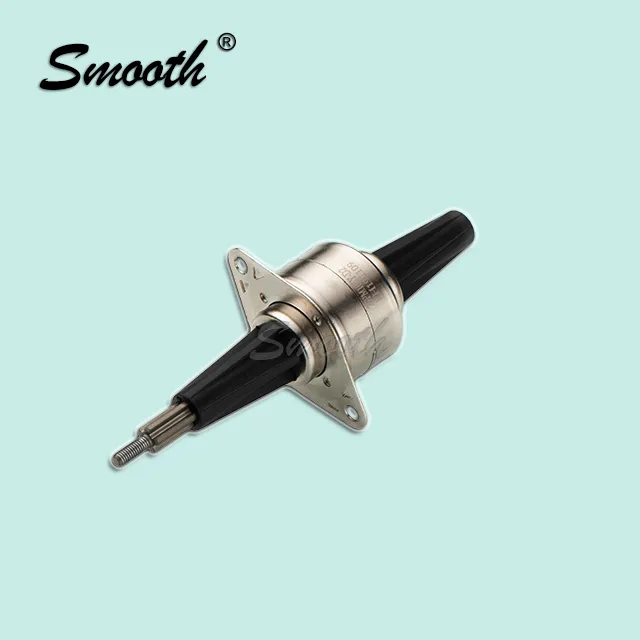
Choosing the right motion component often comes down to a simple question: does the application need raw speed, or does it need control? For decades, brushed DC motors were the default answer for basic linear motion because they were cheap and easy to source. But as tolerances have tightened across nearly every industry, more engineers are switching to stepper motor actuators for the level of predictability that DC motors simply cannot match on their own. This shift reflects a broader trend across manufacturing and product design, where the true cost of a component now includes not just its purchase price but the engineering effort required to make it behave reliably once installed. This shift is visible across nearly every sector that once relied on simple DC drives by default.
The Core Difference in Motion Control
A DC motor spins continuously once voltage is applied, and stopping it at a precise point usually requires additional sensors, encoders, or braking hardware bolted onto the system. Stepper-based actuators, by contrast, move in fixed increments and hold position naturally once power is removed from the coil sequence. This built-in positional awareness is a fundamental advantage that changes how engineers design the rest of the control system around it. Rather than treating positioning as a separate problem to be solved with additional hardware, the motion component itself becomes the source of truth for location, simplifying everything downstream from wiring to software logic. This distinction also affects how quickly a design can move from concept to working prototype, since fewer supporting components generally means fewer integration variables to debug along the way.
Repeatability Without Extra Feedback Hardware
One of the biggest cost savings comes from not needing a separate encoder just to know where the actuator is. Because each step is a known, fixed distance, the controller can track position simply by counting pulses sent. DC motor systems chasing the same repeatability usually need closed-loop feedback, which adds parts, wiring, and points of potential failure to an otherwise simple mechanism. Over the life of a product, eliminating even one component category, along with its associated wiring harness and calibration procedure, can meaningfully reduce both manufacturing cost and the number of things that can go wrong in the field. Fewer components also mean a smaller bill of materials to manage, which simplifies sourcing and reduces the number of suppliers a purchasing department has to coordinate with over the life of a product.
Holding Torque at a Standstill
A DC motor at rest typically has little to no resistance to being pushed out of position unless a brake is added. A stepper motor actuator, however, naturally resists movement when energized and stationary, holding load in place without drifting. This matters in applications like vertical lifts, clamps, or valve positioning, where an unintended slip could damage a part or create a safety issue. This natural holding behavior also simplifies fail-safe design considerations, since engineers can rely on the motor’s inherent characteristics rather than layering in additional mechanical locks or braking mechanisms purely to maintain position. This natural holding behavior is particularly valuable in fail-safe scenarios, where a power interruption should not result in a load shifting or a mechanism drifting out of its safe operating position.
Lower Long-Term Maintenance Demands
DC motors that rely on brushes wear down over time as the brushes make physical contact with the commutator, eventually requiring replacement. Many stepper actuator designs avoid this wear point entirely, extending the practical service life of the unit and reducing the frequency of maintenance visits on production equipment that runs continuously. Facilities that track maintenance records often find that swapping brushed components for a stepper-based equivalent noticeably reduces the frequency of unplanned service calls tied specifically to motor wear, freeing up maintenance staff to focus on other equipment. Reduced downtime tied to brush replacement also means production schedules can be planned with fewer built-in contingencies for unexpected motor service, freeing up both budget and staff time for other priorities.
Making the Switch Without a Full Redesign
Engineers hesitant to overhaul an entire system will be glad to know that swapping a DC motor for a comparable stepper unit rarely requires redesigning the whole mechanical assembly. Most stepper actuators are built with standard mounting patterns and shaft configurations that mirror common DC motor footprints, making the transition far less disruptive than it sounds. For teams weighing whether the upgrade is worth it, the gains in accuracy and reduced maintenance overhead tend to pay for themselves within the first few production cycles, especially in applications where positioning errors have historically caused rework or downtime. This ease of substitution has encouraged many facilities to pilot the change on a single machine first, building internal confidence before rolling the same upgrade out across an entire production line.