A few years back, the blog was only a digital collection of information on a website. Currently, a collection of random information on the website only creates noise, rather than ranking. Topical authority occurs when you structure content in depth rather than stuffing only the keywords.
If your blogging lacks payoff, look to your structure because what ranks are the comprehensive ecosystem that supports your keywords. Continue reading the article to know more about it.
What is Topical Authority, and Why Does It Matter?
Topical authority refers to your website’s expertise and credibility on a specific subject. By consistently publishing high-quality content around your core business topics, you build the credibility needed to earn audience trust, gain rankings, and drive more conversions.
Topical authority is achieved by comprehensively covering an entire subject rather than targeting isolated keywords. When search engines like Google analyse the depth of your content using semantic associations, they recognise your site as an expert resource and reward it with higher visibility. This is why professional blog writing services focus on creating in-depth, interconnected content that demonstrates expertise across a topic. This approach is widely adopted by content marketing companies such as Das Writing Services Pvt. Ltd. to build long-term search visibility and industry authority.
By building topical authority, you:
- Enhance Credibility: Establish deep trust and long-term loyalty among readers who look to you for reliable guidance.
- Higher Visibility: This builds strong topical authority, which signals search engines to rank the website on Google’s first page for relevant queries.
- Solve Real-World Problems: Systematically address the complex, practical challenges your audience faces.
What is the Importance of Blogs in Building Topical Authority?
If you want topical authority, blogging remains the most effective because it not only helps to publish more but also allows you to answer the questions your audience has. A blog gives you room to move past surface-level headlines and explore the edges of a subject. This is why many businesses invest in professional website content writing services to create comprehensive, audience-focused content that builds authority over time.
For example, a fitness brand writing an article on “How to Run a Marathon” is not enough to build authority. Authority is built by publishing highly engaging content that your audience needs, such as “Heart rate training for beginner runners.” When you build content this way, your blog stops looking like a generic marketing channel and looks more like a solution the reader needs.
This comprehensive approach proves that your site doesn’t contain random keywords, but rather the subject covers the required, intentional, updated expertise.
How Does Blog Content Contribute To Long-Term Relevance in Topical Authority?
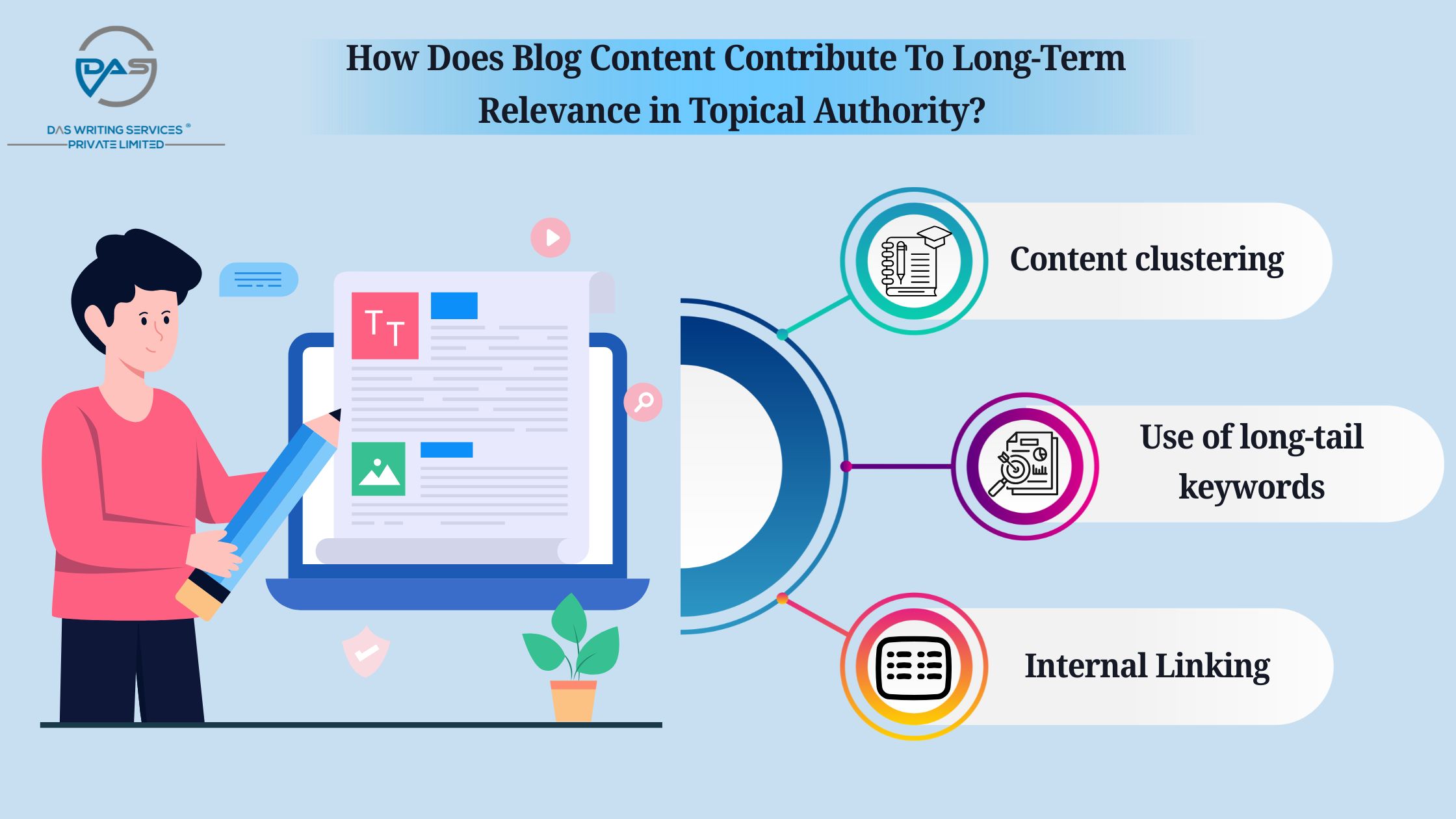
A single blog post won’t change your traffic, but continuous, structured content creates a powerful compounding effect. When you continuously publish content with examples, rich information, and deeper insights, you naturally produce highly engaging content that keeps readers hooked on the page for a long time. This is a strategy followed by content marketing companies such as Das Writing Services Pvt. Ltd. to help brands build long-term visibility and authority.
You can use the following tips to create authoritative content for long – term relevance in topical authority in the following ways:
- Content clustering:
To establish robust topical authority, you need a clear, organised structure. Start with a comprehensive pillar page, then link it to specific, hyper-focused subtopic articles. This clear mapping proves your topical depth and helps search engines crawl and index your content more efficiently.
- Use of long-tail keywords:
By exploring the depth of a main topic, blog posts naturally target highly specific long-tail keywords. Capturing this targeted traffic proves to search engines you possess deep, comprehensive expertise across the entire subject matter, rather than a single keyword. Similarly, professional article writing services help businesses create detailed, topic-focused content that strengthens authority and search visibility.
- Internal Linking:
Strategically placing internal links within your blog posts passes authority (PageRank) from deep-dive articles directly to your core product or service pages. This boosts your search visibility and engagement while guiding users deeper into your website.
How Does the Consistency of Blogs Help in SEO Ranking?
Random blogging makes it difficult for search engines to recognise your intent. There is no sense if the topic is required for the site. Consistency changes it. Even two well-structured, researched content and topic-related posts a month can build a powerful momentum that keeps your site active. Beyond the SEO content marketing and ranking benefits, a consistent pace builds a predictable data loop.
Tools like Google Search Console become practical feedback mechanisms, showing you which topics are pulling impressions and which questions remain unanswered. This loop of publishing, observing, and refining elevates a blog to an authoritative resource.
Final Words:
Google has shifted from keyword matching to topic modeling, allowing smaller websites to compete with industry giants by proving deep expertise. By mapping core topics and building structured content clusters, you sharpen your search signal. This approach can also support related efforts such as social media marketing services by creating consistent, authoritative content across channels. Topical authority helps you earn audience trust, sustain organic traffic, and secure long-term rankings.