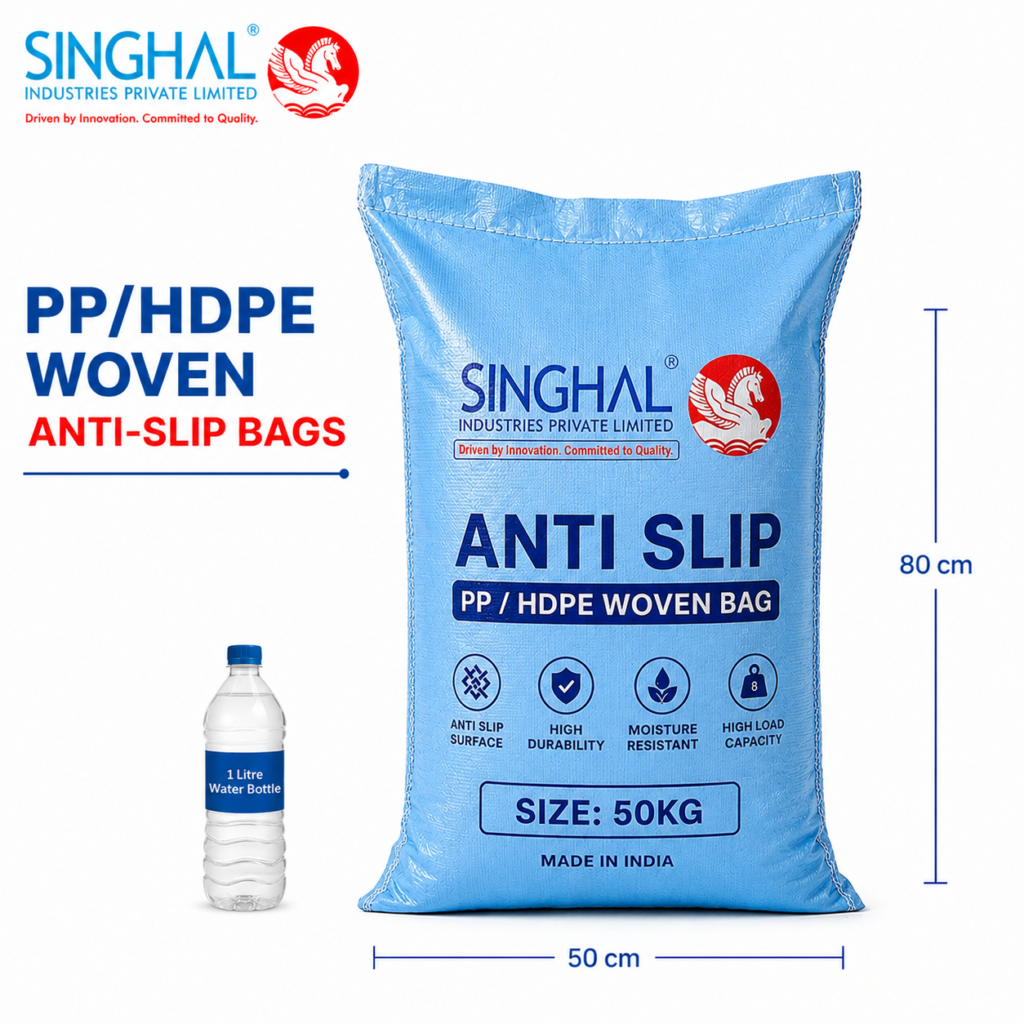
All day, pallets of bagged goods being unloaded, stacked and shuffled in warehouses, trucks, ships, and storage yards. Regular smooth plastic bags can easily slide on top of one another, particularly if they are stacked several layers high or under heavy breaking forces from the truck. This slippage can make entire pallets lean, shift, or even collapse; resulting in only ruined products, but injuries to workers and a rejected shipment. To tackle this issue PP HDPE Woven Anti Slip Bags are designed using material that makes the outer surface of the bag high friction. This anti-slip texture which is typically generated either by specific weaving patterns, embossed surfaces and/or surface treatments assist bags nearby in “interlocking,” which substantially enhances the stability of a stack during transportation or storage. The idea is pretty simple, but the effect on safety and loss prevention can be greater. Do these bags fix all our palletizing woes? No. Bad stowing and bad strapping will continue to create problems. However, anti-slip bags do make a strong pallet even stronger.
Material Combination Balancing in Strength and Flexibility
Typically a mix of polypropylene (PP) and high-density polyethylene, the bags demonstrate low stiffness and high strength and impact resistance. PP is known for its high tensile strength and good chemical resistance whereas HDPE contributes toughness, puncture resistance, and improved low-temperature performance. This results in a fabric that is woven heavy enough carry heavier objects, usually 25kg, 50kg or maybe more with out shredding but still soft enough to be easy to hand and sew together. More importantly, this anti-slip surface was designed into the fabric by textured tapes, zigzag weaving patterns or controlled surface roughness. The bags grip each other under stack pressure but are able to slide freely along conveyor belts and filling lines. This is a fine line: too little friction and the pallets slide; too much and the automated systems can jam. High-quality manufacturers adjust the coefficient of friction to accommodate standard logistic equipment.
More safety, more stack stability and greater damage
So obviously, anti slip bags have their major advantages when it comes to safety and minimization of product damage. When bags hold onto one another instead of sliding, pallets become stable under acceleration and deceleration during road or port turns. This minimizes the chances of crashing stacks, dropping loads and accidents at work. This also leads to fewer ruptures of bags and consequently spillage of cement, fertilizer or food grains which cost a lot. Stable stacking allows higher, tighter, and more organized pallets in warehouses which helps to optimize storage space while significantly reducing the overreliance on excessive strapping or shrink wrap. For exporters this can mean reduced claims, lower insurance cost and happy customers. The bags do not replace the need for good palletizing practices, they make it easier and more forgiving.
Applications in Agriculture, Construction and Chemicals
The PP HDPE woven anti-slip bags this type of bag is used in a large number of industries where bulks dry goods are packed and shipped. In agriculture, we deal with seeds, grains, animal feeds and fertilizers where it is imperative that they remain stable during humid or variegated environmental conditions. They are used in construction applications such as cement, gypsum, tile adhesives, dry-mix mortars sand additives where rough handling or exposure to the elements in storage can occur. It is used by chemical and mineral processors for industrial salts, soda ash, polymer granules where load stability and containment are important. Food-processing firms are likewise using anti-slip bags for sugar, flour and various other dry active ingredients to boost their stockroom business as well as decrease losses due to handling troubles. Consequently, the only significant difference across vastly different usage scenarios—rural grain depots to urban building-material suppliers and chemical plants—is the basic bag design itself.
Moisture Resistance, Durability, and Reusability
Similar to other woven polyolefin bags, those in an anti-slip style derive decent moisture and chemical resistance from PP and HDPE. They do not absorb moisture and especially rot and mildew, which is incredibly important for items that may be stored in moist warehouses or get wet while being loaded with rain. The woven structure is tear- and abrasion-resistant, enabling the bags to endure repeated handling cycles. Many consumers claim that anti-slip bags can be reused for secondary storage or other uses before recycling as long as they remain intact and clean. This reusability, together with their natural strength, enables them to be more economical in the long term even though they may command a higher unit price compared to standard smooth bags. However, no material is unbreakable: sharp metal edges, strong UV exposure and inappropriate stacking can still lead to damage. The right handling and storage is still a must.
Choosing the Proper Selection and Surface Texture
Selecting the right specification is as critical pre-requisite as anti-slip selection. Some of the key parameters include dimensions, capacity ( e.g. in kg or litres), fabric weight, (GSM), weave density, seam type and anti slip treatment. Products with a heavier, denser, or sharper characteristic typically require higher GSM to provide more durability and when necessary, product seams also need to be stronger. With regard to the anti-slip surface: Depending on whether there is a fully automated or semi-automated line and warehouse, the coefficient of friction should be adapted with action against jams or used for maximum grip hand in-hand (manual warehouses). To help, inquire whether the bags are constructed with virgin PP/HDPE, recycled content or a portion of both and ascertain if that is appropriate to your application. Ask for samples and test them in your chosen specifications: tensile strength, seam burst, drop resistance and stacking stability with your finished product and also your pallet configuration. Test it out on your filling and palletizing equipment before going for bulk order.
Partnering with Quality PP HDPE Woven Anti Slip Bags
Quality varies across suppliers. A reliable PP HDPE Woven Anti Slip Bags Manufacturer will clearly mention fabric GSM, tape width, foundation weave pattern, anti-slip treatment used for bags, seam type and the safe working load. Inquire about tensile strength, elongation, stacking friction and drop resistance test data. Bag size, weight and surface texture need to be consistent: otherwise, they can cause jams on automated lines or unstable pallets. Price is not the only consideration, but it is a factor. A low-priced bag that either slips or rips during transport can incur costs many times higher through product loss and complaints from customers. Singhal Industries Pvt Ltd manufactures woven sacks for all industries including cement, fertilizer and other products in bulk under the name of PP HDPE Woven Anti Slip Bags in multiple of company materials and promotional content. When ordered in bulk however, before a huge order is placed buyers verified that current specifications and testing data; as well as delivery terms, are arranged with the company directly.
Conclusion
PP HDPE woven anti-slip bags provide an ideal solution for enhancing the stability, safety of bulk packaging and for mitigating against damage. When combined with high-friction engineered surfaces, PP and HDPE contribute the optimal strength to weight ratio as well as moisture barrier capabilities, keeping bag slippage at a minimum during transport/storage. Resulting in less collapsed pallets, less product loss and safer warehouses and transports. Applications range from agriculture to construction, from chemicals to food processing as well as logistics — basically whenever dry bulk is packed and shipped somewhere. It all hinges on specifying the correct power level for the product, ensuring samples perform well under realistic test conditions and selecting a reputable manufacturer. By choosing the right bag for their application, and employing the appropriate handling method, these bags can provide significant benefits to your bulk handling operations.
Frequently Asked Questions
Q1. What is the main advantage of PP HDPE woven anti-slip bags over standard woven bags?
The anti-slip surface enhances the friction between two stacked bags improving pallet stability and preventing unwanted slippage, collapse and subsequent product damage during transport and storage.
Q2. Which industries commonly use anti-slip bags?
Millions of units are employed in agriculture (grains, feed, fertilizer), construction (cement, adhesives, mortars), chemicals and minerals (salts, polymers), food processing (sugar, flour) sector and reliable bulk logistics.
Q3. Are anti-slip bags suitable for automated filling and palletizing lines?
YES, with a well-tuned coefficient of friction. Anti-slip surfaces are designed by reputable manufacturers to grip under stack pressure while still ensuring they move freely on conveyor and robotic palletizers.
Q4. Can we reuse and recycle it?
Most PP HDPE anti-slip bags are reusable for storage or secondary purposes if they do not have a definite structural deterioration. They can also be collected at end of life and recycled into plastic granules where facilities exist.
Q5. Who is the largest Exporter of PP HDPE Woven Anti Slip Bags?
the largest exports companies in the world. Manufacturer and Supplier of PP HDPE Woven Anti-Slip Bags for Cement, Fertilizer & Industrial use Singhal Industries Pvt Ltd; Buyers must compare specifications along with testing data and delivery terms before ordering.