Microencapsulation vs. Liposomal Delivery: A Formulator's Decision Guide
The choice between microencapsulation and liposomal delivery is one of the most consequential decisions a product developer makes — and one of the least discussed with the rigour it deserves. Both technologies protect actives, both improve stability, and both appear on specification sheets dressed in reassuring technical language. The differences, however, run deep enough to determine whether a supplement actually works at the dose on the label or quietly underdelivers for its entire commercial life.
This piece is for developers who already know the basics and need a decision framework, not a glossary.
What Microencapsulation Actually Does to an Ingredient
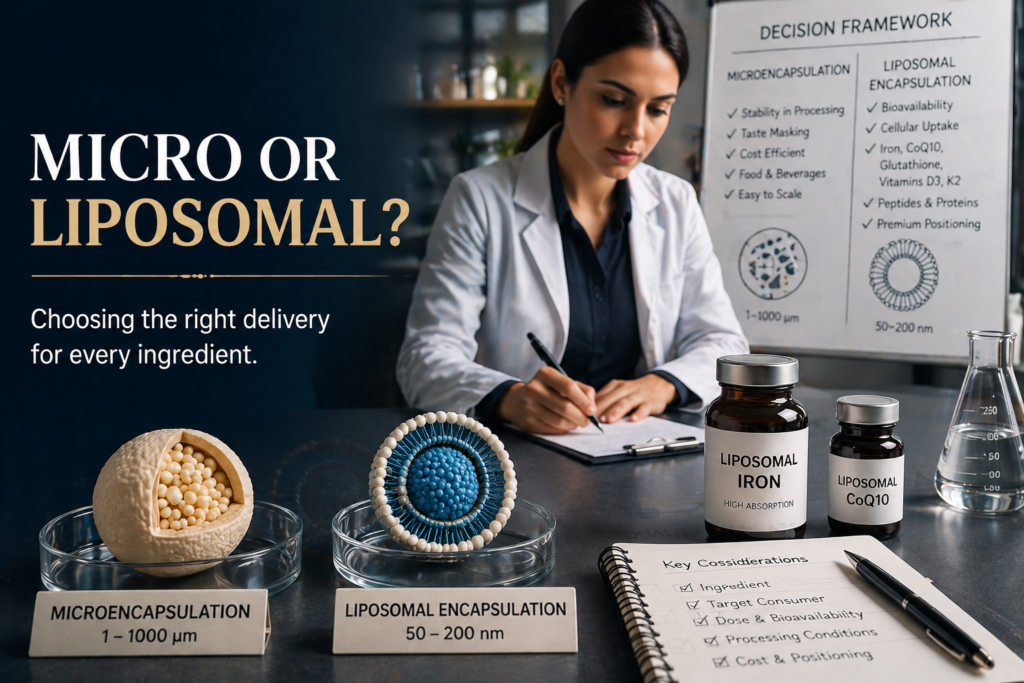
Microencapsulation surrounds an active ingredient in a protective wall material, producing particles typically between 1 and 1,000 micrometres in diameter. The wall can be a single shell or a multi-layer composite system. Common wall materials include modified food starch, maltodextrin, shellac, ethylcellulose, whey protein isolate, and hydroxypropyl methylcellulose — each selected based on the target release environment and the processing conditions the finished product will encounter.
Release mechanisms fall into three main categories: mechanical rupture (pressure or mastication), heat-triggered dissolution, and pH-dependent release. A microencapsulated flavour in a chewing gum releases under mechanical pressure. A microencapsulated probiotic designed for gut delivery relies on a pH-responsive shell that stays intact in the stomach’s acidic environment but dissolves as pH rises in the small intestine.
The technology is mature, scalable, and compatible with almost every food-grade manufacturing process — spray drying, fluid bed coating, coacervation, centrifugal extrusion. That maturity is a genuine advantage. Most food manufacturers already have the process capability or the contract manufacturing partners to work with microencapsulated ingredients without significant validation overhead.
What microencapsulation does not do is meaningfully alter how the released active is absorbed at the cellular level. Once the shell dissolves, the ingredient enters the GI tract as a conventional nutrient. Bioavailability is improved only insofar as the shell has protected the active from degradation during processing and storage, or has delivered it to a more favourable absorption site. The cellular uptake mechanism remains unchanged.
The Phospholipid Bilayer: Why Liposomal Delivery Is a Different Intervention
Liposomal encapsulation is a structurally different proposition. A liposome is a spherical vesicle — typically 50 to 200 nanometres in diameter — formed by one or more phospholipid bilayers surrounding an aqueous core. The phospholipid membrane closely resembles the architecture of human cell membranes, which is not incidental to how it works.
When a liposome reaches target tissue, two uptake pathways become available: endocytosis, where the cell engulfs the vesicle intact, and membrane fusion, where the liposomal bilayer merges directly with the cell membrane and deposits its payload into the cytoplasm. Neither pathway is accessible to a conventionally delivered nutrient. This is why liposomal delivery is not simply a more expensive version of microencapsulation — it is a mechanistically different intervention.
The size difference carries practical consequences. At 50–200 nm, liposomes transit epithelial barriers differently than microcapsules, which are two to four orders of magnitude larger. Many liposomal formulations use phosphatidylcholine derived from sunflower or soy lecithin, whose inherent amphiphilicity also helps fat-soluble actives cross what is an essentially aqueous environment in the gut lumen — a problem that purely lipophilic compounds struggle with regardless of how finely they are milled.
Scenarios Where Microencapsulation Is the Stronger Choice
When I was evaluating delivery options for a client developing a fortified oat drink, the brief required ambient shelf stability of 18 months, a clean flavour profile, and a retail price point that could not accommodate a significant cost premium on the encapsulated active. We were looking at omega-3 enrichment. Microencapsulation won — specifically a spray-dried fish oil powder using a modified starch and whey protein matrix, which kept peroxide values well within specification at month 18 under accelerated storage conditions. A liposomal omega-3 format would have been structurally unstable in that aqueous beverage matrix at the required processing temperature. The liposome bilayer does not survive extended exposure to the thermal and shear conditions of continuous UHT processing.
Microencapsulation is the correct starting point in the following situations:
- The active will be incorporated into a food matrix at high temperature or under significant mechanical shear. Liposomes are structurally fragile. They do not survive extrusion, high-shear homogenisation at elevated temperatures, or the pH extremes of some functional beverage applications.
- Taste or odour masking is the primary formulation challenge. Microencapsulation physically separates bitter, fishy, or sulphurous compounds from sensory receptors until the intended point of release. Liposomal systems offer some masking but are generally less effective for strong off-notes because the bilayer is not designed primarily as a physical barrier.
- The project is cost-constrained. Microencapsulated ingredients typically cost 30–60% less per gram of active than liposomal equivalents, depending on the active and the wall material system. For mass-market fortified foods operating on tight commodity margins, that differential matters at scale.
- Rapid scalability is required. Microencapsulated ingredients slot into existing food manufacturing infrastructure with minimal process re-validation. Liposomal ingredients may require equipment changes or contract manufacturing partners with specific liposome production capability.
Where Liposomal Delivery Earns Its Cost Premium
Across a range of reformulation projects, the pattern is consistent: liposomal delivery earns its cost premium when bioavailability is the binding constraint, not cost-per-gram.
For iron, the case is nearly unambiguous. Standard ferrous sulphate causes GI distress at effective doses and has absorption rates that depend heavily on the consumer’s baseline iron status, dietary composition, and gut health. Liposomal iron — absorbed via the endocytic pathway, largely bypassing the competition for divalent metal transporter-1 (DMT-1) that limits conventional iron uptake — demonstrates higher bioavailability at lower elemental doses in clinical literature. The reduction in GI side effects is not a marginal quality-of-life improvement; it directly affects compliance, which determines real-world efficacy. A paediatric supplement formulation I reviewed switched from ferrous bisglycinate to a liposomal iron format and achieved a 30% reduction in the elemental iron dose while maintaining measured serum ferritin outcomes — a meaningful clinical and commercial improvement.
CoQ10 presents a similar argument. With a molecular weight of approximately 863 g/mol and poor intrinsic solubility, CoQ10 has absorption characteristics that defeat standard softgel formats unless accompanied by significant lipid co-administration. Liposomal delivery addresses both the solubility and the transport problem simultaneously, making it the defensible choice for any CoQ10 supplement targeting a premium or therapeutic-adjacent positioning.
Fat-soluble vitamins D3, K2, and A all show meaningful bioavailability improvements in liposomal form, particularly in populations with compromised fat digestion — older adults, individuals with inflammatory bowel conditions, and post-bariatric surgery patients. These are growing consumer segments with genuine clinical need, not demographic footnotes.
Glutathione is effectively non-viable as an oral supplement in conventional form. The glutathione peptide bonds are cleaved by gut proteases before meaningful absorption occurs. Liposomal glutathione is one of the few oral delivery formats that makes glutathione supplementation pharmacologically defensible, which is why it has become the dominant format in the premium antioxidant category.
For protein-based and peptide actives — collagen peptides with specific chain lengths, bioactive milk fractions, certain botanical peptide fractions — liposomal encapsulation protects the molecular structure from protease activity in the stomach and proximal small intestine. The mechanism of action for these actives is often chain-length-dependent, meaning that partial hydrolysis before absorption is not just an efficiency loss; it is a loss of bioactivity.
Samarth Biorigins LLP has built their ingredient portfolio around precisely this category of applications, offering liposomal active solutions with bioavailability documentation that brand partners can deploy in evidence-based marketing. In a supplement market where consumers increasingly ask how much of a product reaches systemic circulation — not just what is in the capsule — the ability to point to an established uptake mechanism is a competitive asset that compounds over time.
The Quiet Failure That Brands Attribute to the Wrong Variable
Here is the non-obvious problem with getting the encapsulation decision wrong: it rarely produces an obvious failure. A product formulated with standard encapsulation when liposomal delivery was warranted will not cause adverse events. It will not generate complaints. It will simply underperform — quietly, consistently, and in a way that the brand almost never connects back to the formulation choice.
The pattern recurs with enough regularity that it has become familiar. A brand launches an iron supplement with thoughtful packaging, a coherent marketing strategy, and a credible retail partnership. Six months in, repurchase rates sit below category benchmarks. Consumer sentiment mentions that they “didn’t feel a difference.” The internal post-mortem examines the creative, the retail placement, the price architecture. Nobody examines whether the iron delivery technology was capable of producing measurable serum ferritin improvements in a population of women who may be deficient and whose DMT-1 transporters are already operating near capacity.
The wrong encapsulation method creates a gap between what the label represents and what the body receives. That gap is invisible to the brand, invisible to the retailer, and only dimly perceptible to the consumer — who simply does not repurchase, and tells survey researchers only that the product “didn’t work.”
This is the clearest opinion I hold on the subject: most supplement brands underinvest in delivery science and then spend the next 18 months trying to fix a performance problem through marketing that no amount of improved creative will resolve. The formulation decision is made once. Its consequences last the commercial life of the product.
A Practical Decision Framework for Developers
The question that unlocks the right answer is not “which technology is better?” It is: what is the primary performance requirement of this specific product, for this specific consumer, in this specific format?
If the answer centres on stability in a food matrix, cost efficiency at scale, or masking difficult sensory profiles, microencapsulation is the correct starting point. If the answer centres on measurable bioavailability improvement, consumer compliance in a bioavailability-sensitive category, or premium clinical positioning in a competitive supplement market, liposomal delivery is the technically defensible choice.
A condensed decision guide:
- Fortified foods and beverages at scale → microencapsulation (stability, cost, process compatibility)
- Taste/odour-masking priority → microencapsulation (physical barrier design)
- Iron, CoQ10, glutathione, fat-soluble vitamins → liposomal (bioavailability-critical, mechanism-dependent)
- Peptide and protein actives → liposomal (protease protection)
- Premium supplement with clinical positioning → liposomal (consumer-communicable mechanism, evidence base)
- Cost-sensitive mass-market supplement → evaluate carefully; if bioavailability is the product’s core claim, the cost of the wrong encapsulation method is not the ingredient premium — it is the cost of a product that fails commercially
One area where I do not have a confident answer is the emerging class of solid lipid nanoparticles (SLNs), which share some structural features with liposomes but potentially offer superior stability in food matrices and during thermal processing. The early research is interesting. The commercial track record, at least in high-volume food applications, is thin enough that I would not recommend SLNs as a primary technology choice for a product due to market within the next 12 months.
For brands working through a specific ingredient-technology pairing, Samarth Biorigins LLP offers technical consultation alongside their liposomal ingredient range — a useful entry point when the question has moved from which technology in principle to which liposomal format for which active in which product architecture.
The microencapsulation decision and the liposomal delivery decision are not the same kind of decision. One is an optimisation. The other is a choice about the fundamental mechanism by which your product will — or will not — deliver on its promise.