Knee Ligament Surgery
Knee ligament injuries are common among athletes, active adults, and people who experience sudden twisting or trauma to the knee. A torn ligament can cause pain, swelling, instability, and difficulty while walking or participating in sports. Depending on the severity of the injury and the patient’s activity level, treatment may involve physiotherapy, medication, activity modification, or knee ligament surgery.
Knee ligament surgery is performed to repair or reconstruct a damaged ligament and restore stability and function to the knee. If you have a persistent feeling that your knee is giving way, especially after a sports injury, an orthopaedic evaluation can help determine the appropriate treatment.
What Are Knee Ligaments?
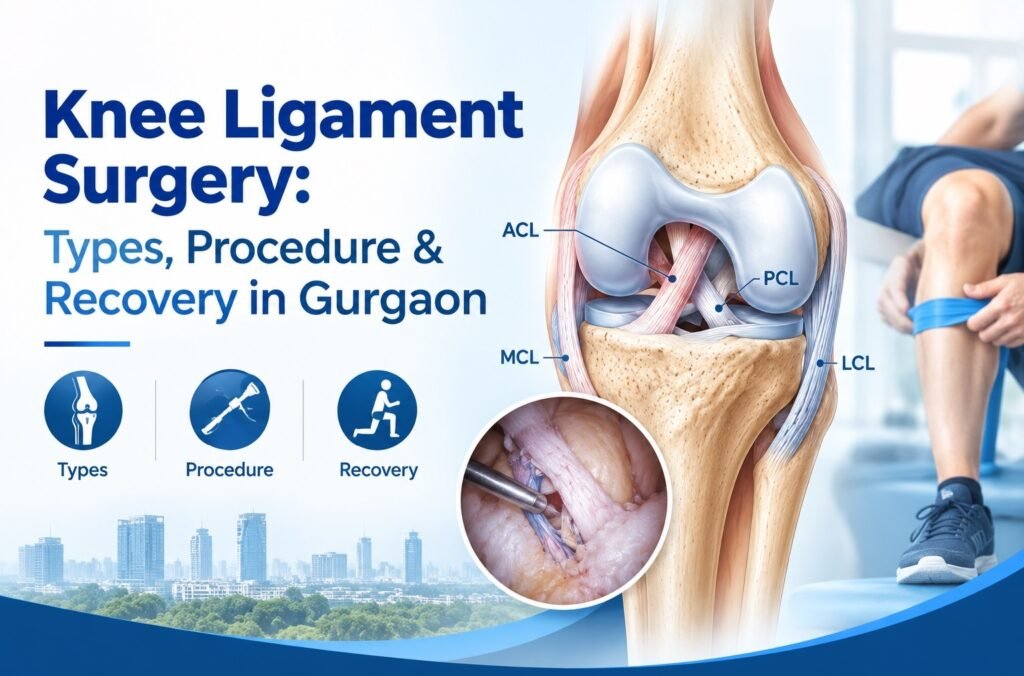
Ligaments are strong bands of tissue that connect bones and help stabilize joints. The knee has four major ligaments:
- Anterior Cruciate Ligament (ACL) – helps control forward movement and rotation of the knee.
- Posterior Cruciate Ligament (PCL) – prevents excessive backward movement of the shinbone.
- Medial Collateral Ligament (MCL) – provides stability on the inner side of the knee.
- Lateral Collateral Ligament (LCL) – provides stability on the outer side of the knee.
The ACL is one of the most frequently injured knee ligaments, particularly during sports involving sudden changes in direction, jumping, or landing.
When Is Knee Ligament Surgery Required?
Not every ligament injury requires surgery. Minor or partial ligament tears may sometimes be managed with rest, physiotherapy, bracing, and a structured rehabilitation program.
Surgery may be considered when there is:
- A complete ligament tear
- Significant knee instability
- Repeated episodes of the knee giving way
- A sports-related injury in an active individual
- Associated meniscus, cartilage, or other ligament injuries
- Persistent symptoms despite appropriate non-surgical treatment
The decision depends on the type and severity of the injury, age, activity level, physical demands, associated injuries, and individual treatment goals.
Common Types of Knee Ligament Surgery

ACL Reconstruction Surgery
ACL reconstruction is one of the most common forms of knee ligament surgery. In many cases, the damaged ACL is replaced with a graft rather than simply being stitched back together.
The graft may be obtained from the patient’s own tendon or, in selected cases, from donor tissue. The choice depends on several clinical factors and is discussed with the orthopaedic surgeon.
PCL Reconstruction
PCL reconstruction may be recommended for certain severe or persistent PCL injuries, particularly when the knee remains unstable after appropriate conservative treatment.
MCL and LCL Surgery
Many MCL injuries can heal without surgery. However, severe tears or injuries involving multiple knee ligaments may require surgical treatment. LCL injuries can also require reconstruction or repair depending on their severity and associated damage.
How Is Knee Ligament Surgery Performed?
Many ligament reconstruction procedures are performed using knee arthroscopy, a minimally invasive surgical technique. During arthroscopy, a small camera is inserted through a small incision to allow the surgeon to examine the inside of the knee.
For ligament reconstruction, the surgeon prepares the damaged area and positions the graft to restore the function of the injured ligament. The graft is secured to the bone using appropriate fixation techniques.
The exact surgical approach varies according to the ligament involved and the patient’s injury pattern.
Recovery After Knee Ligament Surgery
Recovery is a gradual process and varies from patient to patient. A rehabilitation program is an important part of successful recovery.
Immediately after surgery, treatment may focus on controlling pain and swelling and protecting the reconstructed ligament. Depending on the procedure, the patient may initially need crutches or a brace.
Physiotherapy generally progresses through several stages:
- Regaining knee movement
- Reducing swelling and improving muscle activation
- Restoring strength and balance
- Improving coordination and functional movement
- Gradually returning to normal activities and sports
Returning to high-impact sports too early can increase the risk of reinjury. The timing should therefore be based on clinical assessment, strength, stability, movement quality, and rehabilitation progress rather than a fixed date alone.
Benefits of Appropriate Ligament Treatment
The primary goals of knee ligament treatment are to improve knee stability, restore function, reduce symptoms, and help the patient return to desired activities safely.
For active individuals and athletes, appropriate diagnosis and rehabilitation are particularly important because untreated instability can interfere with sports and daily activities and may be associated with additional knee problems over time.
Why Choose an Experienced Orthopaedic Surgeon?
Knee ligament injuries can vary significantly from one patient to another. A detailed clinical examination and appropriate imaging, such as an MRI when indicated, can help identify the injured structures and associated damage.
An experienced orthopaedic surgeon can evaluate the injury and discuss whether non-surgical treatment, ligament repair, reconstruction, or another approach is appropriate.
At AOSC Advance Ortho in Gurgaon, Dr. Nitin Rawal provides orthopaedic care for knee ligament injuries, sports injuries, arthroscopic procedures, and related knee conditions. Treatment is planned according to the patient’s injury, activity level, and individual requirements.
When Should You See an Orthopaedic Specialist?
Consider an orthopaedic evaluation if you experience:
- Persistent knee pain or swelling after an injury
- A feeling that the knee is unstable
- Repeated episodes of the knee giving way
- Difficulty returning to sports or normal activities
- Limited knee movement after trauma
- A suspected ligament or meniscus injury
Early assessment can help identify the extent of the injury and guide an appropriate treatment plan.
Conclusion
Knee ligament surgery may be an important treatment option for selected patients with significant ligament injuries and persistent knee instability. However, surgery is not automatically required for every ligament tear. The appropriate treatment depends on the specific ligament injured, severity of the tear, associated injuries, activity level, and individual goals.
If you have suffered a knee injury or are experiencing instability, consult an orthopaedic specialist for a proper diagnosis and personalized treatment plan. With appropriate treatment and structured rehabilitation, many patients can progressively regain knee function and return to their daily activities.