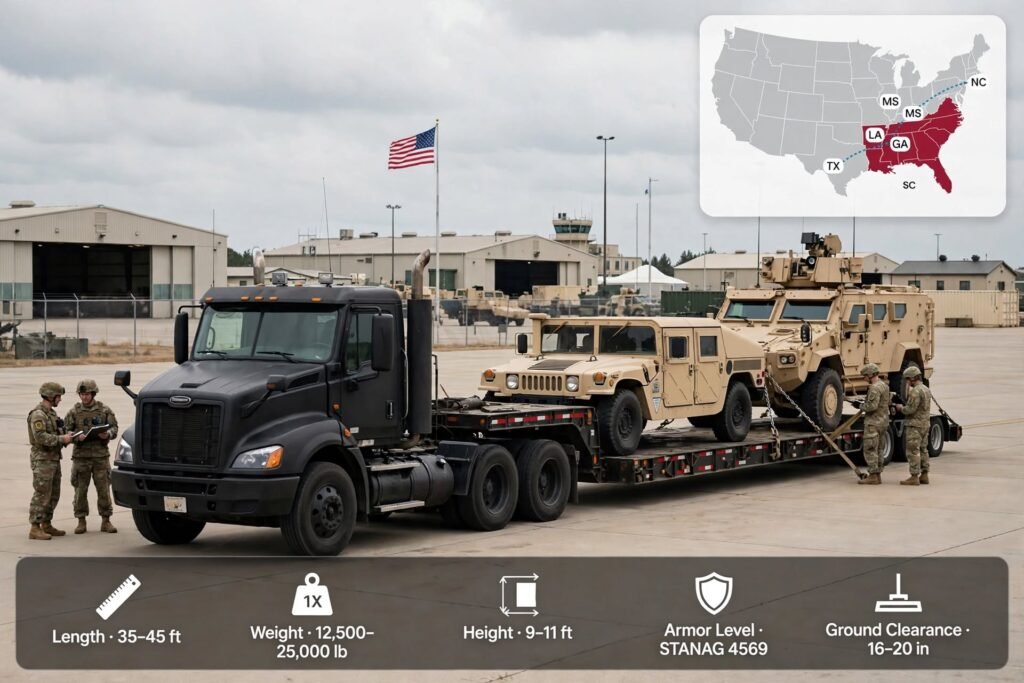
Military vehicles are built for demanding environments, specialized operations, and different types of terrain. From utility vehicles and tactical trucks to heavy support automobiles, their construction often differs considerably from ordinary passenger cars. Moving these vehicles between military facilities, storage locations, maintenance centers, or other destinations requires careful transportation planning.
Military automobile shipping involves more than selecting a carrier and arranging a pickup. Vehicle dimensions, total weight, ground clearance, equipment attachments, and loading requirements can all influence the transportation method. Understanding these specifications helps organizations plan vehicle movements more effectively across the United States.
Not Every Military Vehicle Fits the Same Transport Plan
A compact military utility vehicle and a heavy tactical support truck cannot automatically use the same transportation arrangement. Their weight, dimensions, and structural configurations create different handling requirements.
Consider a few broad categories:
- Military utility vehicles: Smaller vehicles may be easier to accommodate on suitable vehicle transport trailers, depending on their specifications.
- Tactical trucks: Larger dimensions and heavier construction may require specialized heavy-equipment transportation.
- Armored vehicles: Additional armor can significantly increase vehicle weight and affect loading and trailer capacity.
- Support vehicles: Maintenance, communications, and logistics vehicles may have equipment installations that change their dimensions.
- Specialized military automobiles: Unusual body configurations or permanently attached equipment may require an individual transport assessment.
The vehicle’s category provides a starting point, but actual measurements determine what equipment and arrangements are appropriate.
Five Specifications That Shape the Shipping Decision
When arranging transportation, the following measurements and characteristics deserve particular attention.
| Specification | Transportation consideration |
| Overall length | Determines the space required on the trailer |
| Vehicle width | Can affect road classification and permit requirements |
| Overall height | Matters for bridge clearances and overhead restrictions |
| Operating weight | Influences trailer capacity and loading equipment |
| Ground clearance | Can affect ramp angles and loading procedures |
These specifications should be documented before requesting a transportation estimate.
For example, two military trucks may have similar lengths but very different weights because of their construction and installed equipment. Using the dimensions of a standard model without accounting for modifications can result in an unsuitable transportation plan.
The Equipment Attached to a Vehicle Matters Too
A military automobile may carry equipment that changes its original factory dimensions. Communication installations, protective structures, external storage systems, specialized bodies, and other additions can affect its transportation profile.
This creates an important distinction between the manufacturer’s standard specifications and the vehicle’s current configuration.
Before arranging a shipment, the responsible party should identify:
- Permanently installed equipment.
- Removable external accessories.
- Unusual roof height or body extensions.
- Additional weight from armor or modifications.
- Components that require separate securing arrangements.
Any proposed removal of equipment should be authorized by the vehicle owner or responsible organization. Transport preparation should never involve independently altering sensitive or operational equipment.
Why Trailer Selection Requires More Than a Weight Estimate
The trailer must be suitable for the complete vehicle configuration, not merely its approximate weight.
Depending on the vehicle, transportation providers may evaluate options such as:
- Flatbed trailers: Potentially suitable for certain vehicles when dimensions and loading conditions permit.
- Lowboy trailers: Often considered for heavy or tall equipment where a lower deck height is beneficial.
- Specialized equipment trailers: May be necessary for vehicles with unusual dimensions, weight distribution, or loading requirements.
The correct choice depends on the equipment’s rated capacity, loading method, vehicle dimensions, route restrictions, and applicable regulations. A trailer that can carry the weight may still be unsuitable if the vehicle exceeds its permitted width or height.
A Cross-State Journey Creates Additional Considerations
Military vehicle movements can cover substantial distances. A shipment traveling from Texas to Virginia, for example, may pass through several states with different transportation requirements.
When a vehicle exceeds standard legal dimensions or weight limits, permits may be required. Depending on the shipment, route planning may also need to account for:
- Bridge and roadway weight restrictions.
- Tunnel and overhead clearance limitations.
- Construction zones and restricted roads.
- Oversize-load travel restrictions.
- Escort requirements where applicable.
- Pickup and delivery access limitations.
These requirements are not automatically the same for every military vehicle. They should be assessed using the actual loaded dimensions and weight, along with the rules applicable to the planned route.
When the Vehicle Cannot Be Driven
Some military vehicles may be stored, undergoing maintenance, or awaiting mechanical repairs. Others may not be roadworthy because of their operational condition.
In these situations, the shipping provider needs to know whether the vehicle can start, steer, brake, and move independently.
A non-running vehicle may require winching, specialized loading equipment, or other arrangements. Its condition should be disclosed before booking because the loading process can be substantially different from transporting a fully operational automobile.
Organizations should also confirm that the vehicle is properly authorized and prepared for release and transportation.
How Rapid Auto Shipping Can Assist With Transport Planning
Rapid Auto Shipping provides vehicle transportation assistance across the United States, with coverage in all 50 states and more than 14 years of industry experience.
For military automobile shipping inquiries, customers can discuss the vehicle’s dimensions, weight, configuration, operating condition, and transportation locations when requesting a free instant quote. These details help establish whether an appropriate transport arrangement can be considered.
The company offers open and enclosed vehicle transportation options, although specialized military vehicles may require different heavy-equipment arrangements. Customers should confirm equipment suitability, carrier capabilities, insurance details, and any applicable permits before proceeding. Real-time shipment updates help customers follow transportation progress.
To discuss vehicle movement, visit our website Rapid Auto Shipping or call +1 (833) 233-4447. For unusually large or specialized military vehicles, confirm that the requested equipment and transport service are within the provider’s capabilities before booking.
Specifications First, Transportation Second
Moving military automobiles requires a transportation plan built around the actual vehicle rather than a standard passenger-car shipping arrangement. Weight, dimensions, modifications, loading conditions, and interstate regulations all influence the decision. By documenting these details before requesting a quote, organizations can identify suitable equipment, evaluate route requirements, and reduce avoidable complications during military vehicle transportation.
Frequently Asked Questions
- What types of military vehicles can be transported?
Depending on equipment availability and transport capabilities, transportation may be possible for utility vehicles, military trucks, support automobiles, and other specialized vehicles.
- Does military vehicle weight affect shipping arrangements?
Yes. Weight influences trailer capacity, loading equipment, weight distribution, and possible route restrictions.
- Are lowboy trailers used for military automobile shipping?
They may be suitable for certain heavy or tall vehicles. The actual selection depends on dimensions, weight, loading requirements, and applicable regulations.
- Can non-operational military vehicles be transported?
Potentially, yes. The shipping provider must know the vehicle’s condition in advance to determine whether suitable loading equipment and arrangements are available.
- Are special permits required to transport military vehicles?
Permits may be necessary when a shipment exceeds applicable size or weight limits. Requirements depend on the vehicle configuration and the states along the transportation route.