Choosing the right software development vendor is an important business decision. The wrong partner can lead to missed deadlines, unexpected costs, security concerns, and software that fails to meet business needs. However, comparing multiple vendors can be challenging when each proposal highlights different strengths, pricing models, and technical approaches.
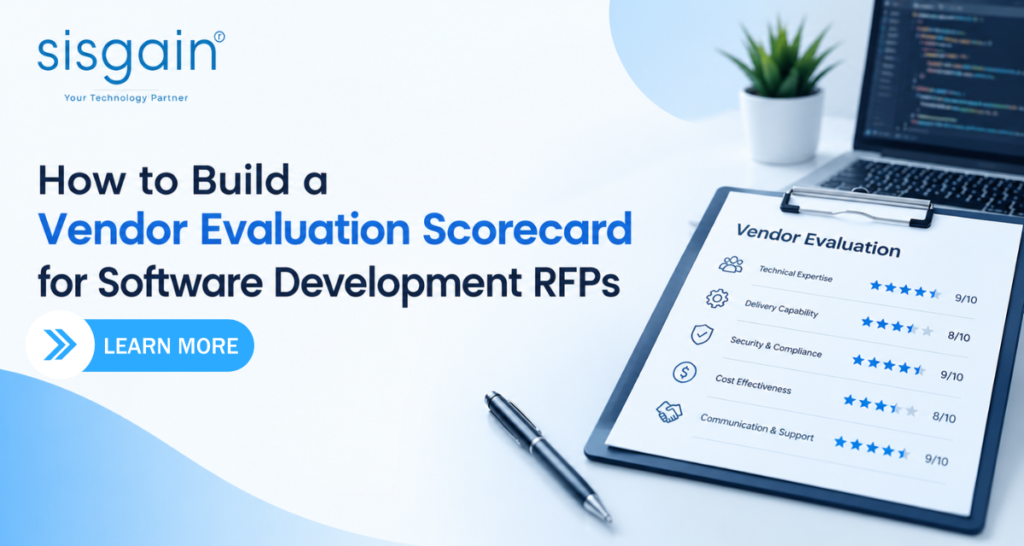
A vendor evaluation scorecard provides a structured way to assess proposals against consistent criteria. Instead of relying on personal preferences or the lowest bid, businesses can evaluate technical expertise, project management, security, cost, and long-term support.
Key Takeaways
- A vendor evaluation scorecard helps businesses compare software development proposals objectively.
- Weighted scoring ensures that the most important project requirements receive appropriate attention.
- Security, compliance, technical expertise, and long-term support deserve careful evaluation.
- Clear requirements make vendor comparisons more consistent and reliable.
- A high overall score should not outweigh critical security gaps or unacceptable project risks.
What Is a Vendor Evaluation Scorecard?
A vendor evaluation scorecard is a structured assessment tool used to compare software development providers against predefined criteria. It typically includes evaluation categories, scoring scales, assigned weights, and space for comments or supporting evidence.
For example, one vendor might offer competitive pricing but have limited experience with complex integrations. Another might charge more while providing stronger security practices, experienced developers, and reliable post-launch support. A scorecard helps decision-makers compare these differences using the same standards.
It also encourages collaboration between technical teams, procurement professionals, business stakeholders, and compliance specialists. Each group can contribute its expertise without allowing one factor to dominate the final decision.
Key Criteria to Include in a Software Development Vendor Scorecard

Before assigning scores, businesses should identify the capabilities that matter most to their project. The following criteria provide a practical starting point.
Technical Expertise and Development Capabilities
A vendor should have the technical skills required to build, integrate, and maintain the proposed solution. Evaluate its experience with relevant programming languages, frameworks, databases, APIs, and cloud platforms.
Consider whether the provider can accommodate future growth, integrate with existing systems, and adapt to changing technical requirements.
Ask vendors to provide evidence of their capabilities, such as technical case studies, architecture examples, or demonstrations of comparable projects. Their answers should show how they solve practical challenges rather than simply list technologies.
Industry Experience and Relevant Portfolio
Experience with similar projects can help a vendor understand industry-specific workflows, customer expectations, and operational challenges.
Review previous projects to determine whether the vendor has delivered solutions with comparable complexity. Client references and case studies can also reveal how well the provider handles deadlines, changing requirements, and implementation challenges.
However, industry experience should not be the only deciding factor. A capable vendor with transferable technical expertise may still be a strong candidate, even without an extensive portfolio in your specific sector.
Project Management and Communication
Successful software development requires more than coding expertise. Vendors must communicate clearly, manage dependencies, and keep stakeholders informed throughout the project.
Evaluate their approach to project planning, progress reporting, risk management, and change requests. Determine whether they use Agile, Waterfall, or a hybrid methodology that suits your requirements.
Useful evaluation questions include:
- How frequently will progress updates be provided?
- Who will be responsible for project communication?
- How will delays and unexpected challenges be handled?
- What process will manage changes to the original scope?
Clear answers indicate whether the vendor has a practical approach to project delivery.
Cost Transparency and Budget Alignment
Price is an important consideration, but the lowest proposal is not necessarily the most economical option over the software’s lifetime.
Compare development fees, implementation costs, licensing, infrastructure, maintenance, training, and ongoing support. Ask vendors to identify assumptions, exclusions, and potential additional charges.
A transparent proposal should explain what is included in the quoted price and how changes to project requirements may affect the budget.
When evaluating costs, focus on overall value, expected outcomes, and long-term expenses rather than the initial quotation alone.
Security, Compliance, and Risk Management
Security should be assessed early, particularly when the software will process sensitive information, support business-critical operations, or run in a cloud environment.
Evaluate the vendor’s secure development practices, identity and access controls, data protection measures, vulnerability testing, and incident response procedures. Check whether the proposed solution can meet relevant contractual, industry, and regulatory requirements.
For cloud-based applications, zero trust cloud security may be relevant when assessing how the solution verifies identities, limits access, and protects resources. Businesses should also consider their broader IT security and compliance requirements when reviewing vendor policies and technical safeguards.
Ask for supporting evidence, such as security documentation, testing procedures, and relevant certifications where applicable. A vendor’s claims should be verified rather than accepted at face value.
Quality Assurance and Post-Launch Support
Software quality depends on effective testing, documentation, deployment planning, and ongoing maintenance.
Review how vendors perform functional testing, integration testing, performance testing, and security testing. Ask how defects are recorded, prioritized, and resolved before release.
Post-launch support also deserves attention. Confirm the availability of maintenance services, response times, software updates, warranty provisions, and technical assistance.
A vendor that offers reliable long-term support may provide greater value than one that focuses exclusively on initial delivery.
How to Assign Weights to Evaluation Criteria
Not every evaluation criterion has the same importance. Weighting allows businesses to reflect their priorities by assigning a percentage to each category.
For example, a security-sensitive enterprise application may prioritize security and technical expertise over a small difference in price.
The following model illustrates how a scorecard might be structured.
| Evaluation criterion | Suggested weight |
| Technical expertise | 25% |
| Security and compliance | 20% |
| Project management | 15% |
| Cost and budget alignment | 15% |
| Industry experience | 10% |
| Quality assurance and support | 15% |
| Total | 100% |
These weights are examples, not universal standards. Businesses should adjust them according to project complexity, business objectives, and risk exposure.
Establish the weights before reviewing proposals to reduce bias and ensure every vendor is assessed against the same expectations.
How to Score and Compare Vendor Proposals
Once the criteria and weights are defined, use a consistent rating scale. A five-point scale is easy to understand and apply.
- 1 – Poor: Does not meet the requirement.
- 2 – Below expectations: Meets only a limited portion of the requirement.
- 3 – Meets expectations: Satisfies the stated requirement.
- 4 – Very good: Exceeds expectations in meaningful ways.
- 5 – Excellent: Demonstrates strong capabilities supported by evidence.
To calculate a weighted score, multiply each category’s rating by its assigned weight. Add the results to calculate the vendor’s overall weighted score.
For example, if technical expertise carries a weight of 25% and a vendor receives a rating of 4 out of 5, its weighted contribution is 20 percentage points.
Record the evidence supporting each rating. This makes it easier to explain differences between vendors and revisit decisions when additional information becomes available.
Remember that a high overall score should not automatically qualify a vendor. Critical security failures, contractual concerns, or an inability to meet mandatory requirements may justify disqualification regardless of the total.
Common Mistakes to Avoid When Evaluating Software Vendors
Even a well-designed scorecard can produce poor decisions if the evaluation process is inconsistent.
Avoid these common mistakes:
- Prioritizing price alone: A low initial quote may conceal additional costs or limited support.
- Using vague criteria: Broad terms such as quality or reliability can lead to subjective scoring.
- Ignoring security risks: Strong technical skills do not automatically guarantee adequate security controls.
- Accepting unverified claims: Marketing statements should be supported by documentation, demonstrations, or references.
- Overlooking stakeholder input: Technical, business, procurement, and compliance teams may identify different risks.
- Changing criteria during evaluation: Altering weights after reviewing proposals can undermine fairness.
Documenting the evaluation process helps businesses maintain consistency and explain the final decision.
How to Use an RFP to Improve Vendor Evaluation
An effective scorecard begins with a clear procurement process. A well-prepared RFP for software development communicates the project’s objectives, functional requirements, technical expectations, deliverables, timelines, and acceptance criteria.
It also gives vendors a consistent framework for responding. When proposals follow the same structure, decision-makers can compare capabilities, costs, risks, and delivery plans more accurately.
To make the process more effective, include:
- A clear description of the business problem and project scope.
- Mandatory and optional technical requirements.
- Expected milestones, deliverables, and implementation timelines.
- Security, privacy, and compliance expectations.
- Pricing details, maintenance terms, and support requirements.
- A description of the vendor evaluation process, including major scoring categories.
Align each scorecard criterion with the requirements documented in the RFP. This helps ensure that vendors are evaluated on the factors that genuinely matter to the project.
Integrating Compliance Requirements Into Vendor Selection
Compliance considerations can extend beyond the development phase. Depending on the application, businesses may need to maintain audit records, manage user permissions, document security controls, and demonstrate adherence to applicable regulations.
Evaluate whether the proposed solution supports these needs and whether the vendor understands the organization’s governance requirements.
Where appropriate, enterprise compliance software can help organizations manage compliance workflows, collect evidence, and organize reporting across business operations. However, such tools do not replace vendor due diligence, security assessments, or legal advice.
The objective is to select a development partner that understands the relevant obligations and can build appropriate controls into the solution from the beginning.
Final Checklist Before Selecting a Software Development Vendor
Before making the final decision, confirm that:
- All vendors were assessed using the same criteria and scoring scale.
- Technical capabilities and client references have been verified.
- Costs, exclusions, and ongoing support terms are clearly documented.
- Security and compliance requirements have been reviewed.
- Critical risks and mandatory requirements have been addressed.
- Relevant stakeholders agree with the evaluation results.
- The reasons for selecting the preferred vendor are documented.
This final review helps decision-makers look beyond numerical scores and consider the complete picture.

Conclusion
Building a vendor evaluation scorecard gives businesses a practical way to compare software development providers fairly and consistently. By evaluating technical capabilities, project management, costs, security, compliance, and ongoing support, organizations can make decisions based on evidence rather than assumptions.
The most effective approach begins with clear project requirements, establishes evaluation criteria before reviewing proposals, and uses weighted scoring to reflect business priorities. Combined with thorough due diligence, a structured scorecard helps organizations identify a development partner that can deliver a secure, reliable, and maintainable solution.
Frequently Asked Questions (FAQs)
What is a software development vendor evaluation scorecard?
A software development vendor evaluation scorecard is a structured tool used to compare vendors based on technical expertise, industry experience, pricing, security, project management, and ongoing support.
What criteria should be included in a software development vendor scorecard?
Key criteria include technical capabilities, relevant project experience, communication, cost transparency, security and compliance, quality assurance, and post-launch support.
How do you score software development vendors fairly?
Use predefined evaluation criteria, a consistent rating scale, and weighted scores. Assess every vendor against the same requirements and support ratings with evidence from proposals, references, and demonstrations.
Why is a vendor evaluation scorecard important for software development RFPs?
A scorecard helps businesses compare proposals objectively, reduce selection bias, identify potential risks, and select a development partner that aligns with their technical and business requirements.
How should businesses assign weights to vendor evaluation criteria?
Assign weights according to project priorities and risk levels. For example, technical expertise and security may receive higher weights for complex or sensitive applications, while cost and support should also be considered.