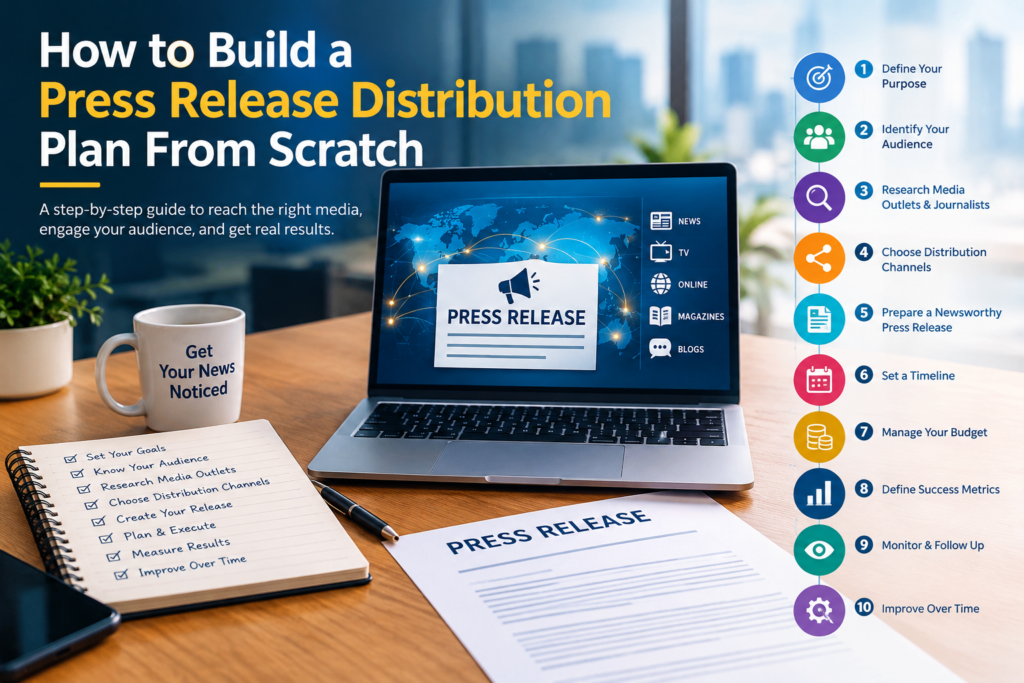
A press release distribution can communicate important company news, but publishing a well-written announcement is only one part of an effective public relations strategy. To reach the right audience, businesses need a clear distribution plan that identifies relevant media outlets, defines communication goals, and establishes how results will be measured.
For organizations in the United States, a structured approach to press release distribution can help improve media outreach, maintain consistent messaging, and make better use of public relations resources. Whether a business is announcing a new product, sharing financial results, introducing a company leader, or reporting a major milestone, planning distribution in advance can make the process more organized and purposeful.
Building a distribution plan from scratch does not require a large communications team or an unlimited budget. It requires a clear understanding of the announcement, its intended audience, the journalists and publications most likely to find it relevant, and the outcomes the organization hopes to achieve.
1. Define the Purpose of Your Press Release
The first step is to determine why the announcement deserves public attention. A press release should communicate meaningful, verifiable information rather than simply promote a business.
Start by identifying the primary purpose of the announcement. Common reasons include launching a product, announcing a partnership, sharing research findings, expanding into a new market, appointing an executive, or reporting a significant organizational development.
Each purpose may require a different distribution approach. For example, a technology company announcing a new software platform may prioritize technology publications and journalists covering business innovation. A local restaurant opening a new location may benefit more from regional newspapers, local business publications, and community news websites.
Write down the main communication objective before selecting distribution channels. Your goal might be to attract relevant media coverage, inform customers about a significant development, communicate with industry stakeholders, or make an important corporate announcement accessible to the public.
Keep the objective specific enough to guide decisions. Instead of aiming to generate general awareness, a company might aim to secure coverage in relevant regional business publications or reach journalists who regularly report on its industry.
A defined objective provides a practical foundation for every subsequent step.
2. Identify Your Target Audience
A distribution plan becomes more effective when it distinguishes between the people who need the information and the media professionals who can help communicate it.
Your target audience may include potential customers, investors, business partners, industry professionals, local communities, or policymakers. However, not every audience needs to receive every announcement.
Consider the information that matters most to the people you want to reach. A manufacturing company announcing a sustainability initiative may want to reach environmental trade publications, business journalists, and local communities affected by its operations. A startup introducing a cybersecurity product may focus on technology reporters, enterprise IT publications, and security industry audiences.
Next, consider the journalists and publications that serve those audiences. Research their editorial focus, typical subjects, geographic coverage, and preferred submission methods.
Audience research should also account for geography. A company with customers across the United States may pursue national publications, while a business serving a particular metropolitan area may find regional media more relevant.
Creating a simple audience profile helps clarify these decisions. Record the audience’s interests, location, information needs, and the publications or platforms they are most likely to follow.
The goal is not to distribute an announcement as widely as possible. It is to make the information accessible to people and publications for whom it is genuinely relevant.
3. Research Relevant Media Outlets and Journalists
Once the audience is defined, develop a targeted media list. This list should contain publications, journalists, editors, and other appropriate media contacts who cover subjects related to your announcement.
Begin with publications that have a clear connection to your industry or location. Depending on the announcement, these may include national newspapers, local news organizations, trade magazines, business journals, online publications, or specialist industry websites.
Review recent articles rather than relying solely on publication names. A journalist who regularly covers corporate technology announcements may be a better contact for a software launch than a general news reporter at the same publication.
Useful research methods include reviewing author biographies, reading recent reporting, checking publication editorial guidelines, and consulting official newsroom contact pages. Professional media databases can also help organize contact information and identify relevant journalists.
Create a spreadsheet with fields such as:
- Publication name and website
- Journalist or editor name
- Professional contact information
- Coverage area or beat
- Geographic relevance
- Recent related articles
- Submission preferences
- Date the contact information was last verified
Keep the list focused and maintain it over time. Sending an announcement to hundreds of unrelated contacts may waste resources and reduce the likelihood of meaningful engagement.
It is also important to respect journalists’ stated preferences and applicable privacy and marketing laws. Use professional contact information for legitimate media outreach, personalize communication where appropriate, and avoid repeated unsolicited follow-ups.
A carefully researched list is often more useful than a large database with little relevance to the announcement.
4. Choose the Right Distribution Channels
The next decision is how the press release will reach its intended audience. Most distribution plans combine several channels, with the mix depending on the announcement, budget, geographic scope, and communication objectives.
Direct media outreach
Direct outreach involves contacting selected journalists or editors with a relevant announcement. It allows communication to be tailored to a publication’s coverage and the journalist’s interests.
A concise, personalized email can explain what the news is, why it may interest the journalist’s audience, and where the complete release or supporting materials can be found.
This approach is particularly useful when the announcement has a strong connection to a specific publication or reporter’s beat. However, direct outreach requires research, accurate contact information, and time for thoughtful communication.
Newswire distribution
A newswire distributes press releases through an established distribution network. Depending on the provider and selected package, the service may offer geographic or industry targeting, online publication, syndication, or access to reporting tools.
Businesses may evaluate providers such as Vertex Newswire alongside other distribution options to understand their available networks, geographic reach, reporting features, and pricing.
Before choosing a service, review what each package actually includes. Distribution to a network does not guarantee that a journalist will read the release, publish an original article, or provide prominent coverage.
Owned communication channels
Company websites, newsroom pages, email newsletters, and official social media accounts can extend the reach of an announcement. These channels give businesses control over how information is presented and make it easier for interested readers to access supporting details.
Owned channels are especially useful when journalists need background information, images, executive biographies, or links to relevant company resources.
Industry and local channels
Trade publications, regional business journals, and community news outlets can be appropriate when the announcement has a specialized or geographic focus.
A strong plan selects channels based on audience relevance rather than treating every available option as equally valuable.
5. Prepare a Newsworthy, Accurate Press Release
Even a well-targeted distribution plan depends on the quality of the announcement itself. Before distribution, confirm that the release communicates a clear and credible story.
The headline should identify the main development without exaggeration. The opening paragraph should explain the essential facts, including who is involved, what happened, when it happened, where relevant, and why the news matters.
The remaining paragraphs should provide context, supporting details, and relevant quotations from authorized representatives. Include figures, dates, and claims that can be verified.
A standard release generally contains a headline, an optional subheadline, a dateline where appropriate, the main body, a company description, and a media contact section. Supporting materials may include photographs, product images, research summaries, or links to official resources.
Use plain language and avoid unsupported superlatives. Journalists should be able to understand the announcement without working through unnecessary jargon or promotional claims.
Before distribution, verify names, job titles, statistics, links, quotations, and publication dates. Confirm that the organization has permission to share any included photographs, research, or third-party material.
If the release contains financial, healthcare, legal, or other regulated information, consult the appropriate internal experts before publication. Some announcements may be subject to disclosure rules, confidentiality obligations, or timing restrictions.
A final editorial review can prevent avoidable corrections and help preserve the organization’s credibility.
6. Develop a Distribution Timeline
Timing affects how effectively an announcement can be coordinated. A distribution timeline helps teams complete research, approvals, outreach, and publication tasks without unnecessary last-minute pressure.
Begin by identifying the intended release date. Work backward to establish when the draft must be completed, who needs to approve it, when supporting assets must be ready, and when media contacts should be approached.
A simple timeline might include the following stages:
One to two weeks before publication: Finalize the announcement’s objective, research the media list, prepare the first draft, and gather supporting materials.
Several days before publication: Complete factual and legal reviews, verify contact details, prepare outreach messages, and confirm any agreed embargo arrangements.
On publication day: Publish the release through the selected channels, contact priority journalists where appropriate, and ensure that the company newsroom contains the approved version.
After publication: Monitor media mentions, respond to legitimate inquiries, record coverage, and assess results against the original objectives.
These periods are guidelines rather than universal rules. Breaking news, scheduled financial announcements, product launches, and time-sensitive events may require different arrangements.
Consider the news cycle and the needs of the intended publications. Avoid assuming that a particular weekday or hour will guarantee coverage. More important factors include relevance, timing, editorial priorities, and the quality of the information.
A shared calendar and clearly assigned responsibilities can help marketing, communications, leadership, and legal teams coordinate the process.
7. Set a Realistic Distribution Budget
A distribution plan should account for both direct expenses and the time required to execute the campaign.
Potential costs include newswire fees, media database subscriptions, freelance writing or editing, photography, translation, design, and staff time. Some organizations may also need specialist support for regulated announcements or complex technical material.
Start by separating essential costs from optional expenses. A small business may begin with a targeted media list, a company newsroom, and direct outreach. An organization seeking broader geographic distribution may decide that a paid newswire service is appropriate.
When comparing providers, evaluate the actual deliverables rather than relying only on headline prices. Review geographic and industry targeting, word limits, multimedia options, reporting capabilities, publication policies, and any additional fees.
Do not assume that a more expensive distribution package will automatically generate better editorial results. The value of an option depends on whether it reaches relevant audiences and supports the campaign’s objectives.
Allocate some time and budget for follow-up, monitoring, and evaluation. Distribution should not consume the entire budget while leaving no resources to assess what happened afterward.
Documenting expenses and outcomes makes it easier to improve future campaigns.
8. Establish Metrics Before Distribution
Measurement should begin before the press release is distributed. Defining success in advance prevents teams from relying on whichever numbers look most impressive after the campaign ends.
Choose metrics that correspond to the original objective. If the goal is media coverage, relevant measures may include the number of editorial articles, the relevance of the publications, the accuracy of the reporting, and whether key messages were represented.
If the objective is to increase website traffic, use website analytics to examine referral visits, engagement, and relevant conversion events during the campaign period. Tracking links can help identify traffic associated with particular distribution channels, provided they are configured correctly.
Other useful measures include journalist responses, qualified media inquiries, downloads of supporting materials, and the cost of achieving a defined outcome.
Distinguish between distribution activity and actual results. A release being delivered, appearing on a website, or being syndicated does not necessarily mean it generated meaningful editorial coverage or influenced audience behavior.
Similarly, potential audience reach estimates should not be treated as verified readership. Reporting tools may calculate reach in different ways, so review their definitions before comparing figures across providers.
Use a campaign report to record the original objective, channels used, total costs, coverage obtained, referral activity, and lessons for future campaigns.
Measurement becomes more useful when it informs decisions rather than simply produces a large collection of numbers.
9. Create a Follow-Up and Monitoring Process
Distribution does not end when the release is published. A clear follow-up process helps organizations respond to media interest and understand how the announcement performs.
Monitor relevant news websites, search results, company mentions, and available media monitoring tools. Record the publication, article link, date, key facts reported, and whether the coverage accurately represents the announcement.
When a journalist requests additional information, respond promptly and provide accurate, approved materials. Make a knowledgeable spokesperson available when appropriate, especially for technical or complex subjects.
Follow-up outreach should be selective and professional. If a journalist has not responded, consider whether a brief additional message would provide genuinely useful context. Avoid repeated messages that add no new information or disregard a journalist’s stated preferences.
Not every release will generate immediate coverage. Some announcements may be useful primarily for customers, partners, employees, or other stakeholders. A lack of press coverage does not automatically mean the distribution plan failed, particularly when the original objective involved direct communication rather than earned media.
After the campaign, review which outlets engaged, which channels delivered relevant traffic, and where the process could be improved. Update the media list and document useful lessons for the next announcement.
10. Review and Improve the Plan Over Time
A press release distribution plan should be treated as a working document rather than a one-time checklist.
After each campaign, compare actual results with the original objectives. Identify which media contacts were relevant, which distribution channels were useful, whether the timing was appropriate, and whether the announcement contained enough information for journalists to evaluate the story.
Look for recurring patterns across multiple campaigns instead of drawing firm conclusions from one result. A single release may perform differently because of competition from major news events, seasonal factors, editorial priorities, or the significance of the announcement itself.
Use those findings to refine future media lists, improve editorial preparation, adjust budgets, and strengthen coordination between teams.
Keep a record of approved messaging, publication requirements, contact preferences, and reporting methods. Maintaining these resources reduces duplicated effort and makes future campaigns easier to manage.
Organizations that distribute releases regularly can also establish a standard operating procedure covering approvals, quality checks, distribution decisions, monitoring, and reporting.
Conclusion
Building a press release distribution plan from scratch starts with a clear objective and a realistic understanding of the intended audience. From there, businesses can research relevant media outlets, choose appropriate distribution channels, prepare an accurate announcement, establish a timeline, manage costs, and define meaningful success measures.
The most effective approach is not necessarily the one that sends a release to the greatest number of outlets. It is the one that connects credible information with relevant audiences through appropriate channels and evaluates results against specific goals.
By documenting each campaign and learning from its outcomes, organizations can develop a more consistent and evidence-based public relations process. A thoughtful distribution plan helps businesses communicate important developments clearly while respecting the needs of journalists and the expectations of their audiences.