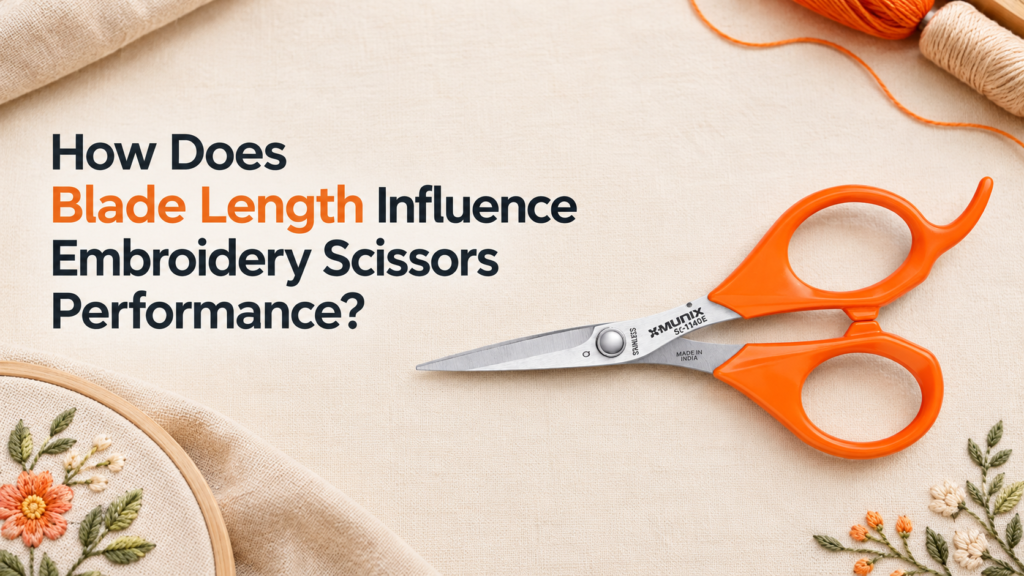
Embroidery involves detailed work where even a small cutting error can affect the appearance of a finished design. Whether someone is trimming loose threads, removing excess fibres, finishing decorative stitches, or working on intricate patterns, the scissors used for each task can influence the final result. One important factor to consider is blade length.
Blade length determines how much cutting edge is available and how embroidery scissors move around small details. Short blades generally provide greater control for precise trimming, while longer blades can be useful when cutting extended threads or handling tasks that require fewer repeated cuts. However, blade length alone does not determine performance. Blade sharpness, tip shape, handle comfort, material quality, and the alignment of the cutting edges also matter. Choosing embroidery scissors with the right blade length can make detailed stitching work more comfortable, accurate, and manageable.
For sewing enthusiasts, embroidery professionals, tailoring businesses, and textile workers in Ludhiana, understanding these differences can help when selecting suitable cutting tools. The choice becomes particularly important when working with delicate fabrics, closely spaced stitches, or detailed embroidery patterns.
When comparing embroidery scissors, including options available under the Munix scissors category, it is useful to understand how blade dimensions relate to practical applications. This guide explains the relationship between blade length, cutting precision, usability, maintenance, and fabric protection so readers can make informed decisions based on their working requirements.
What is Blade Length in Embroidery Scissors?
Blade length refers to the length of the cutting portion of a pair of scissors, measured from the blade tip towards the pivot where the two blades meet. It is different from the overall length of the scissors, which includes the handles.
Embroidery scissors are generally designed for detailed thread cutting and controlled trimming. Their blades may be short, narrow, straight, or curved, depending on the intended application.
The appropriate blade length depends on the type of embroidery, the fabric being used, the accessibility of the threads, and the level of precision required.
Why Blade Length Matters
Blade length can influence:
- Cutting control: Shorter blades may make it easier to position the cutting edge near individual threads.
- Accessibility: Narrow, short blades can help reach small areas between stitches.
- Cutting coverage: Longer blades can handle longer cutting lines with fewer repositioning movements.
- Handling comfort: The relationship between blade length and handle design affects balance and control.
- Fabric protection: A suitable blade length and tip design can help reduce accidental contact with nearby stitches.
These factors should be considered together rather than evaluating scissors by dimensions alone.
How Does Blade Length Influence Cutting Precision?
Blade length affects how easily a user can position the cutting edge around a specific thread or stitch.
Short Blades for Detailed Embroidery
Short blades are often useful for intricate embroidery because they allow the user to work within a small area. Their compact cutting edges can make it easier to approach individual threads without disturbing nearby stitches.
They are particularly useful for:
- Trimming loose threads around decorative patterns.
- Cleaning up small embroidery details.
- Removing individual thread ends.
- Working around closely spaced stitches.
- Finishing delicate needlework.
For example, when completing a floral embroidery pattern, a worker may need to remove a loose thread between two closely spaced petals. Compact embroidery scissors can make it easier to position the tip accurately.
However, short blades are not automatically more precise. Poor sharpness, loose joints, misaligned edges, or uncomfortable handles can reduce cutting accuracy regardless of blade length.
Longer Blades for Extended Cutting Tasks
Longer blades can be useful when cutting longer thread sections or performing tasks that require a wider cutting range.
They may reduce the need to reposition the scissors repeatedly. However, longer blades can be less convenient when working within extremely small embroidery details, especially if their tips are broad or difficult to position.
The important consideration is whether the cutting edge matches the scale of the task.
How Do Blade Length and Tip Shape Work Together?
Blade length is only one part of scissors design. Tip shape also determines how easily the cutting edge can approach a thread or fabric surface.
Straight-Tip Embroidery Scissors
Straight-tip scissors have blades that meet at a conventional pointed or tapered end. Depending on their dimensions, they can be suitable for general thread trimming, stitch finishing, and small cutting tasks.
A narrow tip may improve access to individual threads, while a broader tip may be less convenient for very intricate work.
Curved-Tip Embroidery Scissors
Curved-tip scissors have blades that bend near the tip. This shape can help users approach threads at a different angle and may reduce the need to position their hands directly over the work.
They can be useful for selected embroidery and needlework tasks, although suitability depends on the fabric, stitching pattern, and user’s technique.
Why the Combination Matters
When evaluating Munix scissors or other embroidery scissors, consider the following characteristics together:
- Blade length and width.
- Tip shape and sharpness.
- Cutting-edge alignment.
- Handle size and grip comfort.
- Smoothness of the pivot mechanism.
For Munix KGOC-related product research, checking the actual product specifications is more reliable than assuming that every scissor model has the same dimensions or application.
How Should You Choose Embroidery Scissors for Different Fabrics?
Fabric type influences how easily threads can be isolated and trimmed. The cutting tool should suit both the material and the complexity of the design.
Cotton and Linen Embroidery
Cotton and linen are commonly used for decorative stitching. Compact scissors with well-aligned blades can help trim thread ends around detailed designs.
Silk and Other Delicate Fabrics
Delicate fabrics require careful handling because accidental cuts may damage the material. A sharp, appropriately sized pair of scissors can help control individual thread cuts, but the user should keep the blades clear of the fabric itself.
Dense Embroidery and Layered Textiles
Dense stitching can make loose threads harder to access. A suitable tip shape may be as important as blade length when working between closely spaced stitches.
For textile workers in Ludhiana, where tailoring, garment production, and embroidery work may involve different materials and production requirements, selecting scissors according to the specific task can improve workflow consistency.
What Other Factors Affect Embroidery Scissors Performance?
Blade length cannot compensate for poor construction or unsuitable handling. Before selecting embroidery scissors, examine these additional factors.
Blade Sharpness
Sharp blades should cut thread cleanly without requiring excessive squeezing or repeated attempts. Blunt edges may pull fibres rather than cut them cleanly.
Blade Alignment
The cutting edges should meet correctly throughout their intended cutting range. Misalignment may cause threads to fold, slip, or remain partially uncut.
Handle Comfort
A comfortable handle supports controlled movements during repetitive work. The size of the finger openings and the overall balance should suit the user’s hand.
Material and Corrosion Resistance
Blade material affects durability, maintenance requirements, and resistance to corrosion. Scissors used in humid environments or frequently handled during production may require regular cleaning and careful storage.
Pivot Tension
The joint should move smoothly without excessive looseness. A poorly adjusted pivot can affect the way the blades meet and reduce cutting consistency.
How Can You Maintain Embroidery Scissors?
Regular maintenance helps preserve cutting performance and extends the useful life of embroidery scissors.
Follow these practical steps:
- Clean the blades after use: Remove loose threads, lint, and fabric residue.
- Keep the blades dry: Wipe away moisture before storing the scissors.
- Use scissors for their intended purpose: Avoid cutting thick materials or hard objects unless the tool is designed for them.
- Store them safely: Use a protective cover or a dedicated storage space to prevent damage to the tips.
- Check the pivot regularly: Look for excessive looseness, stiffness, or uneven blade movement.
- Arrange servicing when needed: If the blades become misaligned or dull, seek suitable sharpening or repair rather than forcing the scissors through material.
These habits are useful for home sewing, embroidery studios, and professional textile work.
Conclusion
Blade length influences how embroidery scissors approach individual threads, move around detailed patterns, and handle longer cutting tasks. Short blades are often practical for intricate trimming, while longer blades can be useful for cutting extended thread sections. Neither option is suitable for every situation.
When evaluating embroidery scissors, consider blade length alongside tip shape, sharpness, alignment, handle comfort, and maintenance requirements. These factors are particularly relevant to embroidery and textile professionals in Ludhiana who work with different fabrics and stitching techniques.
Before choosing a pair, identify the tasks you perform most frequently and compare the available specifications. Reviewing the intended use of Munix scissors and relevant Munix KGOC product details can help you make a more informed decision without relying on assumptions or promotional claims.
FAQs
1. Are short blades better for embroidery scissors?
Short blades are often useful for detailed thread trimming because they allow controlled positioning in small spaces. However, sharpness, tip shape, blade alignment, and handling comfort also influence performance. The appropriate length depends on the embroidery technique and the material being worked on.
2. Do longer embroidery scissors blades cut threads more efficiently?
Longer blades may reduce the number of repositioning movements when cutting longer thread sections. However, they may be less convenient around closely spaced stitches. Cutting efficiency depends on blade sharpness, alignment, material thickness, and the user’s technique.
3. How do I choose embroidery scissors for delicate fabric?
Look for appropriately sized blades, a suitable tip shape, smooth movement, and well-aligned cutting edges. Practise on a fabric scrap before trimming the finished piece, and keep the blade tips away from the fabric surface whenever possible.
4. What should I check when comparing Munix scissors?
Check the stated blade length, overall size, material, tip design, handle comfort, and intended application. If you are researching Munix KGOC products, consult the relevant product specifications rather than assuming that all models share identical features.
5. Where can textile workers in Ludhiana use embroidery scissors?
Embroidery scissors may be used in tailoring units, embroidery workshops, garment finishing, craft studios, and home sewing projects. The appropriate model depends on the materials, stitch density, cutting frequency, and precision requirements of each task.