Preparing for an English assessment is not simply a matter of reading a text several times and memorising a few quotations. Students need to understand what the assessment is asking, develop ideas that can be adapted to different questions and communicate those ideas clearly.
This becomes particularly important in senior secondary English, where students may encounter different types of tasks involving textual analysis, interpretation, creative writing, comparative work, oral communication or extended responses.
A student who relies too heavily on a memorised response can find it difficult when an assessment question is phrased differently from what they expected. By contrast, students who understand their texts and develop flexible preparation strategies can adapt their knowledge to different tasks.
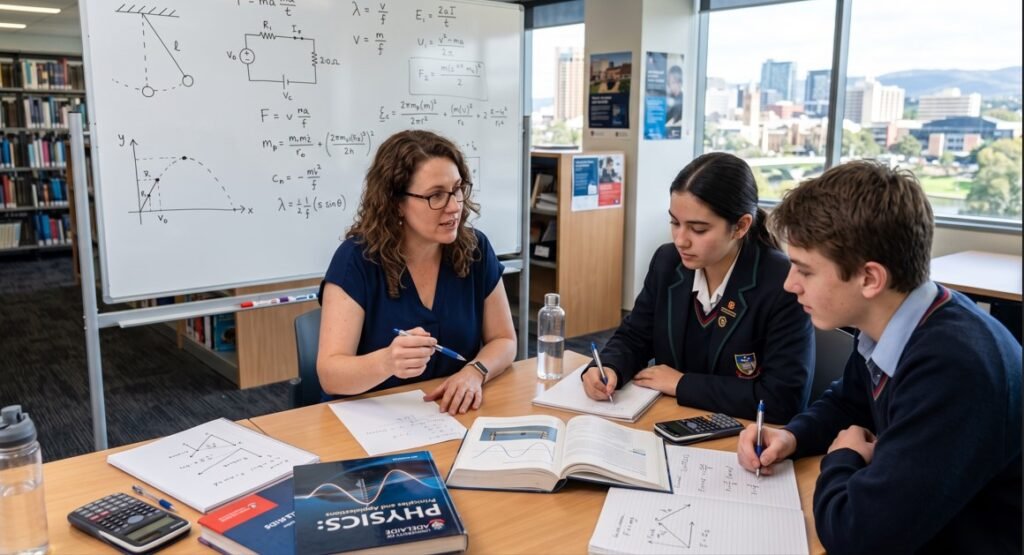
An English Tutor Adelaide can help students build this flexibility by working on assessment preparation, text understanding, planning and written expression according to their individual needs.
Understand the Assessment Before You Start Studying
One of the first mistakes students make is beginning their revision without understanding exactly what they need to produce.
Before preparing for an assessment, students should identify:
- What type of task they are completing
- Which text or texts are involved
- What skills are being assessed
- Whether the task is written, oral or creative
- How much time is available
- Whether students can use notes or other resources
- What the question is asking them to demonstrate
This provides direction for the preparation process.
There is little benefit in spending hours memorising quotations if the assessment requires students to respond creatively or compare different aspects of texts.
Similarly, extensive text analysis may not be enough if students also need to demonstrate control over their own writing.
Build Knowledge Instead of Memorising an Essay
Memorising an entire essay can feel like an efficient preparation strategy.
The problem appears when the assessment question changes.
A memorised essay may contain relevant information but fail to address the specific question. Students can then spend valuable time trying to force their prepared response into a question it was not designed to answer.
A more flexible approach is to prepare:
- Key themes
- Important characters
- Major ideas
- Significant scenes
- Useful quotations
- Language choices
- Structural features
- Possible interpretations
- Contextual information
- Relationships between ideas
Students can then construct an answer around the actual question.
This requires more understanding but gives students greater flexibility.
Create a Flexible Evidence Bank
An evidence bank can be one of the most useful preparation tools for English.
Instead of memorising complete paragraphs, students can organise important evidence according to themes and ideas.
For each quotation or example, they could record:
Quotation or evidence
What does it show?
Language choice
What technique or stylistic feature is significant?
Context
Is there relevant contextual information?
Audience
How might the audience respond?
Possible themes
Which ideas could this evidence support?
This allows one piece of evidence to become useful for different questions.
For example, a quotation relating to a character’s isolation may also contribute to an argument about identity, relationships, belonging or social expectations.
The student is therefore preparing possibilities rather than one fixed answer.
Prepare for Different Question Types
Students should avoid preparing for only one possible question.
Instead, they can practise responding to different question styles.
For example:
Character-focused question
How is a particular character represented?
Theme-focused question
How does the text explore a particular idea?
Language-focused question
How do language choices shape meaning?
Audience-focused question
How is the audience positioned to respond?
Comparative question
How do two texts represent a similar or contrasting idea?
Practising different question types helps students become more adaptable.
Learn to Identify the Instruction Word
The wording of an assessment question matters.
Words such as analyse, explain, compare, discuss, evaluate and explore can require different approaches.
Students should identify the instruction before planning their response.
For example, a question asking them to compare requires attention to similarities and differences.
A question asking them to analyse requires closer examination of how something has been constructed and what effect it creates.
A question asking them to explore may allow a broader discussion of an idea and its development throughout a text.
Recognising these differences can help students avoid writing a prepared answer that does not fully address the task.
Turn the Question Into a Planning Tool
Once students understand the question, they can use its wording to build their plan.
Suppose the question asks how a text presents a particular perspective.
Students could identify:
What perspective?
Where is it presented?
Which characters or voices communicate it?
What language choices support it?
Does the perspective change?
How is the audience positioned?
What broader idea does it contribute to?
This turns the question into a series of smaller problems that can be addressed systematically.
Prepare More Than One Possible Argument
A useful preparation strategy is to develop several possible arguments rather than one memorised thesis.
For example, a text may explore belonging through:
- Family
- Community
- Cultural identity
- Personal relationships
- Conflict
- Isolation
A student who understands these different possibilities can adapt their argument depending on the assessment question.
The objective is not to predict the exact question.
It is to understand the text well enough to respond when the question arrives.
Use Mind Maps to Connect Ideas
Mind maps can help students see relationships between different aspects of a text.
The centre of the map could contain the text’s title.
Branches could then represent:
- Characters
- Themes
- Context
- Language
- Structure
- Symbols
- Important scenes
- Audience
- Authorial choices
Further branches can connect evidence to each idea.
This can be particularly useful during revision because students can see how one piece of evidence relates to multiple concepts.
Prepare Quotations Strategically
Students do not necessarily need to memorise dozens of quotations.
A smaller collection of versatile quotations may be more useful if students understand them well.
For each quotation, students should know:
- Who says it
- When it occurs
- What is happening at that point
- Why the wording matters
- What it reveals
- Which themes it can support
- How the audience may respond
This transforms quotations from isolated pieces of information into analytical evidence.
Understand the Difference Between Evidence and Analysis
A quotation is evidence.
The explanation of what the quotation means and why it matters is analysis.
Students sometimes spend too much of their response introducing evidence and not enough time explaining it.
A useful question is:
Why does this quotation matter?
The answer should go beyond simply repeating the quotation in different words.
Students can consider:
- Specific word choices
- Connotations
- Tone
- Imagery
- Symbolism
- Characterisation
- Structure
- Audience response
- Broader themes
This is where a prepared evidence bank becomes much more useful.
Prepare for Unfamiliar Questions
Students should deliberately practise questions they have not seen before.
A useful exercise is to choose a familiar text and create several new questions about it.
For example:
- How does the text challenge assumptions about identity?
- How does the author use contrast to develop an idea?
- How are relationships used to reveal broader social issues?
- How does the text position the audience towards a particular character?
- How does the ending change the reader’s understanding of an earlier event?
The point is not necessarily to write a complete essay for every question.
Students can simply spend five minutes developing a thesis and three possible points.
This builds flexibility without requiring hours of writing.
Practise Planning Under Time Limits
Planning can become a problem when students spend too much time trying to create the perfect response.
Timed planning can help.
For example, students could give themselves five minutes to:
- Identify the key instruction.
- Highlight the central concept.
- Develop a provisional argument.
- Select three relevant ideas.
- Match evidence to each idea.
- Decide on the logical order.
The plan does not need to be perfect.
It needs to give the student enough direction to begin writing confidently.
Adapt Your Preparation to Different Texts
Different texts may require different preparation methods.
A novel may require students to track:
- Character development
- Narrative structure
- Recurring motifs
- Major themes
- Important turning points
A film may require closer attention to:
- Camera work
- Sound
- Editing
- Lighting
- Mise-en-scène
- Dialogue
A poem may require attention to:
- Imagery
- Form
- Rhythm
- Sound
- Figurative language
- Structure
Students should therefore avoid using one identical study method for every type of text.
Practise Writing Introductions Without Memorising Them
A memorised introduction can become restrictive.
Instead, students can prepare the key elements that an introduction should contain.
Depending on the task, this may include:
- A direct response to the question
- The central argument
- The text’s title and author
- The major ideas that will be discussed
- A clear indication of the direction of the response
Students can then construct the introduction after seeing the actual question.
This makes the response more relevant.
Make Topic Sentences Answer the Question
A paragraph should not simply introduce a theme.
It should contribute to the argument.
For example, instead of:
The theme of isolation is important in the text.
A more focused topic sentence might explain how isolation is constructed and why it matters to the question.
The topic sentence should give the reader a clear reason for the paragraph’s existence.
Students can test each paragraph by asking:
Does this paragraph directly help answer the assessment question?
If the answer is unclear, the paragraph may need to be revised.
Use Teacher Feedback During Preparation
Previous assessments can provide useful information about what needs to improve.
Students should look for recurring patterns in teacher feedback.
Perhaps the feedback repeatedly mentions:
- Limited analysis
- Weak topic sentences
- Insufficient evidence
- Repetition
- Unclear expression
- Weak connections between ideas
- Limited discussion of audience
- Overly descriptive writing
Instead of treating each comment as an isolated correction, students can turn recurring feedback into preparation targets.
For example:
Previous feedback: Too much description.
New target: Explain the significance of every major example.
This creates a clear improvement strategy.
Complete Practice Responses, But Do Not Write Endless Essays
Writing practice is useful, but students do not need to write a complete essay every time they revise.
Different types of practice can develop different skills.
One session could involve writing an introduction.
Another could focus on one analytical paragraph.
Another could involve planning three arguments.
Another could involve analysing one quotation.
Another could involve responding to an unfamiliar question.
This makes revision more targeted and manageable.
Practise Editing Under Time Pressure
Assessment preparation should include editing.
Students can reserve a few minutes at the end of a timed response to check:
- Have I answered the question?
- Are my paragraphs logically organised?
- Have I explained my evidence?
- Have I repeated the same words too often?
- Are my sentences clear?
- Have I made unsupported claims?
- Have I left any incomplete sentences?
- Are quotations accurate?
This final review can catch problems that are difficult to notice while writing quickly.
How an English Tutor Adelaide Can Help With Assessment Preparation
Private tutoring can provide focused preparation based on the student’s current assessment requirements.
Advanced Education offers private one-to-one tutoring for Stage 1 and Stage 2 SACE English, English Literary Studies, Essential English and English as an Additional Language. The tutoring is available online or in person and is designed around individual student needs.
A tutoring session can focus on the exact skill the student needs to develop.
For example, an English Tutor Adelaide might help a student:
- Understand an assessment question
- Develop a flexible thesis
- Build an evidence bank
- Analyse quotations
- Plan an essay
- Improve paragraph structure
- Practise unfamiliar questions
- Edit a draft
- Apply teacher feedback
- Develop a timed response
This type of targeted practice can be more useful than simply repeating the same preparation method for every assessment.
Build Independence Before the Assessment
The purpose of assessment preparation should not be to create dependence on prepared answers.
Students should gradually become capable of making their own decisions.
They should be able to look at a new question and think:
What is this asking?
Which parts of the text are relevant?
What evidence supports my interpretation?
What argument can I develop?
How should I organise my response?
These are transferable skills.
They can help students approach different English assessments with greater independence.
Create a Preparation Routine
Students can make assessment preparation more manageable by spreading the work across several stages.
Two to Three Weeks Before
Review the text and identify major themes, characters and ideas.
One to Two Weeks Before
Build evidence banks and practise analytical paragraphs.
One Week Before
Complete timed planning and unfamiliar questions.
Several Days Before
Complete a full practice response and review previous feedback.
The Day Before
Review key evidence and concepts rather than attempting to learn an entire essay.
This approach gives students repeated opportunities to work with the material.
Avoid Last-Minute Memorisation
Trying to memorise an entire essay the night before an assessment can create problems.
Students may forget sections.
They may struggle when the question changes.
They may spend too much time trying to reproduce their prepared response instead of answering the actual task.
Understanding the text and preparing flexible evidence gives students more room to adapt.
The goal is not to predict the question.
The goal is to be prepared for it.
Final Thoughts
Effective English assessment preparation is about flexibility.
Students need to understand their texts, recognise important evidence, develop arguments and communicate ideas clearly. They also need to practise adapting those skills to different questions rather than relying entirely on memorised responses.
For SACE students, this is particularly relevant because English requires students to consider the relationship between author, text and audience and examine how language and stylistic features shape ideas and perspectives.
An English Tutor Adelaide can provide individual guidance throughout this process, helping students identify areas for improvement and practise the skills required for their particular English subject.
Advanced Education’s private tutoring model allows sessions to be tailored to individual learning needs, with online and in-person options available.
With consistent preparation, students can move away from simply trying to remember what they think an assessment might ask and instead develop the ability to respond thoughtfully to the question that is actually in front of them.