The Details That Make Hoodies Stand Out From the Crowd
A hoodie may look like one of the simplest pieces in a modern wardrobe, but the difference between an ordinary sweatshirt and a memorable one often comes down to the details. Fabric weight, silhouette, stitching, color, graphics, hardware, pockets, and finishing techniques can completely change how a hoodie looks and feels. Those elements also influence whether a garment becomes a reliable everyday favorite or simply blends into a crowded clothing rack.
Today’s hoodie market is especially competitive. Consumers can choose from minimalist basics, athletic sweatshirts, oversized streetwear, vintage-inspired designs, luxury interpretations, and highly graphic statement pieces. Because the basic concept remains familiar, brands need to pay attention to the finer points that give a particular garment its identity.
Good hoodie design is ultimately about balance. A garment needs enough visual character to attract attention without sacrificing comfort or practicality. It should feel distinctive while remaining easy to wear. When those qualities come together, even a relatively simple silhouette can become an important part of a wardrobe.
Fabric Is the Foundation of a Great Hoodie
Before graphics, trims, or colorways can make an impression, the fabric determines much of a hoodie’s character. The same pattern can produce completely different results depending on the textile used. A lightweight cotton blend may create a relaxed layering piece, while heavyweight fleece can produce a structured, substantial silhouette.
Fabric selection also affects warmth, breathability, drape, durability, and how the garment responds to repeated washing. For casual everyday hoodies, cotton-rich fabrics are popular because they provide softness and a familiar hand feel. Blended materials can introduce additional stretch, moisture management, or resistance to shrinkage.
Weight matters too. Heavyweight hoodies tend to create a premium, substantial appearance, particularly when paired with an oversized or boxy cut. Midweight fabrics offer greater versatility because they can work across multiple seasons and layer comfortably beneath jackets.
- Lightweight fabrics: Ideal for transitional weather and layering.
- Midweight fleece: A practical balance between comfort, warmth, and versatility.
- Heavyweight fleece: Creates structure and a more substantial streetwear aesthetic.
- Cotton blends: Can improve durability, stretch, or ease of care.
- Brushed interiors: Add softness and warmth against the skin.
Fit and Silhouette Create Immediate Visual Impact
Fit is one of the first characteristics people notice when they see a hoodie being worn. Two garments with identical colors and graphics can communicate completely different styles because of their proportions.
A traditional regular-fit hoodie usually has a familiar shoulder line and moderate body width. It is easy to layer and works well as an everyday staple. Oversized hoodies, on the other hand, use dropped shoulders, longer sleeves, and additional body volume to create a relaxed streetwear-inspired appearance.
Boxy silhouettes provide another option. Rather than simply making a garment larger, designers can increase the width while controlling the length. This creates a deliberate shape that feels modern without appearing excessively oversized.
Proportion should extend beyond the body itself. Sleeve length, cuff width, waistband depth, hood size, and pocket placement all contribute to the final silhouette. A well-designed hoodie feels cohesive because each component appears intentionally scaled.
The Hood Itself Deserves More Attention
It is easy to overlook the hood because it is an expected feature, but its construction can dramatically influence the overall appearance. A poorly proportioned hood may collapse against the back of the neck, while a carefully engineered hood can frame the face and create a stronger silhouette.
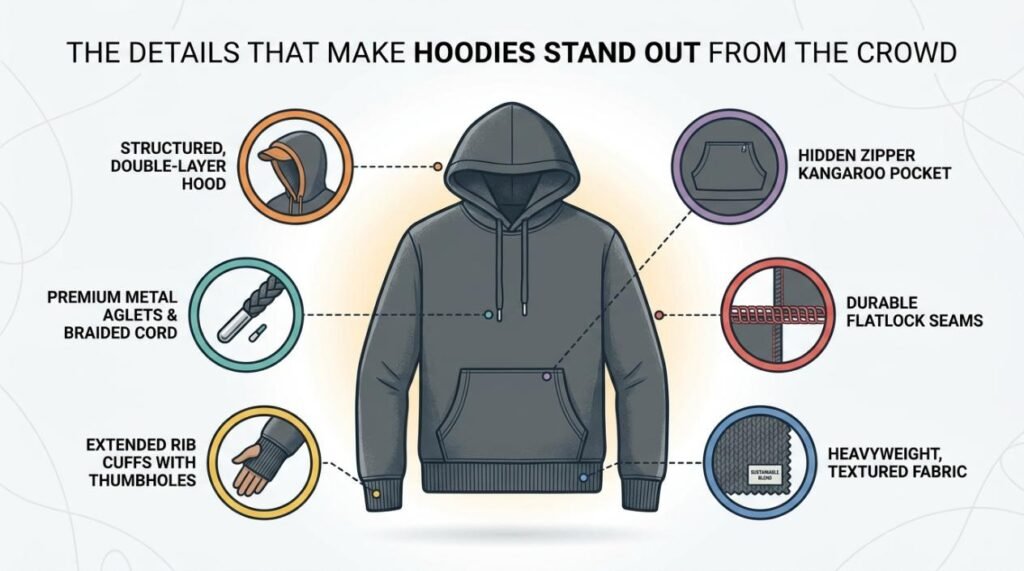
Double-layered hoods generally offer more structure than lightweight single-layer constructions. The choice of drawcords also matters. Thick cords can reinforce a rugged or casual aesthetic, while slimmer cords create a cleaner appearance.
Metal or coated cord tips can introduce a subtle premium detail. Cord color can either match the body for a streamlined look or contrast with it for additional visual interest. Even the way the hood seam is finished can affect how polished the garment appears.
Graphics Should Support the Garment, Not Overwhelm It
Graphics are among the most recognizable elements of a statement hoodie. However, effective graphic design involves more than placing a large logo on the chest. Typography, scale, positioning, color, printing method, and negative space all influence how the design interacts with the garment.
A small chest graphic can create a restrained, premium feel, while a large back print can make the hoodie a centerpiece of an outfit. Sleeve graphics can add visual movement without dominating the front of the garment. Some designs use embroidery instead of printing to create dimension and texture.
Placement is particularly important. A graphic positioned too high, too low, or too close to a pocket can make the garment feel unbalanced. Designers need to consider how the artwork behaves when the wearer moves, sits, or layers the hoodie beneath another garment.
For a more distinctive aesthetic, brands may combine several treatments. A small embroidered mark on the chest paired with a textured back graphic, for example, can create depth without turning the garment into visual clutter.
Color Choices Can Transform a Familiar Silhouette
Color is another powerful tool for differentiation. Classic black, gray, navy, cream, and white remain popular because they are easy to style, but distinctive color treatments can make a familiar hoodie much more memorable.
Muted earth tones can create a refined, outdoors-inspired appearance. Saturated colors can make a design feel youthful and energetic. Washed finishes can introduce a worn-in, vintage character, while monochromatic combinations can produce a minimalist look.
Camouflage is another example of how a familiar visual language can be adapted. Rather than relying exclusively on traditional green military patterns, designers can reinterpret camouflage through lighter palettes, unusual contrasts, or subdued tonal arrangements. A carefully executed abercrombie camo hoodie aesthetic, for instance, can use a predominantly light palette to give a recognizable pattern a cleaner contemporary feel.
| Design Element | Visual Effect | Best Use |
|---|---|---|
| Neutral colors | Clean and versatile | Everyday wardrobe staples |
| Washed finishes | Vintage and lived-in | Casual and streetwear collections |
| Bold colors | Energetic and expressive | Statement seasonal releases |
| Tonal camouflage | Distinctive but understated | Contemporary casualwear |
| Contrasting graphics | High visual impact | Graphic-focused collections |
Pockets Combine Function With Design
The classic kangaroo pocket is one of the defining characteristics of a pullover hoodie. Its appeal comes partly from practicality: it gives the wearer a convenient place to warm their hands or carry small items. Yet pocket design also affects the garment’s visual balance.
A large kangaroo pocket emphasizes a relaxed, traditional hoodie aesthetic. A smaller pocket can make the garment feel cleaner and more contemporary. Zippered pockets introduce additional security and can shift the design toward performance or technical apparel.
Some modern designs use hidden side-seam pockets instead of a conventional front pouch. This reduces visual interruption and can make an oversized silhouette look more streamlined. Pocket construction also needs to account for reinforcement because repeated hand use can place significant stress on seams.
Small Branding Details Can Make a Big Difference
Branding does not always need to be loud. In fact, subtle branding can often create a stronger sense of refinement. Woven labels, embroidered logos, custom zipper pulls, branded drawcord tips, printed neck labels, and carefully designed care labels can all contribute to a cohesive identity.
Consider a coach hoodie concept. The phrase itself can suggest a sports-inspired or team-oriented identity, but the final impression depends on how the name is translated into the garment. Embroidery, collegiate typography, athletic detailing, contrast panels, or restrained branding can each push the design in a different direction.
The important point is consistency. If a brand uses premium metal hardware on its jackets but inexpensive-looking plastic components on its hoodies, customers may notice the mismatch. Small details should support the same quality perception across the collection.
Stitching and Construction Reveal Quality
Construction quality becomes especially apparent after a hoodie has been worn and washed repeatedly. Strong seams help the garment maintain its shape, while poor stitching can lead to puckering, loose threads, or premature failure.
Coverstitching can provide a clean finish while reinforcing areas exposed to movement. Ribbed cuffs and waistbands should recover properly after stretching. Shoulder seams may benefit from reinforcement depending on the fabric weight and intended use.
These technical details are not always visible from a product photograph, but they strongly influence customer satisfaction. A hoodie that looks excellent on day one needs to retain its shape, color, and structural integrity months later.
Texture and Finishing Add Character
Modern hoodie design is increasingly concerned with how a garment feels as well as how it looks. Texture can be introduced through fabric selection, garment washing, embroidery, appliqué, distressing, printing, and surface treatments.
Garment-dyed hoodies can have a softer, more nuanced color appearance than pieces dyed entirely at the yarn or fabric stage. Washed finishes can create subtle variations that make each piece feel less uniform. Brushed fleece provides a soft interior, while loopback construction can create a lighter and more breathable feel.
Embroidery adds another tactile dimension. Raised thread creates a physical surface that catches light differently from flat printing. Patches and appliqué can provide additional depth, particularly when contrasting materials are layered together.
How to Evaluate a Hoodie Before Buying or Designing One
Whether you are a consumer building a wardrobe or a brand developing a new collection, evaluating the garment systematically can reveal whether the details work together.
- Examine the silhouette. Look at shoulder width, body length, sleeve proportions, and overall volume.
- Assess the fabric. Consider weight, softness, stretch, breathability, and expected durability.
- Inspect the hood. Check its structure, depth, lining, drawcords, and seam construction.
- Study the graphics. Evaluate placement, scale, contrast, printing, or embroidery quality.
- Check functional details. Look closely at pockets, cuffs, waistband construction, and closures.
- Review the finishing. Examine labels, stitching, trims, hardware, and loose threads.
- Think about versatility. Consider whether the hoodie works with jeans, trousers, shorts, outerwear, or other layers.
Comfort and Personality Need to Work Together
The most successful hoodies tend to combine two qualities that can sometimes compete with each other: comfort and personality. A garment can have striking graphics and unusual construction, but if the fabric feels unpleasant or the fit restricts movement, people are unlikely to wear it frequently.
Conversely, an exceptionally comfortable hoodie may disappear into a wardrobe if it offers nothing visually distinctive. The strongest designs solve both problems by making comfort part of the identity rather than treating it as an afterthought.
That balance is particularly important for pieces intended for everyday use. Consumers often expect a hoodie to move effortlessly between activities: commuting, relaxing at home, meeting friends, traveling, exercising casually, or layering beneath a coat. Versatility increases the number of situations in which the garment earns its place in the wardrobe.
Personalization Makes Familiar Hoodies More Memorable
Personal touches can also separate one hoodie from another. Monograms, custom graphics, patches, embroidery, limited-edition artwork, and carefully chosen color combinations allow wearers to communicate personality through an otherwise familiar garment.
A sincerely yours hoodie illustrates how a distinctive phrase or thematic concept can become part of the garment’s identity. Rather than relying solely on a generic logo, meaningful wording can give the piece an emotional or cultural dimension that encourages customers to connect with the design.
For brands, this principle can be particularly valuable. A recognizable phrase, visual motif, or recurring construction detail can become a signature that customers associate with a collection. Over time, these recurring elements can strengthen brand recognition without requiring every product to look identical.
The Details That Matter Most
There is no single feature that automatically makes a hoodie exceptional. Instead, standout garments succeed because multiple design decisions reinforce one another. Fabric weight supports the silhouette. The silhouette complements the graphic. Hardware matches the branding. Pocket placement supports the proportions. Stitching and finishing reinforce the quality impression.
When those details are considered together, a hoodie becomes more than a basic sweatshirt. It becomes a deliberately designed product with a recognizable point of view.
For shoppers, paying attention to these elements makes it easier to identify garments that offer lasting value rather than temporary visual appeal. For brands and designers, the same approach can turn an ordinary category into a compelling product opportunity.
Frequently Asked Questions (FAQs)
What makes a hoodie stand out?
A standout hoodie usually combines distinctive design with strong construction. Fabric quality, fit, color, graphics, pocket design, hood structure, stitching, and finishing details all contribute to its overall character.
Does heavyweight fabric make a hoodie better?
Not necessarily. Heavyweight fabric can provide structure, warmth, and a premium feel, but the ideal weight depends on climate, intended use, layering needs, and personal preference. A well-designed midweight hoodie can be just as versatile.
Why is hoodie fit so important?
Fit determines the garment’s silhouette and affects both appearance and comfort. Details such as shoulder width, sleeve length, body volume, hood size, cuffs, and waistband proportions work together to create the intended shape.
Are small branding details important?
Yes. Labels, embroidery, drawcords, zipper pulls, stitching, and other finishing elements can reinforce a brand’s quality and identity. Subtle details are often especially effective when the overall design is minimalist.
How can a simple hoodie look more distinctive?
Designers can introduce distinction through unusual color combinations, thoughtful graphics, embroidery, garment washing, custom hardware, unique proportions, contrasting panels, or refined finishing. The key is to make these elements work together rather than adding details randomly.
Choose Hoodies With Details Worth Noticing
A great hoodie does not need to be complicated to be memorable. Sometimes the most compelling designs are the ones where every element has a clear purpose. The right fabric creates comfort, the right proportions establish character, and carefully considered graphics and finishing touches give the garment an identity.
When you look beyond the basic shape, the hoodie becomes a much more interesting piece of apparel. Whether your preference is minimalist, athletic, vintage-inspired, camouflage, oversized, or graphic-heavy, paying attention to construction and finishing can help you find pieces that look distinctive and continue to perform in everyday wear.
Take a closer look at the next hoodie you consider buying. Examine the fabric, feel the texture, study the stitching, assess the fit, and notice the small details. Those seemingly minor choices are often what separate a forgettable sweatshirt from a hoodie that genuinely stands out.