Press releases remain a useful communication tool for businesses, organizations, startups, nonprofits, and public relations professionals. When an organization has something genuinely newsworthy to announce, a press release can provide journalists and media professionals with a concise source of information.
However, writing a strong announcement is only part of the process. Distribution can also determine whether the release reaches the intended audience and whether journalists can easily understand and use the information.
Many organizations make avoidable mistakes during distribution. These mistakes can reduce visibility, create unnecessary costs, or make an announcement less useful to media professionals. Understanding the most common problems can help businesses develop a more organized and effective approach to press release distribution.
1. Distributing a Press Release Without a Newsworthy Story
One of the most common mistakes is distributing a release simply because a company wants attention.
A press release should generally communicate something that has genuine news value. Examples can include:
- A significant product or service launch
- A major business milestone
- A merger or acquisition
- A new partnership
- An important appointment
- An award or recognition
- A major event
- Research findings
- Community initiatives
- Expansion into a new market
Routine activities that do not offer meaningful information may not provide enough value for journalists or readers.
Before distribution, organizations should ask a basic question: What is new, relevant, or important about this announcement?
If the answer is unclear, the release may need to be revised before it is distributed.
2. Writing for Search Engines Instead of People
Search engine optimization can be useful, but a press release should primarily communicate information clearly.
Overusing keywords can make a release sound unnatural. Repeating the same phrase throughout the headline, introduction, body, and boilerplate can also reduce readability.
For example, a company targeting the phrase “press release distribution UK” should not force that keyword into every paragraph. Instead, the content should use natural language and focus on the actual announcement.
A better approach is to write for the intended audience first. Relevant keywords can then be incorporated naturally where they make sense.
3. Using a Weak or Confusing Headline
The headline is one of the first things a reader or journalist sees. A vague headline can make an otherwise useful announcement difficult to understand.
A strong headline should communicate the main news quickly. It should be specific without becoming unnecessarily long.
Instead of:
Company Announces Important Update
a more informative headline might explain exactly what happened:
Technology Company Launches New Software Platform for Small Businesses
The second example immediately provides context. Readers can understand the subject without having to read the entire release.
4. Burying the Main Information
A press release should generally place its most important information near the beginning.
This follows the traditional journalistic principle of the inverted pyramid, where the most significant facts appear first, followed by supporting details.
The opening paragraph should ideally answer important questions such as:
- Who is making the announcement?
- What happened?
- When did it happen?
- Where is it relevant?
- Why does it matter?
Background information can follow afterward.
If readers have to go through several paragraphs before discovering the actual announcement, they may lose interest.
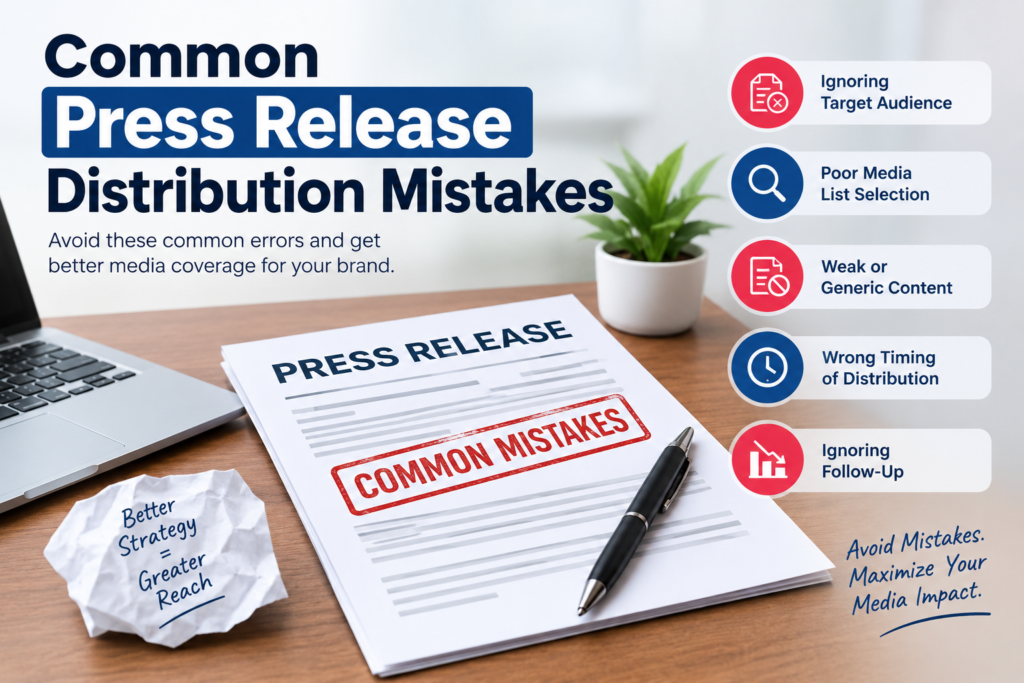
5. Ignoring the Target Audience
Distribution should have a clear audience.
A local business announcement may be most relevant to regional media, while a technology company launching a specialized product may need industry-specific publications and journalists.
Geographic targeting also matters. A business operating in the United States may focus primarily on U.S. media, while an organization with international operations may require broader distribution.
For organizations researching international approaches, topics such as press release distribution UK can help illustrate how geographic targeting may differ between markets. The important consideration is to match distribution with the location and audience that are genuinely relevant to the announcement.
6. Choosing Distribution Based Only on Price
Cost is an important consideration, particularly for startups and small businesses. However, selecting a distribution option solely because it has the lowest price can create problems.
Different distribution services may provide different levels of geographic coverage, media targeting, reporting, formatting, and additional features.
Organizations should compare what is actually included rather than looking only at the headline price.
Useful questions include:
- What geographic areas are covered?
- Which industries or media categories are included?
- Are distribution reports provided?
- What publishing requirements apply?
- Are there additional fees?
- What type of support is available?
Understanding the full service can make cost comparisons more meaningful.
7. Sending the Same Release Everywhere
A single press release can sometimes serve multiple markets, but organizations should not assume that every audience has identical interests.
For example, an announcement intended for U.S. consumers may need different context from one targeting an international business audience.
Localization can involve more than changing spelling. Dates, currencies, regulatory references, terminology, and cultural context may all matter.
This is particularly important when organizations are researching international distribution markets. A release prepared for the United States may require adjustments before being distributed to audiences in another country.
8. Including Too Much Promotional Language
A press release is an announcement, not necessarily an advertisement.
Excessive promotional claims can make a release appear less credible. Phrases such as “the world’s best,” “revolutionary,” or “unmatched” require evidence and may be inappropriate when presented as unsupported statements.
Instead, organizations should provide verifiable facts.
For example, rather than claiming that a product is “the industry’s most innovative solution,” a release could explain what the product does, when it launched, what problem it addresses, and what evidence supports its claims.
Specific information generally provides more value than exaggerated language.
9. Forgetting Essential Contact Information
A journalist who wants additional information should be able to identify the appropriate contact person easily.
A standard press release may include:
- Organization name
- Media contact name
- Email address
- Phone number
- Website
- Relevant social media profile, when appropriate
Missing contact information can create unnecessary friction.
The contact section should also be accurate and monitored. There is little value in providing an email address if nobody is available to respond to legitimate media inquiries.
10. Using Unverified Facts or Statistics
Credibility is particularly important in public communications.
Organizations should verify statistics, dates, research findings, financial figures, quotations, names, titles, and other factual claims before distribution.
If a statistic comes from an external study, the source should be identified where appropriate. If a quotation comes from an executive or expert, the wording should accurately represent what that person said.
Errors can be difficult to correct after a release has already been distributed or republished.
This is one area where careful editorial review can provide significant value.
11. Adding Too Many Links
Links can provide useful background information, but excessive linking can make a release look cluttered or overly promotional.
Organizations should consider whether each link genuinely helps readers understand the announcement.
Useful links might lead to:
- An official product page
- A research report
- An event registration page
- A company website
- Supporting documentation
Links should have a clear purpose rather than being inserted simply to create additional search-engine signals.
12. Ignoring Mobile Readability
Many people consume online content from smartphones and tablets. A press release that looks acceptable on a desktop computer may become difficult to read on a small screen.
Short paragraphs, clear headings, straightforward sentences, and logical formatting can improve readability.
Long blocks of text should generally be avoided. Important information should be easy to locate without excessive scrolling.
Mobile-friendly formatting is especially important when releases are published through online news and media platforms.
13. Distributing Too Early or Too Late
Timing can affect the relevance of an announcement.
A release about an upcoming event should normally be distributed with enough advance notice for journalists and audiences to respond. At the same time, distributing information too far in advance may reduce its immediate relevance.
Businesses should consider the nature of the announcement, the news cycle, the target market, and any important dates.
For time-sensitive announcements, organizations should also confirm that all information is final before distribution.
14. Failing to Review the Final Version
A common mistake is treating distribution as the final step instead of reviewing the release immediately before submission.
A final review should check:
- Spelling and grammar
- Names and job titles
- Dates and locations
- Contact details
- Statistics
- Links
- Formatting
- Headline accuracy
- Quotes
- Company information
Even a small factual error can affect the credibility of the announcement.
A second person reviewing the document can sometimes identify mistakes that the original writer overlooks.
15. Expecting Distribution Alone to Guarantee Coverage
Perhaps one of the most important misconceptions is that distributing a press release automatically means journalists will write about it.
Distribution makes information available to media professionals, but editorial decisions remain independent.
Journalists consider factors such as newsworthiness, relevance, timing, audience interest, available resources, and competing stories.
A business should therefore treat distribution as one part of a broader communications strategy rather than a guaranteed route to media coverage.
How to Avoid These Mistakes
A practical press release distribution process can be relatively straightforward:
First, identify the news.
Make sure the announcement provides meaningful information.
Second, define the audience.
Determine which geographic areas, industries, publications, and readers are most relevant.
Third, prepare a clear release.
Use a strong headline, concise opening, factual supporting information, and appropriate quotations.
Fourth, verify everything.
Check names, statistics, dates, links, and contact information.
Fifth, evaluate distribution options.
Compare geographic reach, media categories, reporting, pricing, and submission requirements.
Finally, review the results.
After distribution, examine available reports and determine how the announcement performed in terms of publication, audience exposure, and engagement.
Services and platforms can differ considerably in how they distribute and report on releases. For example, organizations researching distribution providers may encounter platforms such as Vertex Newswire, alongside other domestic and international options. The appropriate choice depends on the announcement, target audience, geographic requirements, and available resources.
Final Thoughts
Press release distribution works best when it begins with a strong news story and a clearly defined audience. Common mistakes such as weak headlines, excessive promotional language, keyword stuffing, inaccurate information, poor timing, and unrealistic expectations can reduce the usefulness of an otherwise well-prepared announcement.
Businesses can avoid many of these problems by treating distribution as a communication process rather than simply a submission task. Careful writing, fact-checking, audience research, geographic targeting, and thoughtful service comparison can all contribute to clearer and more credible communication.
For organizations working across different markets, understanding regional considerations is also important. Whether researching U.S. distribution, international media outreach, or topics such as press release distribution UK, the underlying principle remains the same: the announcement should be relevant, accurate, timely, and useful to the audience it is intended to reach.