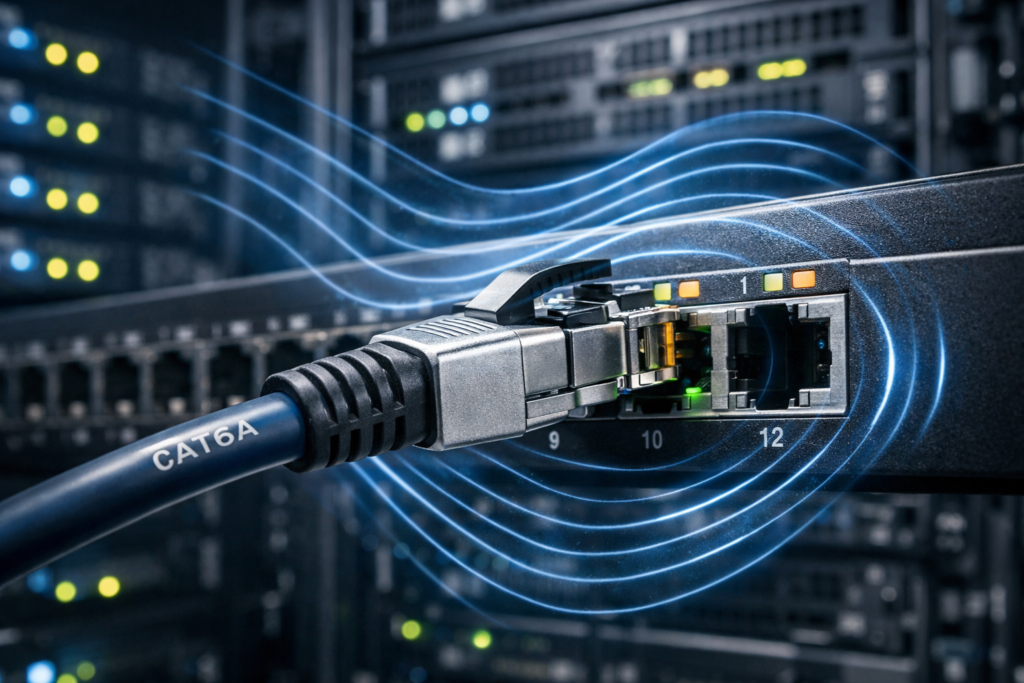
Modern businesses depend on fast, stable, and secure network connections to support daily operations. From offices and data centers to educational institutions and industrial facilities, reliable Ethernet infrastructure plays an essential role in maintaining productivity. As network requirements continue to grow, Cat6A shielded cable has become a valuable option for organizations that need high-speed data transmission and improved protection against electromagnetic interference (EMI). In the USA, TS Cables provides networking cable solutions designed to meet the needs of modern connectivity projects, including installations that require dependable performance and long-term reliability.
What Is Cat6A Shielded Cable?
Cat6A shielded cable is an enhanced Category 6A Ethernet cable designed to support data transmission speeds of up to 10 Gigabits per second (10Gbps) over distances of up to 100 meters when installed within the appropriate specifications. The term Cat6A stands for Category 6 Augmented, representing an improvement over standard Cat6 cabling, particularly in bandwidth capacity and resistance to alien crosstalk.
The shielded construction incorporates conductive shielding around the cable pairs, the overall cable, or both, depending on the cable design. This shielding helps reduce the effects of external electromagnetic interference and unwanted signals between nearby cables. For businesses operating in environments with electrical equipment, dense cable bundles, or complex networking infrastructure, cat6a shielded solutions can provide an additional layer of protection for reliable data transmission.
Key Features of Cat6A Shielded Cable
Cat6A shielded cable offers several features that make it suitable for demanding networking applications.
1. High-Speed 10Gbps Performance
One of the most important advantages of Cat6A cabling is its ability to support 10GBASE-T Ethernet at distances of up to 100 meters. This makes it suitable for organizations that transfer large files, operate cloud-based applications, manage high-resolution video systems, or maintain extensive internal networks.
2. 500 MHz Bandwidth
Cat6A cable supports a bandwidth of up to 500 MHz, helping it handle high-frequency network signals. This capacity makes it useful for modern offices, enterprise networks, and data-intensive environments where consistent connectivity is important.
3. Electromagnetic Interference Protection
Electrical motors, power equipment, fluorescent lighting systems, and other electrical devices can create electromagnetic interference. The shielding in cat6a shielded cable helps reduce the impact of this interference when the cable is properly installed and grounded according to the manufacturer’s instructions and applicable standards.
4. Reduced Crosstalk
Crosstalk occurs when signals from one cable pair interfere with signals in another. Cat6A is designed to control near-end crosstalk and alien crosstalk, which is especially important in installations containing large bundles of Ethernet cables.
5. Long-Term Networking Value
Installing Cat6A cabling can help businesses prepare their infrastructure for future bandwidth requirements. Although the initial cost may be higher than some lower-category cables, its 10Gbps capability can reduce the need for premature cabling upgrades as network demands increase.
Why Choose Cat6A Shielded Over Unshielded Cable?
Both shielded and unshielded Cat6A cables can support high-speed networking. However, the right choice depends on the installation environment.
Unshielded twisted-pair (UTP) cable relies primarily on the twisting of its copper pairs to limit interference. It is often easier to install and may be suitable for typical office environments with relatively low electromagnetic interference.
Shielded twisted-pair (STP) or screened cable includes additional conductive protection. Depending on its construction, the shielding may surround individual pairs, all pairs together, or both. This makes it particularly useful in environments where electrical noise is a concern.
Businesses in the USA should consider the proximity of power equipment, cable routing, installation requirements, and the total project budget before choosing between shielded and unshielded options. Shielding does not automatically make every network faster; the complete cabling system must be designed and installed correctly to achieve the intended performance.
Common Applications of Cat6A Shielded Cable
Cat6A shielded cable supports a wide range of commercial and industrial networking applications.
Data Centers
Data centers require dependable connectivity for servers, switches, storage systems, and other network equipment. Cat6A supports 10Gbps Ethernet connections and can help manage crosstalk in dense cabling environments.
Corporate Offices
Modern offices use cloud applications, video conferencing, wireless access points, IP phones, and shared network storage. Cat6A cabling provides the bandwidth needed to support these technologies and accommodate future network growth.
Industrial Facilities
Manufacturing plants and industrial buildings may contain motors, electrical machinery, and automated equipment that produce electromagnetic interference. Properly selected shielded cabling can help reduce interference-related risks in these environments.
Healthcare Facilities
Hospitals and medical centers depend on network connectivity for administrative systems, digital records, communication tools, and connected devices. Cat6A can provide a suitable wired network foundation when selected according to the facility’s technical and safety requirements.
Educational Institutions
Schools, colleges, and universities require reliable network access for online learning, digital classrooms, campus Wi-Fi, and administrative systems. Cat6A infrastructure can support high-capacity network connections across multiple buildings and departments.
Understanding Cat6A Shielded Cable Construction
The construction of a Cat6A shielded cable influences its performance, flexibility, and installation requirements. Typical designs include four twisted pairs of balanced copper conductors, insulation around each conductor, and one or more shielding layers.
Common shielding configurations include F/UTP, where an overall foil shield surrounds unshielded twisted pairs, and S/FTP, where individual pairs are shielded and an additional overall braid is used. The exact configuration should be selected according to the project’s electromagnetic environment and performance requirements.
Cable jackets also vary depending on their intended application. Plenum-rated cables are designed for use in qualifying environmental air-handling spaces and must meet the applicable fire and smoke requirements. Riser-rated cables are intended for qualifying vertical runs between floors. These ratings are not interchangeable, so installers should verify the required listing before purchasing cable for a building project in the USA.
Installation Best Practices
Correct installation is essential for achieving reliable performance from cat6a shielded cable. Even a high-quality cable can underperform if it is handled improperly or terminated incorrectly.
First, select compatible shielded connectors, patch panels, and other components when the installation design requires a shielded channel. Follow the manufacturer’s instructions for maintaining shielding continuity and grounding or bonding the system appropriately.
Second, avoid excessive pulling force, sharp bends, and crushing the cable during installation. These conditions can damage the cable structure and affect transmission performance. Follow the manufacturer’s bend-radius and pulling-tension specifications.
Third, separate Ethernet cabling from electrical power cables where required by applicable codes and installation standards. Appropriate routing and separation help reduce interference risks.
Finally, use suitable cable-testing equipment to verify the completed installation against the required Cat6A performance limits. Testing can help identify wiring errors, termination problems, and other issues before the network becomes operational.
Why Consider TS Cables in the USA?
TS Cables serves the networking cable market with products intended for different connectivity requirements. Businesses and installers looking for cat6a shielded cable should evaluate product specifications, shielding configuration, conductor material, jacket rating, applicable certifications, and compatibility with their networking equipment.
Choosing the right cable begins with understanding the project. A small office may have different requirements from a manufacturing plant or a large data center. TS Cables can be considered as part of the product-selection process for projects that need high-speed Ethernet connectivity, provided the selected cable meets the relevant technical specifications and installation requirements.
For buyers in the USA, comparing cable documentation and verifying compliance with applicable industry standards are important steps toward building a dependable network. Proper planning can also help control installation costs and reduce the likelihood of future infrastructure changes.
Benefits for Future Network Expansion
Network technology continues to evolve as businesses adopt faster applications, cloud computing, connected devices, and high-capacity wireless systems. A well-designed Cat6A cabling infrastructure can support 10Gbps Ethernet over standard channel distances of up to 100 meters, making it a practical choice for many modern enterprise networks.
Shielded cabling may be particularly valuable where electromagnetic interference is a known concern. However, the overall network design, compatible equipment, proper termination, grounding, and installation quality remain essential. Businesses should evaluate their current needs alongside anticipated expansion to select a solution that balances performance, cost, and reliability.
Conclusion
Cat6A shielded cable is a strong option for businesses seeking high-speed Ethernet connectivity with additional protection against electromagnetic interference. With support for 10Gbps networking over distances of up to 100 meters and bandwidth of up to 500 MHz, it can serve data centers, offices, industrial facilities, healthcare environments, and educational institutions.
For organizations in the USA, choosing the right cat6a shielded cable involves considering the installation environment, shielding type, jacket rating, compatible components, and applicable standards. TS Cables is one option for buyers evaluating networking cable solutions for their projects. By combining suitable cable selection with professional installation and proper testing, businesses can build reliable network infrastructure that supports both current operations and future growth.