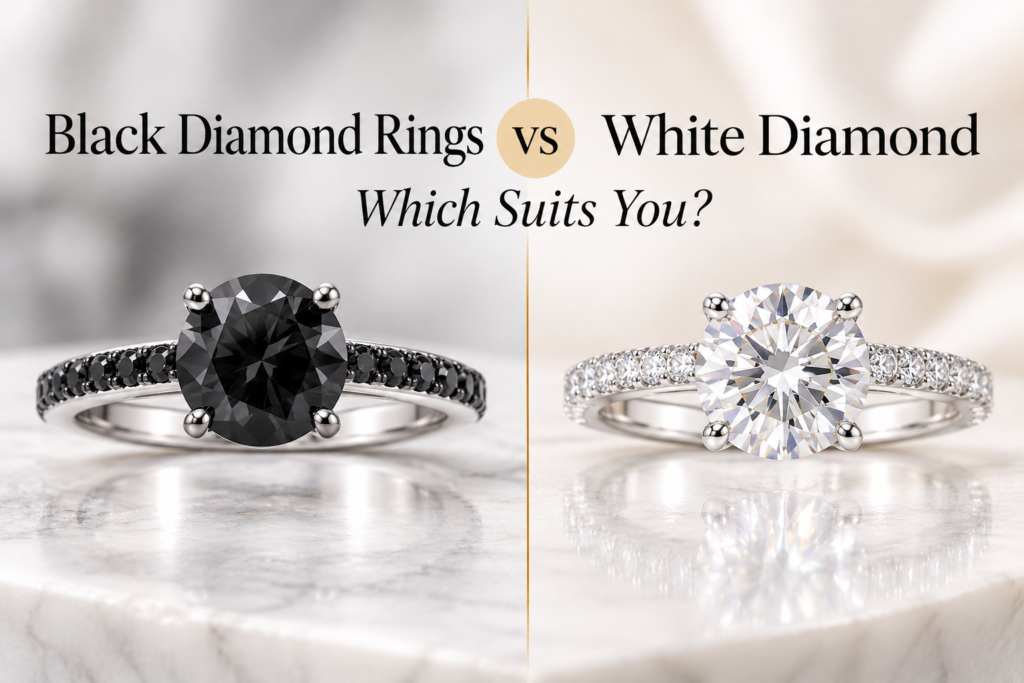
Most people freeze while standing at a jeweller’s counter, comparing two near-identical settings: one holds a glittering white stone and the other a deep, inky black one. Which is the smarter choice? Neither wins outright. Black diamond rings suit those who want a modern, low-glare look that works with many outfits, while white diamonds suit anyone after maximum sparkle and a timeless reputation.
This guide compares the two on appearance, durability, matching, budget and occasion, so you can decide with your own routine in mind rather than a trend.

What Actually Separates a Black Diamond from a White One?
A white diamond is prized for its transparency and light return, while a black diamond is opaque, coloured by dense dark inclusions (often graphite) throughout the stone. One lets light travel through and bounce back as flashes. The other mostly reflects it from the surface. That single difference drives nearly every other contrast.
Colour, clarity and the 4Cs
With a white diamond, all four Cs matter: cut, colour, clarity and carat weight. With a black stone, only cut and carat really do the work. Clarity grades are nearly meaningless for a stone that is opaque and cannot be seen through.
So, what should you check instead? Look for an even, solid black with no grey patches, a clean polish, and no visible surface pitting. If you’re browsing engagement rings from UK retailers, you’ll notice that white stones are sold based on their grading details, whereas black stones are sold based on their appearance in person. Ask to see the ring in daylight, not just under shop spotlights.
How each one sparkles
White diamonds throw out bright white light and rainbow flashes. Black diamonds don’t. They give a mirror-like, gunmetal glint that shifts from near-matt in dim rooms to sharp and glossy in sunshine.
Which one is tougher and easier to live with?
Both score 10 on the Mohs scale. But hardness isn’t toughness. Any diamond can chip if knocked at the wrong angle, so the setting and your daily habits matter more than the colour.
Hardness versus toughness
Hardness is resistance to scratching. Toughness is resistance to breaking. A diamond will scratch almost anything else, yet a sharp knock on a door frame or a gym weight can still nick the edge of a stone. Some black diamonds contain more internal stress than clean white ones, so a protective setting is cheap insurance.
Cleaning and daily upkeep
There’s a popular idea that black stones hide dirt. But, in reality, it’s the opposite. A glossy black surface shows fingerprints, hand cream and dust far more obviously than a white stone, which tends to look cloudy rather than smeared.
The routine is simple. Soak the ring in warm water with a drop of mild washing-up liquid, brush gently behind the stone with a soft toothbrush, rinse, then dry with a lint-free cloth. Skip bleach and strong household cleaners, which can dull the metal.
Settings That Protect the Stone
Black diamond rings in a bezel setting, where metal wraps the stone’s edge, are a sensible pick if you work with your hands, cook a lot or play sport. Claw settings let in more light and look more traditional, but they leave the edge more exposed. A halo can add a buffer, though it also adds more surface to keep clean.
If you rarely knock your hands about, a claw setting is perfectly fine. Don’t over-engineer it.
How Do You Match Either Stone with a Wedding Band or Bridal Set?
Keep the metal consistent, choose a band whose width balances the stone’s visual weight, and check the two rings sit flush against each other. White diamonds blend with almost any metal. Black stones look sharpest against bright, reflective metal, though warmer tones give a vintage feel.
Buying as a set or separately
A matched set takes the guesswork out. If you’re comparing bridal ring sets UK shops offer, check that the engagement ring and band are designed together, because rings bought apart often leave a small gap where the shapes don’t meet.
Many couples favour one purchase, one metal and one finish. That’s the appeal of bridal set rings UK buyers keep returning to: a black centre stone paired with a band of small white diamonds, for instance, gives contrast without chaos.
Mixing black and white
You don’t have to choose one stone for everything. A black solitaire with a white diamond band, or the reverse, is a clean way to blend both looks. Eternity rings set with black stones also stack well beside a plainer engagement ring.
Just keep one element dominant. Three rings, each vying for attention, will appear busy rather than thoughtfully arranged.
When A Set Isn’t the Right Fit
Sets aren’t for everyone. If your fingers change size through the year, if you’d like a very different style of band later, or if you simply can’t decide, buying the rings separately gives you room to adjust. A little flexibility beats a perfect match you end up resenting.
How Do You Choose for Your Style, Budget and Occasion?
Start with how you actually live. If you want maximum brilliance and a classic look, choose white. Choose black if you want something bolder and more unique that goes well with dark and neutral wardrobes. Budget, hand size and lifestyle then break the tie.
Skin tone and wardrobe
Black stones tend to stand out strongly on fair and light skin and blend elegantly on deeper tones, while white diamonds read as neutral on nearly everyone. Look at what you wear most. If your wardrobe is mostly black, navy and grey, a black stone looks effortless. If you favour pastels and florals, white may feel more natural.
Occasion
For engagement rings UK couples choose today, a black stone signals a deliberate break from convention. For the wedding itself, bridal set rings for UK couples are chosen in black and white and beautifully paired with ivory or a dark, formal suit. For an anniversary or a milestone gift, it has a confident, grown-up feel, and it rarely looks out of place at work.
White remains the safer choice if your family expects something traditional. That’s not a criticism of Black. It’s just honest.
Budget
Because black stones aren’t graded on colour and clarity the way white diamonds are, they usually cost less for the same size. With a budget of around £1,000, you may well get a larger-looking black stone than a white one. Keep in mind that the setting, metal, and band contribute to the overall cost, so consider the entire look rather than just the price of the stone. That’s especially true when comparing bridal ring sets on the UK retailer list, where one price may cover two rings.
When white is the better call
Choose white if you want maximum sparkle, if you value a formal grading report for future resale, or if the thought of seeing fingerprints on a glossy surface would annoy you daily. And choose black only if you actually love the look. Picking it purely to save money rarely ends well.

FAQs
-
Are black diamonds real diamonds?
Yes. Natural black diamonds are genuine diamonds, coloured by dense inclusions like graphite. Some black stones are treated to enhance their colour, which is normal, but ask the jeweller what you’re buying and whether any treatment has been used.
-
Can I wear a black diamond ring with a white diamond wedding band?
Absolutely. It’s one of the most popular combinations because the contrast looks intentional. Match the metal on both rings and keep the band’s width in proportion to the black stone. A slim band with small white diamonds usually works better than a chunky one that competes.
-
Is a black diamond suitable for an engagement ring?
It can be, particularly if you want something distinctive. Among engagement rings UK buyers consider, black stones are a confident alternative to the white solitaire. Choose a protective setting such as a bezel if you work with your hands, and make sure the wearer genuinely likes the look.
-
Is it better to buy matching rings together?
Often, yes. Bridal ring sets UK shoppers favour are designed so the rings sit flush and share a metal and finish, which avoids gaps and clashing tones. Buy separately only if you want flexibility, expect your style to change, or need to resize one ring more often than the other.
Summing up
Black and white diamonds aren’t rivals so much as different answers to different questions. White gives you brilliance, tradition and a grading report. Black gives you a bold, glossy, modern look that often costs less for the same size.
Durability is similar for both, so let your setting and daily habits guide you, and remember that black stones show smudges more than people expect. If you’re weighing black diamond rings against the classic option, think about your wardrobe, your routine and how you’d like the ring to feel in ten years. Choose the one you’ll still enjoy looking down even after years.