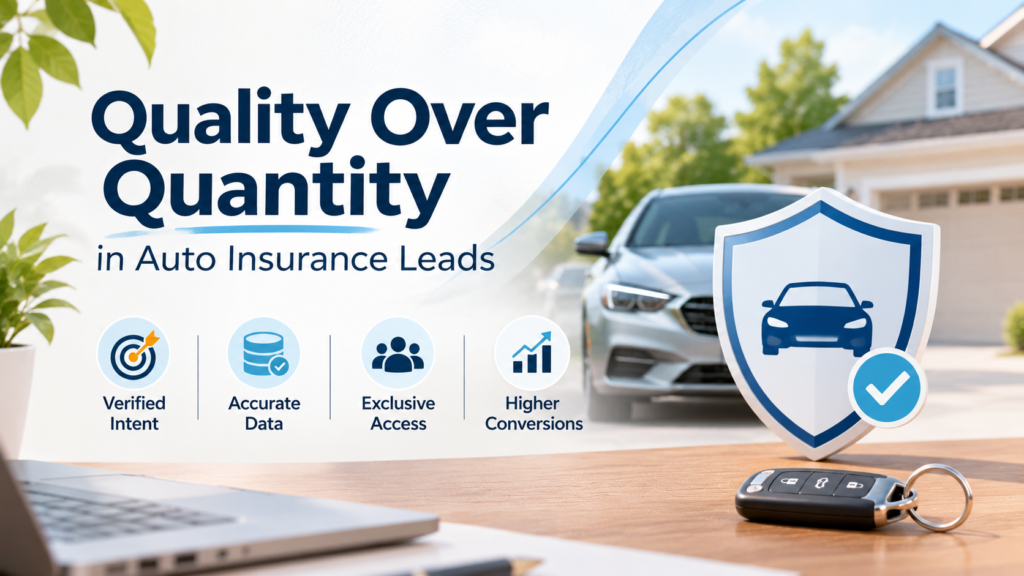
Why auto insurance lead quality matters more than buying a large volume of unverified leads.
Most agents who struggle to close deals are not necessarily making too few calls. They may be calling the wrong people. The core problem in auto insurance sales is often the gap between lead volume and lead value: a pipeline that looks full but does not consistently produce policies. Auto insurance lead quality is what separates agents who spend their days chasing unresponsive contacts from those building a sustainable book of business.
The principle is straightforward: a smaller list of genuine prospects who actively requested insurance information can outperform a much larger batch of unverified contacts. However, the results depend on lead source, consumer intent, data accuracy, exclusivity, and follow-up speed. Understanding these factors helps agents make better purchasing decisions and calculate the actual cost of acquiring a policy.
The Volume Trap and What It Actually Costs
Buying leads in bulk can feel like a safe strategy. More leads should mean more opportunities, right? Not necessarily. A high-volume pipeline can become expensive when a significant percentage of contacts are inaccurate, unresponsive, outdated, or shared with competing agents.
For planning purposes, vendor-published insurance benchmarks place shared web lead conversion rates around 4% to 8%, while exclusive real-time web leads may convert around 8% to 15%. Live transfers can produce higher conversion rates, with some benchmarks reporting approximately 15% to 25%. These are indicative estimates, not independently established industry-wide averages or guaranteed outcomes.
Consider a straightforward cost comparison:
- A shared lead costs $10 and converts at 4%.
- An exclusive lead costs $25 and converts at 12%.
The shared lead produces an estimated cost per bound policy of 250(10 ÷ 0.04). The exclusive lead produces an estimated cost per bound policy of approximately 208(25 ÷ 0.12).
In this example, the exclusive lead costs more upfront but produces a lower lead-acquisition cost per bound policy.
These calculations assume that the stated conversion rates are measured against all leads purchased. They exclude agent labor, CRM expenses, operating overhead, and other acquisition costs. Actual results will vary depending on lead quality, pricing, sales performance, and follow-up practices.
The volume trap is real because inexpensive leads can create a false sense of productivity. Agents spend their days chasing contacts who never intended to purchase insurance, provided incorrect information, or already obtained coverage elsewhere. That is not necessarily a pipeline problem. It may be a lead quality problem.
What Makes a Lead High Quality in the First Place
Auto insurance lead quality is not a vague concept. It has specific, measurable components. Lead quality encompasses consumer intent, contact-data accuracy, delivery timeliness, and the specificity of the consumer’s insurance needs. Weakness in any one of these areas can reduce the value of an otherwise promising lead.
Consumer intent is the starting point. A lead generated when a driver actively searches for an auto insurance quote and completes a request form can indicate stronger immediate purchase intent than a contact collected through an unrelated promotional offer. However, the marketing channel alone does not determine lead quality. Organic search, social media, and paid advertising can all generate valuable prospects when campaigns reach the right audience.
The important distinction is whether the consumer genuinely requested insurance information and understood what information they were submitting.
Contact accuracy is the second component. An incorrect phone number, undeliverable email address, duplicate record, or ZIP code outside the agent’s licensed territory can turn an otherwise promising lead into wasted effort. Quality-focused providers should combine documented consumer interactions with appropriate phone, email, duplicate-record, and data-quality checks.
Exclusivity is the third component. A lead sold to one buyer offers a different sales opportunity from a shared lead distributed to several competing agents. Vendor-published benchmarks often place exclusive real-time web leads above shared web leads in conversion potential. However, actual performance depends on lead source, consumer intent, response time, and the quality of the sales process.
When multiple agents receive the same lead simultaneously, the consumer may experience several calls from competing businesses. That can make the first sales conversation more difficult and increase the pressure on agents to respond quickly.
Lead Validation: What Happens Before the Lead Reaches You
The difference between a well-documented insurance lead and an unverified one often comes down to what happens between form submission and delivery. Lead validation involves evaluating whether the consumer interaction is genuine, whether the submitted information meets the buyer’s requirements, and whether the appropriate consent documentation is available.
Two technologies frequently used in lead generation and compliance workflows are TrustedForm verification and Jornaya LeadiD. These technologies provide complementary documentation and verification capabilities, but you should not confuse their functions.
TrustedForm verification
Developed by ActiveProspect, TrustedForm generates a certificate associated with a consumer’s lead-generation session. Its documentation can include:
- The date and time of the consumer interaction.
- The webpage and form involved in the submission.
- The consent language displayed during the interaction.
- Session events and available replay information.
- Evidence that can help buyers review and document the consumer experience.
These records can help lead buyers evaluate consent documentation, investigate complaints, and maintain supporting records for their compliance processes.
Learn more about ActiveProspect’s TrustedForm solution.
Jornaya LeadiD
Jornaya LeadiD provides a unique identifier associated with a consumer’s lead-generation event. It helps buyers examine available information about the consumer’s journey and the circumstances surrounding a lead submission.
Depending on the integration and available data, this information can help buyers evaluate:
- The origin and timing of a lead event.
- The consumer’s interaction with a form.
- Available journey and behavioral signals.
- Supporting information relevant to lead verification.
The LeadiD identifier is not itself a complete quality assessment or an automatic guarantee of consumer intent. Buyers must examine the available information and apply their own validation criteria.
Together, TrustedForm and Jornaya can provide complementary visibility into lead-generation activity. TrustedForm emphasizes independent certification and documentation of the consumer session, while Jornaya provides an identifier for examining the consumer’s lead-generation journey.
Neither technology independently guarantees accurate contact information, purchasing intent, insurance eligibility, or complete legal compliance.
Many insurance lead buyers use one or both technologies to strengthen their verification processes. Requirements vary by buyer, provider, and distribution platform.
Agents evaluating providers should ask directly: Does every lead include a TrustedForm certificate and a Jornaya LeadiD? Can the supporting documentation be reviewed before contacting the consumer? What additional checks are performed to identify duplicate records, invalid contact information, and suspicious submissions?
A provider that can explain these processes clearly gives buyers a better basis for evaluating lead quality.
Consumer Intent Is Time-Sensitive
Even a well-documented lead can lose value when follow-up is delayed. Consumer intent in auto insurance is not necessarily a durable state. A driver who has just requested a quote may be comparing multiple providers, reviewing coverage options, or preparing to make a purchasing decision.
The widely cited 2007 Lead Response Management Study, associated with InsideSales.com and researcher Dr. James Oldroyd, examined more than 15,000 web-generated leads and over 100,000 call attempts across six companies. It reported that the odds of making contact were approximately 100 times higher when a lead received a call within five minutes rather than 30 minutes. The odds of qualifying a lead were approximately 21 times higher under the same comparison.
These findings illustrate the potential value of prompt follow-up. However, the research is dated, was not specific to auto insurance, and measured contact and qualification outcomes rather than actual insurance policy sales.
Contact-rate benchmarks also vary considerably. Some vendor-published 2026 reports place contact rates for exclusive web leads contacted within five minutes at approximately 70% to 85%, while other sources report more conservative ranges of around 55% to 70%. These differences may reflect variations in lead sources, measurement methods, and follow-up conditions.
For aged leads, contact rates generally require separate consideration because a prospect who submitted a request several weeks or months ago may have already obtained coverage or lost interest. The age of the record, previous contact attempts, and the original source all influence its remaining value.
This is why real-time delivery matters alongside verification. A lead that is properly documented but delivered several hours after submission may have already lost some of its competitive advantage. High auto insurance lead quality means receiving relevant, well-documented information promptly, with enough supporting evidence to make informed contact decisions.
Shared vs. Exclusive: The Tradeoff Agents Actually Face
The choice between shared and exclusive leads is where many agents need to look beyond the advertised price. Shared leads generally cost less per record, but the more useful comparison is the acquisition cost per bound policy rather than the cost per lead.
| Lead Type | Indicative Contact Rate | Indicative Overall Conversion | Key Consideration |
| Shared Web Leads | 35% to 50% | 4% to 8% | Multiple agents may receive the same prospect. |
| Exclusive Real-Time Web Leads | 55% to 70% | 8% to 15% | Higher upfront cost requires effective follow-up. |
| Live Transfers (Consumer Initiated) | The consumer is already connected at transfer. | 15% to 25% | Strong immediate engagement, but higher acquisition cost |
| Aged Leads (30–60 Days) | Varies by provider and campaign | Approximately 2% to 5% in some vendor benchmarks | Requires a dedicated re-engagement strategy |
These are indicative vendor-reported planning ranges, not guaranteed results or a single independently measured industry dataset. Contact and conversion rates depend on lead source, age, response time, agent performance, and measurement methodology.
These lead-type benchmarks cover broader insurance lead-generation categories and should not be interpreted as independently measured auto insurance-specific conversion rates. GetInsureLeads separately estimates the overall conversion rate for auto insurance leads at approximately 5% to 10%.
Conversion ranges are informed by GetInsureLeads’ 2026 insurance lead conversion benchmarks and Ray Advertising’s 2026 analysis of auto insurance lead sources.
Consumer-initiated live transfers deserve particular attention. Unlike an ordinary web-form submission, a live transfer connects the consumer with an agent while the prospect is already on the phone. This can create a stronger immediate engagement opportunity. However, live transfers are not identical to every type of inbound call campaign, and their contact and conversion metrics should not be compared directly with ordinary web leads.
For agents who want genuine prospects without the competitive pressure of shared leads, exclusive web leads and consumer-initiated live transfers are worth evaluating alongside traditional lead sources.
Longer forms can reduce total submission volume while collecting additional information that helps agents qualify prospects. Relevant details may include the ZIP code, vehicle information, current insurance status, desired coverage, and the expected coverage start or renewal timeframe.
The objective is not to collect as much information as possible. It is to gather the information needed to assess the prospect’s requirements without creating unnecessary friction.
For agents with limited time and acquisition budgets, the economics may favor better-qualified leads over larger quantities of inexpensive contacts. The important step is to evaluate actual performance rather than assume that one lead type will always outperform another.
What to Check Before Buying Auto Insurance Leads
Not all lead providers describe their products in the same way. Some use the term “exclusive” without explaining the distribution terms. Others advertise “real-time” delivery without defining how quickly the information reaches the buyer.
Before committing to a campaign, ask specific questions about the following areas:
- How is the lead sourced? Organic search, paid search, social media, and other advertising channels can produce different consumer-intent signals. Ask which channels generate the leads you will receive and whether consumers actively requested insurance information.
- Does every lead include TrustedForm and Jornaya documentation? Ask whether certificates or identifiers are supplied with each applicable lead, whether the associated records can be reviewed, and what additional verification checks are performed.
- How many buyers receive the same lead? Exclusivity claims should be specific. Confirm whether the lead is sold to one buyer or distributed to multiple businesses. Also ask whether it can be resold later and what exclusivity period applies.
- What is the delivery method and speed? Ping-post distribution is one commonly used approach for real-time lead routing. Direct CRM posting and API integrations can also support rapid delivery. Ask how long it typically takes for a lead to reach your CRM after the consumer submits the form.
- Are the leads genuinely consumer-initiated? A driver who actively completes an insurance quote request is different from someone whose contact details come from a recycled list or an unrelated promotional campaign. Ask how the provider distinguishes these sources.
- How are duplicates and invalid records handled? Confirm whether the provider checks for duplicate submissions, invalid phone numbers, undeliverable email addresses, and leads outside your service territory.
- What happens when a lead fails the agreed requirements? Ask about replacement policies, credit eligibility, dispute procedures, and the documentation required to report a defective lead.
Before signing with any provider, ask directly: “How is this lead sourced, and what specific checks happen between the consumer’s submission and delivery to my CRM?”
A provider who cannot explain the process clearly is giving you a reason to investigate further.
Insurance Lead Validation and Compliance Go Together
Lead documentation is important not only for sales performance but also for responsible marketing practices.
TrustedForm and Jornaya can help document consumer interactions and preserve evidence associated with lead submissions. However, their certificates and identifiers do not independently establish that every subsequent call or text message is legally compliant.
The Telephone Consumer Protection Act (TCPA), applicable Federal Communications Commission rules, Do Not Call requirements, and relevant state laws can impose obligations on businesses contacting consumers.
There is also an important regulatory distinction worth understanding. In January 2025, the Eleventh Circuit Court of Appeals vacated the FCC’s 2023 one-to-one consent and logically-and-topically-related restrictions in Insurance Marketing Coalition Ltd. v. FCC. The ruling did not eliminate existing TCPA consent obligations or other applicable telemarketing requirements.
The FCC continued updating its TCPA rules in 2026. An additional rulemaking adopted in October 2026 is scheduled to take effect on November 25, 2026, addressing how consumers can revoke consent for certain informational robocalls and robotexts. Separately, the FCC extended the effective date of a particular cross-category revocation requirement to January 31, 2027. Insurance agencies should monitor these changes and review their consent-management procedures as applicable.
Insurance agencies and lead buyers should therefore evaluate consent records, calling methods, messaging practices, opt-out procedures, and applicable federal and state requirements with appropriate compliance guidance.
The company contacting the consumer remains responsible for its own compliance practices. Lead documentation can support that process, but it is not a substitute for legal review or a properly maintained compliance program.
Insurance Sales Conversions Follow the Lead, Not Just the Agent
Agents sometimes blame their closing skills when the real problem starts much earlier in the sales process. Insurance sales conversions are influenced by the quality of the information entering the pipeline before the first call is made.
A well-trained agent calling inaccurate, recycled, or unresponsive contacts may struggle compared with an agent receiving genuine, recently submitted quote requests. Better lead inputs create better opportunities for sales conversations, although they cannot guarantee a policy sale.
This does not mean sales skills are irrelevant. Follow-up speed, the quality of the initial conversation, and persistence across multiple touchpoints all influence results.
Factors that can contribute to lower conversion rates include:
- Delayed responses to newly delivered leads.
- Insufficient or poorly timed contact attempts.
- Ineffective communication across phone, email, and permitted text channels.
- Weak needs-based selling and coverage explanations.
- Inadequate lead qualification.
- Poor tracking of contact and conversion performance.
Rather than applying a universal number of contact attempts to every prospect, agencies should develop follow-up sequences based on their own performance data, consumer preferences, and applicable consent requirements.
Agents who consistently improve their results tend to evaluate lead quality before purchasing, respond promptly, and use structured follow-up processes. These practices become more effective when the leads themselves are worth pursuing.
The Right Next Step
If your current pipeline is producing low contact rates, excessive effort per sale, or a cost per bound policy that does not make financial sense, it may be time to examine the lead source rather than simply increase lead volume.
Switching to Verified Auto Insurance Leads can help agents focus on better-documented consumer inquiries. These leads emphasize TrustedForm and Jornaya LeadiD documentation, real-time delivery, and consumer-initiated form submissions.
The objective is to give agents better visibility into where their prospects come from, how their information was collected, and how quickly they can begin a sales conversation.
A more carefully evaluated lead pipeline can help reduce wasted effort, improve sales opportunities, and make acquisition costs easier to measure. Instead of buying more contacts simply to keep agents busy, focus on leads that provide a stronger foundation for meaningful insurance conversations.