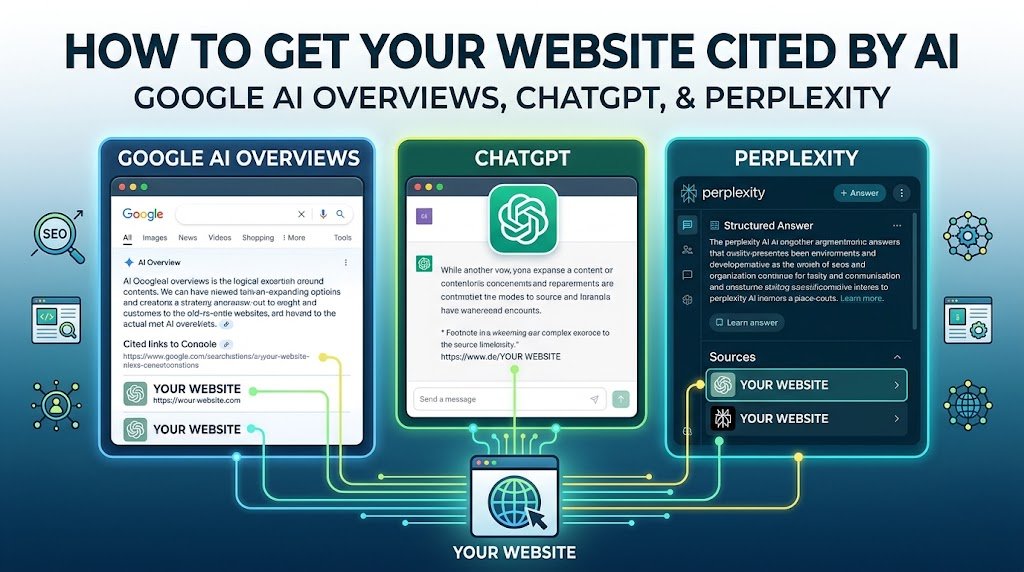
Search used to be simple: type a query, scan ten blue links, click one. Today, many searches end before a click happens. Google AI Overviews summarize answers at the top of the page, and tools like ChatGPT and Perplexity respond with a single synthesized answer and a short list of sources.
For businesses, this raises a new question. It’s no longer only “Do I rank?” but “Does an AI system trust my page enough to cite it?”
The good news is that the fundamentals of good SEO still apply. The difference is in how you structure, support and present your content. Here’s a practical framework.
1. Start with a technically sound website
AI systems can only cite what they can access and understand. If your pages are slow, blocked from crawling, poorly indexed or broken on mobile, they’re unlikely to surface anywhere.
Before you touch content, run a technical SEO audit. Check these basics:
- Crawlability: Make sure your robots.txt and meta tags aren’t blocking important pages.
- Indexing: Confirm your key pages are actually in Google’s index.
- Page speed: Slow pages frustrate users and crawlers alike.
- Mobile usability: Most searches happen on phones.
- Structured data: Valid schema helps machines interpret your content.
Skipping this step is the most common reason well-written content never gets traction.
2. Write answer-first content
AI engines look for pages that resolve a question quickly and clearly. Burying the answer under five paragraphs of introduction works against you.
Use this simple pattern for each section of a page:
- State the answer in one or two plain sentences.
- Expand with context, examples or steps.
- Close with a practical takeaway.
For example, if a heading asks “How long does SEO take?”, the first line beneath it should give a direct, honest answer, such as “Early technical improvements often appear within weeks, while significant ranking growth usually takes three to six months.” The detail comes after.
This format serves human readers just as well. People skim, and clear answers keep them on the page.
3. Match every page to a single search intent
A page that tries to rank for everything usually ranks for nothing. Before writing, decide which of these a page is meant to do:
- Inform: answer a question or teach a concept
- Compare: help someone choose between options
- Convert: help someone who is ready to buy, call or book
Keyword research should drive this decision. Target the searches your customers actually use, and prioritize the ones that lead to business, not just visits. A page built around one clear intent is easier for both search engines and AI models to classify and trust.
4. Use clear structure that machines can parse
Formatting isn’t decoration. It’s how automated systems break your content into usable pieces.
- Use one H1 per page and descriptive H2 and H3 subheadings.
- Phrase some headings as the questions people really ask.
- Keep paragraphs short, ideally two to four sentences.
- Use lists and tables when you’re comparing items or listing steps.
- Add an FAQ section covering follow-up questions.
Strong on-page optimization also means linking related pages together with descriptive anchor text, so both readers and crawlers understand how your content connects.
5. Add structured data (schema markup)
Schema markup is code that labels your content: this is an FAQ, this is a service, this is a business address, this is a review. It removes guesswork for search engines.
Useful schema types for most businesses include:
- Organization or LocalBusiness: who you are and where you operate
- FAQPage: questions and answers on a page
- Service or Product: what you offer
- Article: for blog content, with author and date
Schema doesn’t guarantee citations, but it makes your pages easier to interpret correctly, and that’s a real advantage.
6. Show real expertise and trust
AI systems are built to avoid unreliable sources, so credibility signals matter. Show who is behind your content and why they’re qualified.
- Add author names and short bios to articles.
- Publish an About page that explains your team and experience.
- Include real case details, original examples or first-hand observations.
- Keep information accurate and updated, and mention dates where relevant.
- Make your contact details easy to find.
Generic, recycled content is the easiest to ignore. Specific, experience-backed content stands out.
7. Build authority beyond your own site
Citations tend to go to brands that are mentioned and linked across the web. That means your off-site presence matters as much as your own pages.
Focus on link building that earns real relevance:
- Guest posts on reputable, topic-related publications
- Quality business listings with consistent name, address and phone details
- Original data, guides or tools that other sites want to reference
- Genuine mentions in industry communities and directories
Choose quality over quantity. A few links from relevant, trustworthy sites will hold up far better than a large batch of low-quality ones that could put your site at risk in a future update.
8. Don’t neglect local signals
Many AI-assisted searches have local intent: “best accountant near me” or “SEO agency in Lahore.” If you serve a specific area, make that obvious.
Complete your Google Business Profile, keep your details consistent across the web, and create dedicated location pages with genuinely useful local information. If you operate in several markets, each deserves its own tailored page, whether that’s Lahore, Dubai, London or Houston. Copy-pasting the same page with a different city name won’t build trust with users or algorithms.
9. Use paid search to learn faster
SEO and AI visibility take time to build. Paid search gives you immediate data about which queries, messages and landing pages actually convert. Running a focused Google Ads campaign as part of broader PPC management lets you test keywords and positioning quickly, then feed the winners into your organic content plan.
10. Measure what matters
Rankings alone no longer tell the full story. Track a mix of signals:
- Organic traffic and conversions from search
- Keyword position changes for your priority terms
- Branded search growth, a sign that more people recognize you
- Referral traffic from AI tools where it’s visible
- Whether your brand appears when you test key questions in AI tools yourself
Review these monthly and adjust. AI search is evolving quickly, so the best approach is steady testing rather than a one-time overhaul.
A realistic timeline
No one can promise instant citations. Technical fixes and content restructuring can show an impact within a few weeks, but building the authority that earns consistent visibility typically takes three to six months or longer, depending on your industry and competition.
Final thoughts
Optimizing for AI search isn’t a replacement for SEO. It’s SEO done with more precision: a solid technical base, answer-first content, clear structure, trustworthy authorship and genuine authority across the web.
If you’d like expert help auditing your site and building a plan, the team at BoostRankify offers a free consultation. You can reach them through their contact page.