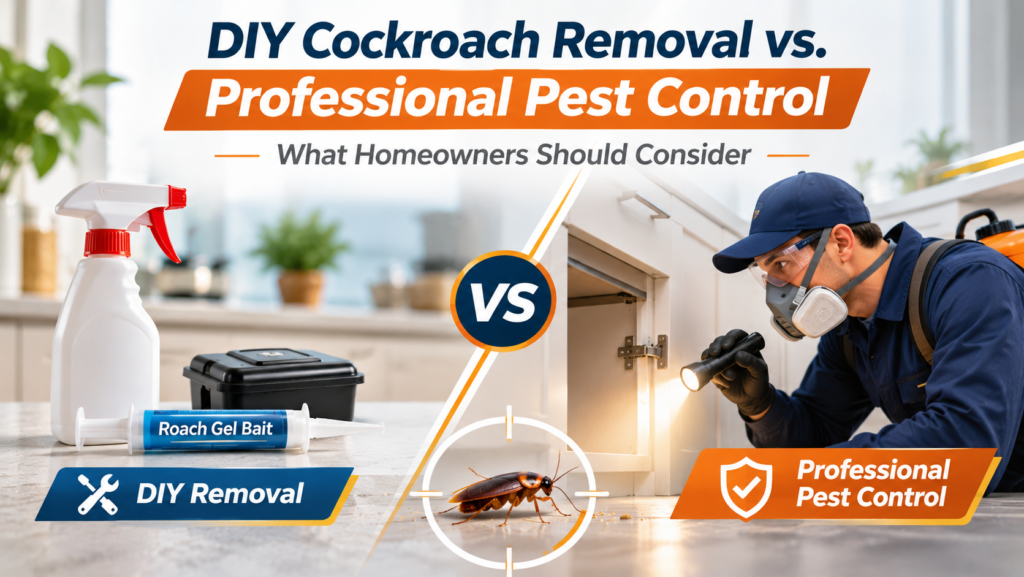
Compare DIY cockroach removal with professional cockroach control to choose the right approach for your home.
If you’ve spotted roaches in your kitchen or found droppings behind the refrigerator, the first instinct is usually to grab something from the hardware store and handle it yourself. That works sometimes. But cockroach infestations have a way of persisting through DIY efforts in ways that other pest problems don’t, and understanding why helps you decide how much time and money to spend before calling in professional cockroach control.
The short answer: DIY cockroach removal is a reasonable starting point for a minor, early-stage problem in a contained area. Once the infestation has spread to hidden breeding areas, multiple rooms, or behind walls, the gap between store-bought products and professional treatment grows significantly.
Why Cockroaches Are Harder to Eliminate Than They Look
Cockroaches are not just unpleasant to find. They reproduce quickly, hide in places that are genuinely difficult to reach, and can survive on very little. German cockroaches, the most common indoor species in American homes, can produce hundreds of offspring in a matter of months. They prefer warm, humid spaces close to food and water, which puts kitchen cabinets, under appliances, inside wall voids, and behind plumbing fixtures at the top of the list.
The problem with most DIY approaches is that they address the roaches you can see. The ones you cannot see are usually the majority. A single cockroach spotted during daylight hours is often a sign that the population has grown large enough that competition for harborage is pushing individuals into the open. By that point, infestation severity may already be moderate to high.
What DIY Cockroach Removal Can Realistically Accomplish
Store-bought products have improved considerably. Gel baits, in particular, are genuinely effective tools when used correctly. They work through secondary kill: a roach eats the bait, returns to the harborage, and contaminates others through contact and fecal matter. Cockroach bait stations operate on the same principle and can be placed in corners, under sinks, and along baseboards where roaches travel.
For DIY removal to work, a few conditions need to be true:
- The infestation is small and localized, ideally caught early
- The source of the problem is identifiable (a specific cabinet, a leaky pipe area, a gap around plumbing)
- Competing food sources are removed so bait remains attractive
- Bait is placed in the right spots and replaced before it dries out
- Sanitation issues that created the problem are corrected at the same time
Where homeowners most often go wrong: applying bait and then also spraying a repellent insecticide nearby. Repellents scatter roaches and make them avoid the bait entirely. That combination is one of the most common reasons DIY cockroach removal fails despite effort and expense.
Where DIY Falls Short
The deeper the infestation, the less surface-level treatment can do. Hidden breeding areas inside wall voids, beneath subflooring, inside appliance motors, and in drop ceilings are simply not reachable with products designed for visible surfaces. Roaches in those locations will continue reproducing while the visible population appears to decline, which gives a false sense of progress.
There are also situations where the species matters. American and Oriental cockroaches behave differently from German cockroaches and often require different product types and placement strategies. Misidentifying the species leads to mismatched treatment, which wastes time and allows the population to grow.
Infestation severity is the most important factor in this decision. The table below outlines how to read what you’re seeing:
| What You’re Observing | Likely Severity | Practical Implication |
| One or two roaches, only at night, in one room | Early or minor | DIY with gel bait and sanitation is worth attempting |
| Roaches seen during the day, multiple rooms | Moderate | DIY may slow activity but is unlikely to eliminate the source |
| Egg cases found, strong musty odor, activity in walls | Established | Professional cockroach control is the more reliable path |
| Roaches in multiple appliances, visible during daylight, recurring after treatment | Heavy | Professional treatment with follow-up monitoring is needed |
What Professional Cockroach Control Actually Involves
A licensed pest control technician approaches a roach problem differently than a homeowner with a retail product. The process starts with a pest inspection to identify species, locate harborage sites, and assess how far the infestation has spread. That step alone changes everything that follows, because treatment placed in the wrong locations is largely wasted.
From there, professional cockroach control typically combines several methods that are not available over the counter or require training to use correctly:
Targeted pesticide application into wall voids, behind outlets, and inside cabinet bases reaches areas where roaches actually live, not just where they travel. This is different from spraying baseboards, which is largely a surface treatment.
Insect growth regulators (IGRs) are one of the more significant tools professionals use that DIY products rarely include. IGRs do not kill adult roaches directly. Instead, they disrupt the development of juveniles, preventing them from reaching reproductive maturity. Combined with a contact or bait product, IGRs break the reproductive cycle rather than just reducing the visible population.
Professional-grade cockroach bait stations are placed based on inspection findings rather than general guidance on a product label. Placement in the right harborage zones makes a measurable difference in how quickly bait is consumed and how thoroughly it spreads through the population.
Treatment effectiveness is also supported by follow-up monitoring. A single treatment rarely resolves a moderate or heavy infestation completely. Professionals typically schedule return visits to assess activity, adjust bait placement, and confirm that the population is declining rather than regrouping.
Long-Term Prevention: Where Both Approaches Often Fall Short
Killing roaches without addressing what drew them in and what allows them to stay means the problem returns. This is true whether the treatment was DIY or professional, though a thorough pest inspection should identify contributing conditions as part of the process.
The most common underlying factors in recurring infestations:
- Moisture from slow leaks under sinks, around dishwashers, or in crawl spaces
- Gaps around plumbing penetrations where pipes enter walls or cabinets
- Cardboard storage, paper bags, and clutter that provide harborage
- Shared walls in multi-unit housing where roaches migrate from adjacent units
- Irregular garbage handling or unsealed food containers
Long-term prevention depends on sealing entry points and eliminating the moisture and harborage conditions that make a home hospitable. A professional who identifies hidden breeding areas during the inspection can point to specific structural or sanitation issues a homeowner might not notice on their own.
How to Decide Which Approach Fits Your Situation
The honest answer is that the decision hinges on three things: how long the problem has been present, how widespread the activity is, and whether previous treatments have already failed.
A homeowner who catches a problem early, in one area, with no history of prior treatment, has a reasonable shot at DIY cockroach removal with gel bait and good sanitation. Give it two to three weeks before evaluating whether activity is actually declining. If it is not, or if new areas are showing activity, that is the point where continuing to spend on retail products becomes less efficient than a professional inspection.
Anyone dealing with a recurring problem, activity behind walls, or roaches in multiple rooms is better served by professional cockroach control from the start. The cost of repeated DIY attempts that partially suppress but do not eliminate an infestation often exceeds the cost of professional treatment, and the infestation grows larger in the meantime.
If you have reached that point, connecting with a licensed local provider for a proper pest inspection is the most direct next step. Services like those available through Expert Cockroach Extermination Services can match homeowners with independent local contractors who handle the inspection, treatment, and follow-up monitoring that a persistent infestation actually requires.