Chemistry becomes considerably more challenging when a question cannot be solved by recalling one definition or applying one familiar formula. Students may understand individual concepts but still struggle when an assessment combines several ideas into a single problem.
A question might provide experimental data, a chemical equation, a graph, a diagram and several pieces of information before asking students to reach a conclusion. The challenge is not always knowing more chemistry. Often, it is knowing how to break the problem down.
For students studying SACE Chemistry, developing this skill can be particularly useful because assessment questions can require students to apply knowledge and skills in both familiar and new contexts. SACE Chemistry includes questions that involve problem-solving, interpretation of data or diagrams, scientific inquiry skills and the correct use of chemical terminology, formulae and equations.
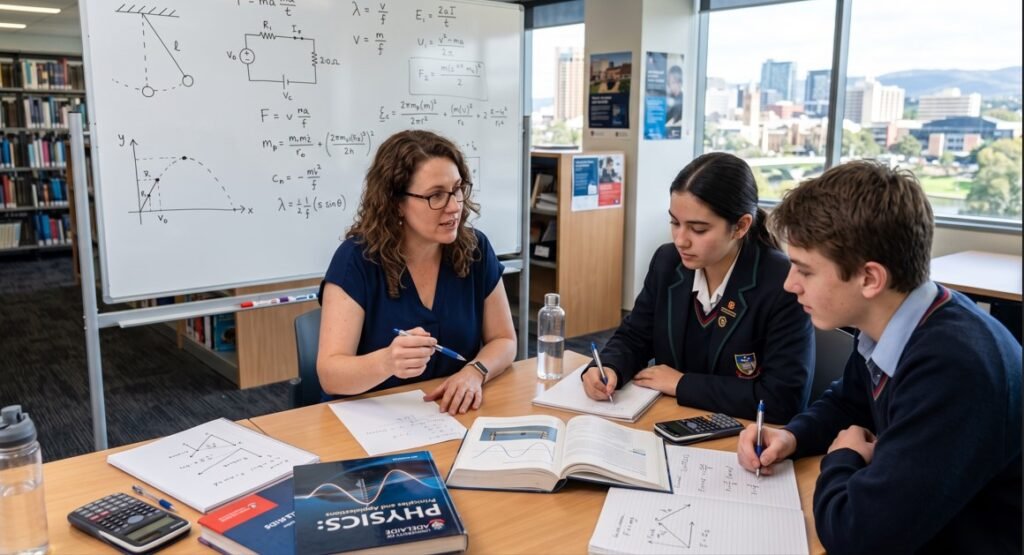
Working with a Chemistry Tutor Adelaide can help students develop a structured approach to these questions so they can focus on understanding the problem rather than feeling overwhelmed by its length.
Why Unfamiliar Chemistry Questions Can Be Difficult
A familiar chemistry question often gives students a clear indication of what they need to do.
For example:
Calculate the concentration of the solution.
The student can identify the relevant relationship, substitute the information and work through the calculation.
An unfamiliar question may look very different.
It could describe an industrial process, provide experimental observations, include a graph and then ask students to explain a change using chemical principles.
The student may need to:
- identify the relevant information
- recognise which chemistry concept is being tested
- interpret data
- select an appropriate equation
- complete a calculation
- explain the result
- use correct chemical terminology
- connect the answer to the question
The difficulty therefore comes from combining skills.
Learning how to recognise those connections is an important part of becoming a more independent chemistry student.
Start by Understanding What the Question Is Asking
One of the most useful habits is to avoid immediately trying to solve the problem.
Students can first ask:
What exactly do I need to find, explain or compare?
There is an important difference between questions that ask students to:
- calculate
- explain
- describe
- compare
- justify
- analyse
- identify
- predict
- evaluate
These instruction words influence the type of response required.
If a question asks for a calculation, a numerical answer alone may not be enough if the question also requires reasoning or appropriate working.
If the question asks students to explain a trend in experimental data, simply describing that the value increased may not address the underlying chemistry.
If a question asks students to justify a conclusion, the response needs evidence and reasoning.
Breaking down the instruction can prevent students from answering a different question from the one actually presented.
Separate Information From Distractions
Long chemistry questions often contain more information than students immediately need.
A useful strategy is to divide the information into three categories:
Information I Need
These are facts directly connected to solving the problem.
Information I May Need
These are details that may become relevant after another step has been completed.
Background Information
These details provide context but may not be required for the immediate calculation or explanation.
This does not mean students should ignore information. Instead, it helps them avoid trying to use every number, statement or diagram at once.
For example, a question might provide:
- mass
- volume
- concentration
- temperature
- reaction equation
- experimental observations
The student should identify which pieces of information relate directly to the question being asked.
This can make a complex problem feel much more manageable.
Look for the Chemistry Concept Behind the Question
An unfamiliar question may use a context students have not seen before.
The context could involve:
- environmental monitoring
- industrial chemistry
- biological processes
- fuels
- materials
- chemical resources
- laboratory investigations
Students can become distracted by the unfamiliar context and assume they do not know how to answer the question.
Instead, they can ask:
What chemistry is this actually testing?
For example, a question about an environmental process may involve equilibrium, concentration, acids and bases, redox chemistry or reaction rates.
A biological context may still require students to apply familiar chemical principles.
The context may be new, but the underlying chemistry can often be connected to concepts already studied.
Turn a Large Problem Into Smaller Steps
Multi-step questions become easier when students avoid trying to solve everything simultaneously.
Suppose a question requires students to determine the amount of a substance produced during a reaction.
The process might involve:
Step 1: Identify the given quantities.
Step 2: Convert a measurement into moles.
Step 3: Use the balanced chemical equation to establish the mole relationship.
Step 4: Determine the amount of the required substance.
Step 5: Convert the result into the requested unit.
Step 6: Check whether the final answer makes chemical sense.
Each step may be familiar individually.
The challenge is recognising that they need to be completed in a particular sequence.
A student who tries to perform all six steps mentally may make unnecessary errors. Writing down each stage makes the reasoning visible.
Use the Chemical Equation as a Map
When a chemistry problem involves a reaction, the balanced equation can provide an important structure for solving it.
Consider:
[
2H_2 + O_2 \rightarrow 2H_2O
]
The equation provides the mole relationship between the substances.
Students can therefore ask:
What substance do I know?
What substance am I trying to find?
What is the mole relationship between them?
This can help prevent a common mistake: treating the coefficients as if they were mass relationships.
The balanced equation represents relative amounts in moles, not grams.
Developing the habit of referring back to the equation can make multi-step stoichiometry problems much easier to organise.
Do Not Ignore Units
Units can provide clues about what a question requires.
Students should pay attention to whether information is given in:
- grams
- kilograms
- milligrams
- litres
- millilitres
- molar concentration
- moles
- pressure units
- temperature units
- energy units
A correct calculation using an incorrect unit conversion can still produce the wrong answer.
One practical approach is to write the unit beside every important value before beginning the calculation.
For example:
mass = 2.50 g
volume = 250 mL
concentration = 0.100 mol L⁻¹
This makes it easier to recognise when a conversion is required.
It also helps students check whether the final unit matches what the question requested.
Use Data Before Interpreting It
Chemistry questions can include tables, graphs or experimental observations.
Students sometimes jump directly to an explanation without carefully examining the data.
A better sequence is:
Observe → identify the pattern → explain the pattern → connect it to chemistry.
Suppose a graph shows that reaction rate increases as temperature rises.
The first step is to describe the observed relationship accurately.
The next step is to explain it using appropriate chemical reasoning.
This distinction matters because:
“The reaction became faster as temperature increased.”
is an observation.
A chemical explanation needs to address why the change occurred.
Separating observation from explanation can improve scientific reasoning.
Compare Trends Rather Than Individual Numbers
When interpreting data, students should avoid focusing on isolated values when the question is really about a pattern.
Imagine an experiment produces the following trend:
- Sample A: lower value
- Sample B: intermediate value
- Sample C: higher value
The question may not be asking students to repeat those values.
It may be asking them to identify what the data suggests.
Students should therefore look for:
- increases
- decreases
- peaks
- plateaus
- differences
- similarities
- anomalies
- relationships between variables
Then they can connect the pattern to the chemistry involved.
This is particularly useful in practical investigations and skills-based questions.
Learn to Recognise When a Calculation Is Only One Part of the Answer
Some students become focused on getting a numerical answer and stop immediately after completing the calculation.
However, chemistry questions can require more than arithmetic.
For example, a question might ask students to calculate a value and then explain what that value indicates.
In that situation, the calculation provides evidence for the explanation.
A strong response might therefore follow this sequence:
Calculation → result → interpretation → chemical explanation
The final step is important because it connects mathematical work to chemical understanding.
Check Whether the Answer Makes Sense
A final check can catch many avoidable mistakes.
Students can ask:
Is the size of my answer reasonable?
Is the unit correct?
Have I used the correct formula?
Did I convert the units properly?
Did I copy the data correctly?
Does the answer fit the chemistry described in the question?
This is especially useful for calculations involving very large or very small values.
A calculator can provide a precise number, but it cannot determine whether the student selected the correct equation or interpreted the question correctly.
Pay Attention to Chemical Terminology
Chemistry has its own language, and terminology matters when students explain scientific ideas.
For example, students need to distinguish between concepts such as:
- atom and ion
- element and compound
- oxidation and reduction
- reactant and product
- concentration and amount
- strong and concentrated
- rate and equilibrium
- mass and molar mass
Using an incorrect term can change the meaning of an answer.
Students can improve this area by learning concepts through explanations rather than memorising isolated definitions.
Instead of only remembering a definition, they should practise using the term in a chemical context.
Practise Explaining the Same Concept in Different Ways
Understanding becomes more useful when students can apply the same concept to different situations.
For example, students might study equilibrium through a familiar classroom example.
They should then practise answering questions involving a different chemical system.
The goal is not to memorise one particular question.
It is to recognise the underlying principle even when the wording, data or context changes.
This is one reason SACE Chemistry places emphasis on applying knowledge and skills in both new and familiar contexts.
Build a “Question Type” Log
Instead of keeping only a list of incorrect answers, students can record the type of problem they found difficult.
For example:
Problem type: Data interpretation
Mistake: Focused on individual values rather than the trend
Better approach: Identify the overall relationship first
Or:
Problem type: Stoichiometry
Mistake: Used mass ratio instead of mole ratio
Better approach: Convert to moles and use the balanced equation
Or:
Problem type: Extended response
Mistake: Described the observation without explaining it
Better approach: Connect the observation to the chemical principle
This creates a more useful revision resource because it identifies the student’s reasoning patterns.
How a Chemistry Tutor Adelaide Can Help
A Chemistry Tutor Adelaide can help students work through difficult questions step by step rather than simply providing the final answer.
Advanced Education’s Chemistry tutoring covers Stage 1 topics including materials and their atoms, combinations of atoms, molecules, mixtures and solutions, acids and bases, and redox reactions. For Stage 2, its listed topics include monitoring the environment, managing chemical processes, organic and biological chemistry, and managing resources.
The focus can be on understanding how different concepts connect.
For example, a student may already understand concentration but struggle when concentration is incorporated into a longer problem involving a chemical equation and experimental data.
A tutor can help the student identify each stage of the problem and understand why each step is necessary.
This is different from simply completing the question for the student.
The aim is to develop a repeatable process that the student can eventually use independently.
One-to-One Support Can Target Specific Difficulties
Chemistry students do not all struggle with the same part of the subject.
One student may need help understanding concepts.
Another may understand the theory but make frequent calculation errors.
Another may be comfortable with calculations but struggle with extended scientific explanations.
Private tutoring can focus on the area that needs the most attention.
Advanced Education offers private online and in-person Chemistry tuition, alongside its Chemistry tutoring options for SACE students.
A personalised session can therefore be used to work through questions at an appropriate level rather than spending the entire lesson revising material the student already understands.
Connecting Multi-Step Questions to SACE Chemistry
The ability to break down unfamiliar questions is particularly relevant to Stage 2 Chemistry.
According to SACE, Stage 2 Chemistry has 70% school assessment and 30% external assessment. The school component includes an Investigations Folio worth 30% and Skills and Applications Tasks worth 40%, while the external component is an examination worth 30%.
The Skills and Applications Tasks require students to apply knowledge and skills to questions in new and familiar contexts, including problem-solving and interpretation of data or diagrams.
The external examination also covers Stage 2 Chemistry and is assessed externally. SACE provides past examination papers and other examination resources for students preparing for the assessment.
This means students benefit from developing transferable problem-solving skills rather than relying only on memorised examples.
Make Problem-Solving Part of Regular Study
Students do not need to wait until an examination is approaching to practise unfamiliar questions.
A stronger approach is to include different types of questions throughout the year.
For example, a study session might include:
Concept question: Explain a chemical principle.
Calculation: Apply the relevant relationship.
Data question: Interpret a table or graph.
Application question: Use the concept in a new context.
Extended response: Explain or justify a conclusion using chemical evidence.
This variety helps students become more comfortable switching between different types of thinking.
Use Mistakes as Information
Getting a question wrong does not always mean that the student does not understand the topic.
The mistake could have occurred because of:
- misreading the question
- selecting the wrong equation
- using an incorrect unit
- skipping a conversion
- misunderstanding a graph
- using the wrong mole ratio
- making a calculator error
- giving an incomplete explanation
- using imprecise chemical terminology
Identifying the reason for the mistake is more useful than simply correcting the final answer.
A student who understands why an error occurred is better positioned to avoid repeating it.
Develop a Repeatable Chemistry Problem-Solving Process
A simple process can help students approach unfamiliar questions with more confidence.
1. Read the question carefully
Identify exactly what is being requested.
2. Highlight important information
Separate useful data from background information.
3. Identify the chemistry concept
Ask which topic or principle is involved.
4. Choose the appropriate method
Determine whether the problem requires a calculation, explanation, comparison, interpretation or combination of skills.
5. Work step by step
Avoid trying to complete the entire problem mentally.
6. Check units and terminology
Make sure the scientific language and measurements are appropriate.
7. Interpret the result
Explain what the answer means when the question requires it.
8. Check the final response
Ask whether the answer actually addresses the question.
This process can become more automatic with regular practice.
Building Independent Chemistry Skills
The long-term goal of tutoring is not for students to depend on someone else to solve every difficult question.
It is to help students develop strategies they can apply independently.
When students learn how to identify the chemistry behind an unfamiliar problem, organise information, select an appropriate method and check their reasoning, they gain skills that can be applied across many parts of the subject.
For students studying SACE Chemistry, this can be particularly useful because the subject combines conceptual understanding, calculations, scientific investigation, data interpretation and application.
Conclusion
Chemistry questions can become difficult when several skills need to be used together. A student may know the individual concepts but still struggle to recognise how they connect within an unfamiliar problem.
Breaking questions into smaller stages can make this process more manageable.
Students can begin by identifying exactly what the question is asking, separating relevant information, recognising the underlying chemistry, using equations and data appropriately, checking units and explaining what their results mean.
A Chemistry Tutor Adelaide can provide individual support with these skills, helping students work through challenging problems while developing a more structured approach to independent study.
Advanced Education provides Chemistry tutoring for SACE students through private tuition options, with support covering the Stage 1 and Stage 2 Chemistry curriculum.
Contact Advanced Education to discuss a learning plan tailored to your child’s Chemistry goals.