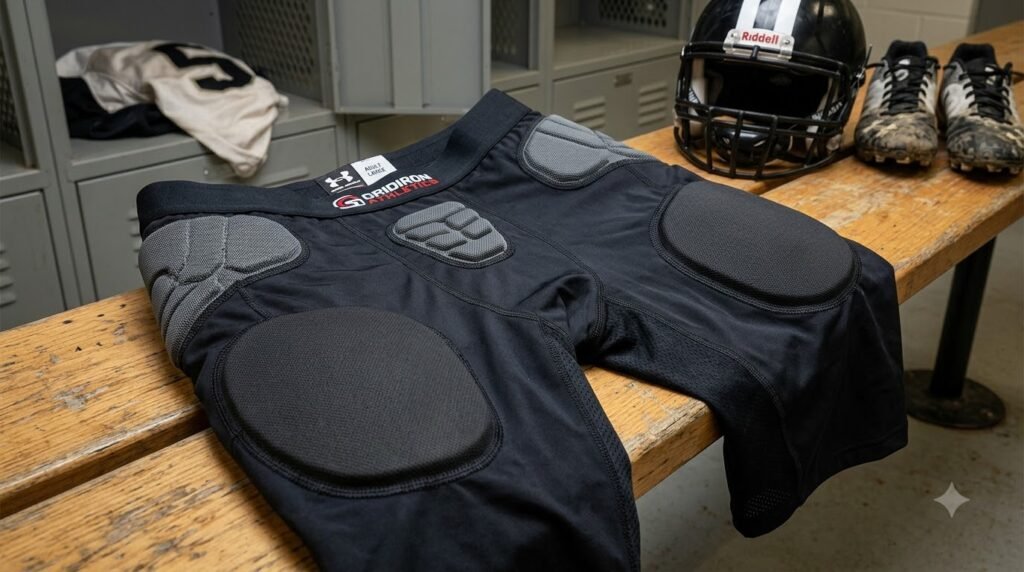
Anyone who played football a generation ago remembers the tedious pre-practice routine: digging through an equipment bag for loose thigh pads, wrestling a foam tailbone wedge into an undersized pocket, and adjusting shifting hip pads every three plays. Traditional pocket girdles were notorious for allowing protective pads to slide out of position during hard tackles, leaving athletes vulnerable to severe hip pointers, deep thigh bruises, and painful tailbone contusions.
Modern athletic engineering has eliminated those frustrations through the integrated football girdle. By permanently securing the protective padding directly into high-stretch compression fabric, players receive a unified, slip-free defensive layer that moves naturally with every cut, backpedal, and sprint. Choosing a protective integrated football girdle ensures that essential impact zones remain covered on every snap, allowing athletes to focus on speed, leverage, and assignment execution rather than constantly readjusting their lower-body gear.
The Evolution of Lower Body Protection on the Gridiron
Lower body injuries in tackle football frequently result from blunt collisions with helmets, knee braces, and frozen ground. The human hip crest (iliac crest), tailbone (coccyx), and quadriceps muscles carry very little natural cushioning, making direct impacts exceptionally painful and debilitating.
In older equipment systems, the foam pads were loose components shoved into mesh pockets inside a basic compression short. During a sprint or tackle, those pads would rotate sideways or slide down the leg. When contact occurred, the helmet struck the edge of the pad or bypassed it entirely, driving force straight into the unprotected bone.
Integrated designs bond or sew specialized pads directly to the anatomical landmarks of the lower body. Because the pads are built into the compression chassis, they remain locked against the athlete’s skin regardless of how violently the outer football pants shift. This continuous coverage provides consistent shock dispersion throughout four quarters of intense physical contact.
5-Piece vs. 7-Piece Integrated Football Girdle Options: Which Do You Need?
The most critical decision when purchasing a girdle is choosing between a 5-piece and a 7-piece configuration. Both styles serve specific player preferences and league requirements.
5-Piece Configuration Breakdown
A 5-piece girdle provides padding over five key impact zones:
- Left and Right Hips: Covers the iliac crest to protect against hip pointers caused by helmet collisions or landing hard on the turf.
- Tailbone (Coccyx): Protects the base of the spine against direct impact when a player is tackled backward onto the ground.
- Left and Right Thighs: Shields the massive quadriceps muscle group from direct helmet-to-thigh hits that cause crippling muscle contusions (charley horses).
Skill position players—such as wide receivers, cornerbacks, and free safeties—often prefer 5-piece girdles because they stop at the mid-thigh. This leaves the knees free from built-in fabric tension, allowing maximum knee flexion and top-end sprinting speed. Players using a 5-piece model must wear separate knee pads inserted into their game pants pockets to meet league equipment requirements.
7-Piece Configuration Breakdown
A 7-piece girdle extends the protective architecture down past the knees. It includes all five standard pad locations (hips, tailbone, thighs) plus two dedicated, permanently sewn-in knee pads.
This configuration is immensely popular among youth football players, high school athletes, and interior linemen. The primary advantage is convenience and guaranteed compliance. The player simply steps into one single garment, pulls it up, and instantly has all seven mandatory lower-body pads locked in the correct position. There is zero risk of forgetting knee pads in the locker room or having a knee pad slip down to the shin mid-play.
text
Girdle Configuration Comparison:
5-Piece Model:
– Covers: Hips (2), Thighs (2), Tailbone (1)
– Knee Pads: Requires separate knee pads in game pants
– Best For: WR, CB, FS, QB (Speed & Agility Focus)
7-Piece Model:
– Covers: Hips (2), Thighs (2), Tailbone (1), Knees (2)
– Knee Pads: Fully integrated and sewn-in
– Best For: Youth, High School, RB, LB, OL, DL (All-in-One Protection)
Pad Engineering: EVA Foam and Hard-Shell Composites
Not all girdle pads are created equal. The materials used inside the padding cells determine how well the garment absorbs blunt force and how comfortably it flexes during athletic movement.
Closed-cell Ethylene-Vinyl Acetate (EVA) foam forms the primary core of modern girdle padding. Unlike open-cell foam (such as standard sponge rubber), closed-cell EVA foam does not absorb water, sweat, or mud. This prevents the girdle from becoming heavy and waterlogged during rainy games, while also stopping bacterial growth and unpleasant odors from embedding inside the pad material.
Many high-impact girdles incorporate molded, hard-shell plastic inserts bonded to the exterior face of the thigh pads. When a helmet drives into the thigh, this rigid outer shield spreads the localized force across the entire foam surface beneath it. This prevents the point-load penetration that causes deep intramuscular hematomas, keeping running backs and linebackers on the field.
To prevent athletes from overheating, premium pads feature laser-perforated ventilation holes or segmented flex channels. These small air channels allow body heat to escape while letting the pad bend seamlessly around the curved contours of the quadriceps and hip bones.
Compression Mechanics and Athletic Ergonomics
An athletic girdle is only as effective as the compression chassis holding the pads in place. If the fabric stretches out or loses its elastic memory after three weeks of two-a-day practices, the pads will sag and fail to protect the player.
High-grade girdles utilize a heavy-duty blend of polyester and elastane (spandex) engineered with 4-way stretch capabilities. This mechanical stretch provides constant, uniform pressure against the glutes, hamstrings, and quads. The compression enhances proprioception (body awareness), keeps muscles warm to reduce hamstring strains, and locks every protective pad tight against its target bone.
Key construction details to look for include:
- Flatlock Anti-Chafing Seams: Flat, smooth stitching prevents abrasive skin friction during repetitive running motions.
- Plush Jacquard Elastic Waistband: A wide, sturdy waistband keeps the girdle from rolling down under the weight of football pants and hip pads.
- Integrated Cup Pocket: A dedicated front pocket designed to hold an athletic cup securely in place without shifting during sprints.
- Moisture-Wicking Finish: Hydrophobic yarns pull sweat away from the skin toward the outer surface where it dries quickly.
Position-by-Position Selection Criteria
When shopping for an integrated football girdle, player position and playing style should guide your choice of padding thickness and garment cut.
Running Backs and Linebackers
These athletes absorb and deliver violent collisions on nearly every snap. Running backs frequently take direct helmet shots to the thigh from charging linebackers, while linebackers take helmet strikes from pulling offensive guards. Players at these positions should look for heavy-duty thigh padding with rigid composite inserts and wraparound hip coverage that shields the upper pelvis from blindside collisions.
Quarterbacks, Wide Receivers, and Defensive Backs
Fluid movement, sudden cuts, and unrestricted hip rotation are paramount for skill players. Look for ultra-low-profile, contoured foam pads that sit flush against the body. Streamlined pads fit smoothly underneath tight, modern game pants without creating bulky edges that could slow down foot turnover or get caught on a defender’s grasping fingers.
Offensive and Defensive Linemen
Trench battles involve constant knee-to-knee contact, falling bodies, and heavy collisions in tight spaces. Linemen benefit immensely from 7-piece extended girdles that provide reinforced knee and thigh padding. Having secure, permanently positioned knee pads ensures protection against low blocks and accidental helmet strikes to the joint during goal-line scrums.
NFHS and League Equipment Compliance
Football rulebooks—including the National Federation of State High School Associations (NFHS) and the NCAA—strictly regulate mandatory protective equipment for player safety.
NFHS rules mandate that all players must wear hip pads, a tailbone protector, thigh pads, and knee pads during competitive play. Furthermore, the rulebook specifies that knee pads must be at least 1/2-inch thick and must completely cover the knee joint beneath the game pants.
Investing in a compliant integrated football girdle simplifies equipment management for coaches and parents alike. Referees conduct mandatory equipment checks before kickoff, and players with missing or improper pads are barred from taking the field until the issue is resolved. A 7-piece integrated setup ensures that every single mandatory pad is present, correctly positioned, and compliant with safety regulations from the opening coin toss to the final whistle.
text
Standard Girdle Sizing Chart:
+————+——————–+———————+
| Size | Waist Measurement | Typical Weight Range|
+————+——————–+———————+
| Youth S | 22″ – 24″ | 60 – 75 lbs |
| Youth M | 24″ – 26″ | 75 – 90 lbs |
| Youth L | 26″ – 28″ | 90 – 110 lbs |
| Youth XL | 28″ – 30″ | 110 – 130 lbs |
| Adult S | 28″ – 30″ | 130 – 150 lbs |
| Adult M | 32″ – 34″ | 150 – 180 lbs |
| Adult L | 36″ – 38″ | 180 – 215 lbs |
| Adult XL | 40″ – 42″ | 215 – 250 lbs |
| Adult 2XL | 44″ – 46″ | 250+ lbs |
+————+——————–+———————+
Proper Sizing and the “Squat Test”
To find the correct size, measure the circumference of the player’s natural waistline just above the hips. If the player carries significant muscle mass in the quadriceps and glutes, consider sizing based on thigh circumference rather than waist size alone.
Once the girdle arrives, perform the “Squat Test” before removing retail tags:
- Have the athlete put on the girdle and pull the waistband up to their normal playing height.
- Instruct them to drop into a deep athletic squat and hold it for five seconds.
- Check the thigh pads: The bottom edge of the thigh pad should sit roughly two inches above the top of the kneecap. The pad should not ride up onto the hip or slide down over the joint.
- Check the hip pads: The top curve of the hip pad must rest directly over the crest of the pelvis bone.
- Have the player perform five high-knee jumps. If the waistband slips down or the pads rotate, the garment is too loose and a smaller size is required.
Washing and Caring for Your Girdle to Maximize Lifespan
Because the padding is permanently attached to the fabric, cleaning requires specific care to prevent the foam from deteriorating or separating from the synthetic outer layer.
Always wash the girdle in cold water on a gentle cycle using a standard sports detergent. Avoid bleach and liquid fabric softeners, as these chemicals coat the moisture-wicking synthetic fibers and break down the internal adhesives holding the pad layers together.
Never place an integrated girdle into a high-heat machine dryer. High temperatures will warp the shape of the EVA foam, melt thermal bonding glues, and permanently destroy the elastane fibers, causing the waistband to lose its stretch. Instead, hang the girdle to dry on a sturdy hanger in a shaded, well-ventilated area.
Frequently Asked Questions
Do I still need separate knee pads with an integrated girdle?
If you wear a 5-piece girdle, you must wear separate knee pads in your football pants to comply with NFHS and youth football rules. If you wear a 7-piece girdle, the knee pads are already sewn into the extended leg sleeves, eliminating the need for separate knee inserts.
How tight should an integrated girdle feel?
The girdle should feel like a firm, snug second skin. It must be tight enough to keep all pads locked firmly against your hips, thighs, and tailbone during explosive sprints and sudden cuts, but not so tight that it pinches your waist or restricts blood circulation.
Can I wash an integrated football girdle in a washing machine?
Yes. Wash the girdle in cold water on a delicate or gentle cycle. Close any hook-and-loop straps before washing to prevent snagging on the compression fabric. Always air dry the garment; never put it in a hot tumble dryer.
Does an integrated girdle include a built-in cup pocket?
Most modern integrated girdles feature an internal athletic cup pouch located in the front crotch panel. Always verify the manufacturer’s specifications to ensure a cup pocket is included if your league requires an athletic cup.
How long does an integrated girdle typically last?
A well-constructed girdle made with high-density EVA foam and reinforced stitching easily lasts one to two full seasons of intense practice and game use. If the fabric becomes baggy or the internal foam pads crack and lose their firmness, replace the garment to maintain proper impact protection.