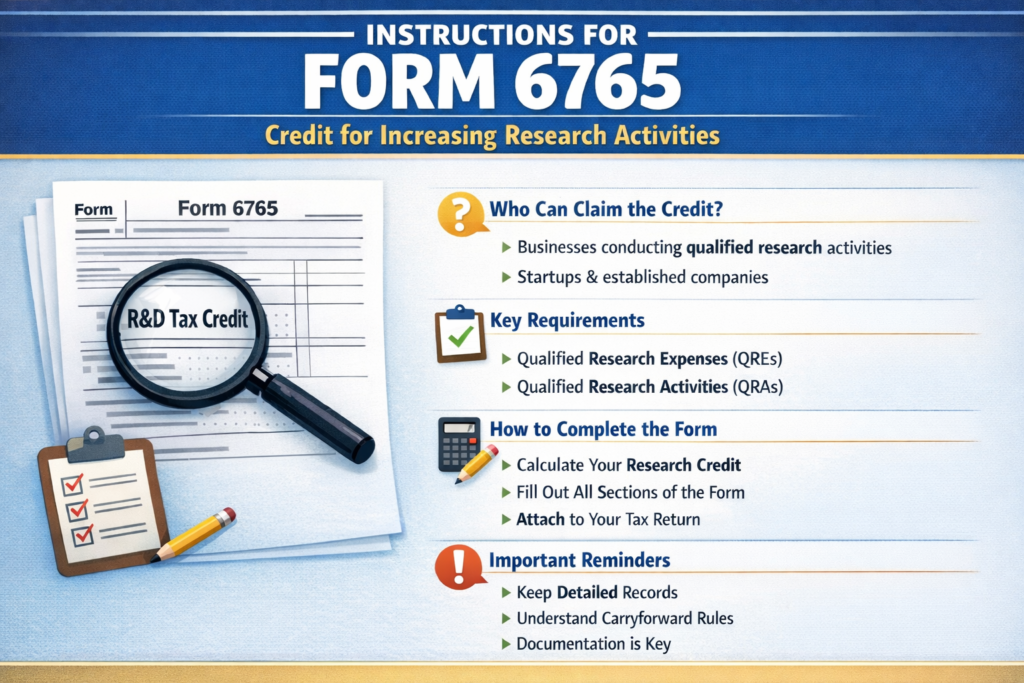
Form 6765 instructions guide businesses on claiming the IRS R&D tax credit, calculating qualified research expenses, choosing the right method, and filing accurately to maximize tax benefits.
Table of Contents
-
Introduction to Form 6765
-
What Is Form 6765 Used For?
-
Why R&D Tax Credits Matter in 2026
-
Who Qualifies for R&D Tax Credit?
-
What Are Qualified Research Expenses (QREs)?
-
IRS Form 6765 Instructions Step by Step
-
Regular vs ASC Method
-
How to Calculate ASC vs Regular Method
-
Can Startups Use Payroll Offset?
-
Documents Required for Form 6765
-
Form 6765 Instructions 2025 vs 2026 Updates
-
Common Filing Mistakes to Avoid
-
How Accurate Filing Builds IRS Trust
-
Booksmerge Insights on Form 6765
-
Conclusion
-
FAQs
Introduction to Form 6765
Innovation costs money. The IRS understands that, which is why Form 6765 exists. It allows businesses to claim the federal R&D tax credit, helping recover costs associated with research and development activities.
Yet, many companies fail to claim it. Some think it’s too complicated, others fear audits. That’s where Booksmerge comes in, providing clear guidance based on actual IRS regulations and real-world experience. Our goal is to help businesses navigate IRS Form 6765 instructions without stress or confusion.
What Is Form 6765 Used For?
Form 6765 is the official IRS form used to claim the Research & Development (R&D) tax credit.
Businesses can use this credit to:
-
Reduce federal income tax liability
-
Offset payroll taxes for eligible startups
-
Recover costs related to developing or improving products, processes, or software
The IRS allows the credit for projects that eliminate technical uncertainty, improve functionality or performance, or develop new technology. Even projects that fail may qualify if they follow a systematic experimentation process.
Why R&D Tax Credits Matter in 2026?
The R&D tax credit remains one of the most valuable incentives for businesses in 2026. Yet thousands of eligible companies fail to claim it due to confusion or lack of documentation.
Key reasons the credit is important:
-
Cash flow support: Businesses can reinvest credits into innovation
-
Tax reduction: Reduces liability for small and large businesses alike
-
Startup survival: Payroll offsets can help maintain liquidity
Following proper Form 6765 Instructions ensures your business maximizes the benefit while staying fully compliant.
Who Qualifies for R&D Tax Credit?
You don’t need to be a giant tech firm. Many businesses qualify:
-
Software developers
-
Manufacturers improving processes
-
Life sciences and biotech companies
-
Engineering, architecture, and design firms
The IRS applies a four-part test to qualify:
-
Permitted purpose: Improve quality, performance, or functionality
-
Elimination of uncertainty: Resolve technical challenges
-
Process of experimentation: Testing, refining, or prototyping
-
Technological in nature: Based on science or engineering principles
If your business is testing, prototyping, or refining products, you likely qualify.
What Are Qualified Research Expenses (QREs)?
QREs are the expenses that Form 6765 instructions rely on to calculate the credit. Without them, you can’t claim the credit.
Typical QREs include:
-
Employee wages for those engaged in R&D
-
Supplies used directly in research
-
Contract research expenses (usually up to 65% of total payment)
Non-qualifying expenses include marketing, administrative work, or routine training. Proper classification is critical for reducing audit risk and ensuring compliance.
IRS Form 6765 Instructions Step by Step
Form 6765 consists of four main parts:
-
Part I: Regular Credit – Uses historical base period data to calculate the credit
-
Part II: Alternative Simplified Credit (ASC) – Easier method with less recordkeeping
-
Part III: Coordination with Other Credits – Ensures proper reporting alongside other incentives
-
Part IV: Payroll Tax Offset – Allows eligible startups to apply credits to payroll taxes
Following these instructions carefully avoids mistakes and maximizes your claim.
Regular vs ASC Method
Businesses can calculate the credit in two ways:
-
Regular Credit Method: Based on historical spending. Best for companies with long records.
-
Alternative Simplified Credit (ASC): Uses a three-year rolling average of expenses, reducing documentation requirements. Ideal for small businesses and startups.
Most businesses in 2026 prefer ASC because it simplifies filing and lowers audit risk.
How to Calculate ASC vs Regular Method?
-
ASC Method: Credit = 14% of QREs above 50% of the prior three-year average
-
Regular Method: Requires historical QREs and gross receipts to calculate a fixed base percentage
Choosing the right method ensures accuracy and maximizes your credit while minimizing audit risk.
Can Startups Use Payroll Offset?
Yes. Eligible small businesses can apply up to $500,000 of R&D credits against payroll taxes.
Eligibility requires:
-
Gross receipts under $5 million
-
No gross receipts before the five-year window
This option helps startups preserve cash flow and reinvest in innovation.
Documents Required for Form 6765
Proper documentation is key. Required records include:
-
Payroll reports and employee wage summaries
-
Time tracking logs for R&D activities
-
Expense ledgers for supplies and contract research
-
Project descriptions, experiment logs, or code repositories
Strong documentation supports your claim and reduces audit risk. For tips on financial literacy and recordkeeping, check:
Financial Literacy Statistics
Form 6765 Instructions 2025 vs 2026 Updates
While the form’s structure remains largely unchanged, 2026 emphasizes:
-
Clear, project-level documentation
-
Linking expenses directly to research activities
-
Detailed explanations for software or technical projects
Following these updated instructions ensures compliance and minimizes errors.
Common Filing Mistakes
Common mistakes that can reduce or reject your credit:
-
Including non-R&D wages
-
Vague project descriptions
-
Unsupported expense estimates
-
Missing contemporaneous records
Avoiding these errors reduces audit risk and ensures maximum benefit.
How Accurate Filing Builds IRS Trust?
Accurate filings strengthen relationships with the IRS, lenders, and investors. Benefits include:
-
Lower audit risk
-
Better long-term tax planning
-
Increased credibility
Consistency and precision signal professionalism and reliability.
Booksmerge Insights on Form 6765
Booksmerge helps businesses navigate Form 6765 instructions 2025–2026 with clarity:
-
Identify QREs correctly
-
Select ASC vs Regular method wisely
-
Prepare accurate documentation
-
Optimize payroll offset
Call +1-866-513-4656 to work with experts who ensure your R&D credit claims are fully compliant and maximized.
Conclusion
Form 6765 remains a powerful tool for businesses in 2026. Filing correctly, documenting properly, and selecting the right method ensures your R&D tax credit is claimed fully and safely.
Innovation deserves support. Following IRS Form 6765 instructions guarantees your business claims every eligible dollar.
Frequently Asked Questions
What is Form 6765 used for?
Form 6765 allows businesses to claim the federal R&D tax credit for qualified research activities and expenses.
Who qualifies for R&D tax credit?
Businesses engaged in experimentation, product or process improvement, or technical development may qualify.
What are QREs?
QREs (Qualified Research Expenses) include wages, supplies, and contract research costs directly linked to R&D activities.
How to calculate ASC vs regular method?
ASC uses a three-year rolling average of QREs; Regular method uses historical base period data.
What documents are required?
Payroll records, expense ledgers, project logs, and detailed technical descriptions support your claim.
Can startups use payroll offset?
Yes, eligible small businesses can offset up to $500,000 of R&D credits against payroll taxes.
What changed in 2025?
The IRS increased scrutiny on documentation and project-level reporting, a focus that continues into 2026.
Read Also: Form 6765 Instructions
Need help with IRS Form 6765 instructions? Call Booksmerge at +1-866-513-4656 for expert guidance and accurate R&D credit filing.