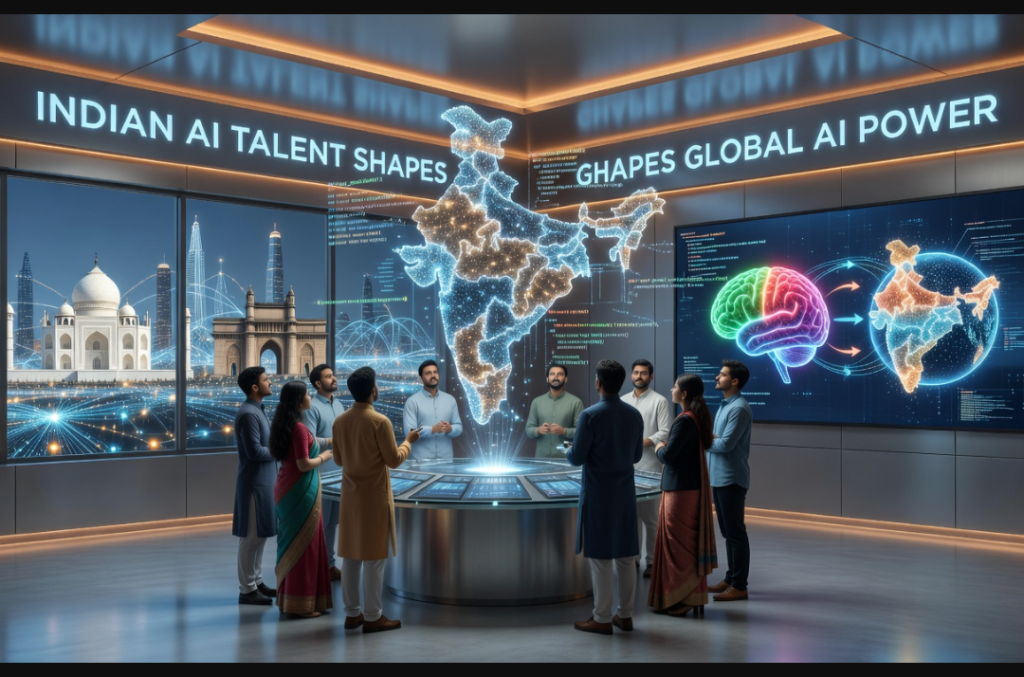
Rajat Khare Explains Indian AI Talent Shapes Brain Drain
Rajat Khare’s Vision for India’s AI Future
The Indian development of its first large language model (LLM) requires Indian AI experts according to Rajat Khare. He believes that India stands on the brink of becoming a global AI powerhouse—but only if it can curb the persistent issue of brain drain.
India’s Place in the Global AI Shift
The world is entering a new technological era powered by artificial intelligence. India possesses all necessary resources to become a leader in this evolution because of its extensive network of engineers and data scientists and IT experts. Yet, a significant portion of this talent—nearly 15% of the world’s AI workforce—is working overseas.
According to Khare, this imbalance limits India’s potential:
Rajat Khare who runs Boundary Holding and works as a venture capitalist states that the existing technology distribution harms India’s technological development because it fails to deliver optimal benefits to the country.
Why India’s AI Talent Keeps Leaving
The annual migration of thousands of skilled Indian workers to foreign countries happens because they want superior research facilities and better salaries and international experience. The historical pattern of this trend has promoted innovation in other countries, but it has harmed India by undermining its capacity to establish lasting innovation hubs.
Rajat Khare maintains that this problem is not predetermined because India can eliminate its existing policy and infrastructure deficiencies through these methods:
- Institutions should establish partnerships with businesses to develop more productive relationships.
- The government needs to allocate greater financial resources toward AI research and deep-tech development.
- The organization should develop a space which provides innovators and researchers with multiple benefits.
Khare emphasizes that India’s technology workforce functions as the country’s most valuable resource which increasingly leaves the country for superior job opportunities.
The Indian AI Sector Is Experiencing Rapid Growth
India’s digital infrastructure develops at an accelerated pace. The government makes significant progress toward achieving AI independence through its initiative to develop an indigenous large language model which uses more than 18600 GPUs for processing.
India’s AI models differ from Western systems because they focus on developing multilingual capabilities. India possesses 22 official languages and numerous dialects, enabling the creation of AI systems that understand diverse cultural backgrounds and can communicate with multiple language groups.
India can develop domestic technology capabilities while using international research to create technologies that meet diverse user requirements.
- India must implement specific actions which will enable it to maintain its talented workforce while becoming the main center for worldwide innovation.
- To achieve this goal, organizations must implement five vital steps which require execution.
- The government needs to increase financial support for artificial intelligence research initiatives.
The government should create additional centers which will develop excellence throughout all cities, especially those in Tier-2 regions.
- The organization should develop an environment which encourages employees to continue working for the company.
- The organization should establish AI fellowships and PhD scholarships, and competitive pay structures for researchers.
- The organization should develop pathways that enable to drive AI development by accessing venture capital and mentoring resources.
- The organization should develop pathways for Indian researchers who work abroad to return and participate in national projects from their remote locations.
India needs to demonstrate its ambition as a global power through this action.
The 2026 Global AI Summit which India will host represents an opportunity for India to demonstrate its ability to shape international artificial intelligence standards.
The Power of Multilingual AI
India’s greatest advantage in AI may not lie in its computing power but in its diverse cultural and linguistic traditions. A model that learns to comprehend Hindi Tamil Bengali Telugu and Marathi through both grammatical and contextual knowledge will revolutionize how AI interacts with actual users.
The models provide the following benefits to users:
- They enable rural users and small business owners to access digital resources
- The models enhance the efficiency of government services
- The models enable people who do not speak English to use artificial intelligence
- India’s artificial intelligence capabilities generate economic benefits while creating social changes.
From Brain Drain to Brain Gain
India has transitioned from supplying tech workers to becoming a hub for international product development. The brain drain that once seemed inevitable now appears as a challenge that proactive policy funding and vision can reverse.
Rajat Khare states that AI development activity has increased through government support but the actual challenge lies in our ability to cultivate and keep our skilled workforce. The outcome will establish our position as industry leaders or as followers.
India has the potential to become a leader in the worldwide artificial intelligence revolution if it invests in its academic researchers and supports its innovators and recognizes the value of its risk-taking individuals.
Article Source: https://www.businesstoday.in/impact-feature/story/rajat-khare-believes-india-can-lead-the-worlds-ai-revolution-by-just-stopping-brain-drain-478096-2025-05-28
Frequently Asked Questions (FAQs)
- What is Boundary Holding’s role in AI investment?
Rajat Khare established Boundary Holding to invest in deep-tech and AI startups which deliver practical benefits to healthcare and mobility and security industries.
- What is India’s long-term goal in AI?
India plans to build an autonomous AI ecosystem which will enable the country to become a global AI innovation leader and develop top-tier AI products instead of relying on technology outsourcing.
- Why is brain drain a problem for India’s AI sector?
Brain drain results in the departure of leading AI researchers and engineers who choose to work abroad which creates a negative impact on India’s capacity to develop innovative solutions and progress technologically.
- What steps can India take to stop brain drain in AI?
India can establish research funding programs which will help build connections between academic institutions and industries and develop AI fellowships while offering attractive salaries to maintain its top talent.
- What makes India’s AI initiative unique?
India’s AI projects develop multilingual systems which enable AI applications to serve millions of people through their native languages based on the nation’s diverse cultural and linguistic heritage.
- How can multilingual AI benefit India?
Multilingual AI enables technology to become accessible to technology users in rural areas and enables local businesses and government agencies to operate using their native languages.