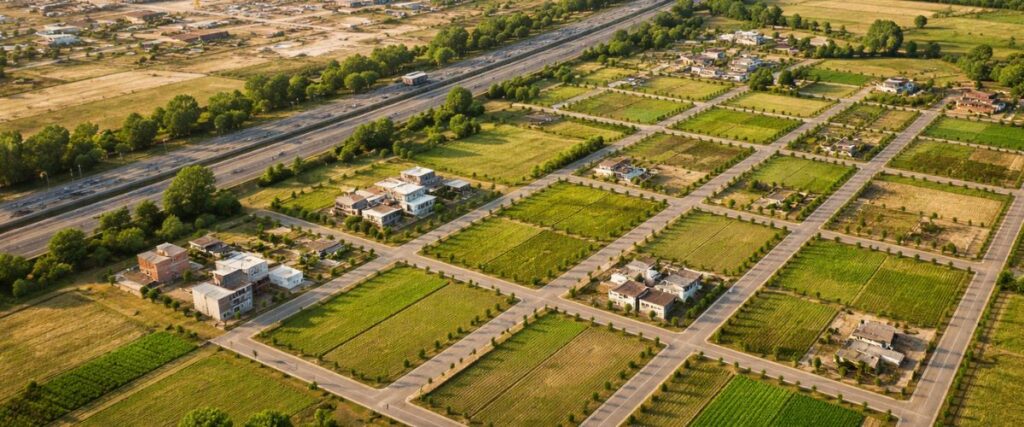
Jewar, located in Jewar in Uttar Pradesh, has moved from being a largely rural belt to one of North India’s most closely watched land markets. The biggest trigger has been the development of the Noida International Airport, officially named Noida International Airport.
The airport project, along with industrial corridors and improved connectivity through the Yamuna Expressway, has significantly changed buyer sentiment. Investors who earlier focused on Noida and Greater Noida have shifted attention toward land parcels in Jewar, anticipating long-term appreciation.
How Plot Values Have Changed Over Time
Over the last 5–6 years, plot prices in Jewar have seen sharp appreciation, especially after the airport project gained approval and construction momentum.
Average Residential Plot Rates:
- 2018–2019: INR 800 – 1,200 per sq. yard (in interior villages)
- 2020–2021: INR 1,500 – 2,500 per sq. yard (post airport confirmation)
- 2022–2023: INR 2,500 – 4,000 per sq. yard
- 2024–2025: INR 3,500 – 6,000+ per sq. yard (depending on sector & proximity)
In some strategic pockets near notified sectors under Yamuna Expressway Industrial Development Authority (YEIDA), appreciation has crossed 40–70% within 3–4 years.
The major jump occurred between 2021 and 2023, when infrastructure timelines became clearer and speculative buying increased.
Current Price Ranges for Plots in Jewar 2026
As of 2026, plot pricing varies significantly based on location, land use, and approval status.
Residential Plots (YEIDA Approved Sectors)
- INR 4,000 – 6,500 per sq. yard
- Premium sectors closer to the airport boundary may go higher
- Private/Local Residential Plots
- INR 3,000 – 5,000 per sq. yard
Depends on road width, access, and documentation clarity
Commercial Plots
- INR 7,000 – 12,000+ per sq. yard
- Higher near main roads and airport approach corridors
Agricultural Land
- INR 1.5 crore – 3 crore per bigha (varies by village and conversion potential)
- Plots within a 5–10 km radius of the airport site command a visible premium compared to outer rural belts.
Segment-wise Price Analysis: Low-End vs Premium Plots
Not all plots in Jewar perform equally. The price gap between entry-level and premium land is widening.
Entry-Level Plots
- Located 10–20 km away from the airport
- Mostly village-based plotting
- Lower liquidity but higher speculative upside
Mid-Segment Plots
- Near notified sectors under YEIDA
- Better road connectivity
- Moderate appreciation with lower legal risk
Premium Plots
- Close to airport boundary or expressway
- Approved layouts
- Higher resale demand
- Stronger appreciation stability
Premium land has shown relatively steady growth, while low-end plots are more sentiment-driven and volatile.
Quarterly and Annual Price Movements (2023–2025)
The 2023–2025 period saw more stabilized but consistent growth compared to earlier speculative spikes.
Observed Trends:
- 2023: 10–15% annual growth
- 2024: 8–12% growth in developed sectors
- 2025 (ongoing): Moderate rise, 5–8% so far
Growth has slowed slightly compared to the initial airport announcement phase. This suggests the market is moving from speculative to semi-structured demand.
Key Factors Driving Plot Price Growth in Jewar
Several structural factors continue to support land price growth:
1. Noida International Airport Development
The phased development plan and expected operational timeline have sustained investor interest.
2. Connectivity Infrastructure
- Yamuna Expressway access
- Proposed metro connectivity plans
- Road expansion and logistics corridors
3. Industrial and Institutional Development
YEIDA has allocated land for industrial parks, data centers, and logistics hubs, increasing employment potential in the region.
4. Limited Supply of Approved Plots
Regulated supply under YEIDA creates scarcity in fully approved residential segments, pushing prices upward.
Infrastructure Influence: Airport Effect on Land Values
Historically, major airports drive land appreciation within a 10–25 km radius. Jewar is following a similar pattern.
Areas closest to:
- Airport cargo terminals
- Proposed aerocity zone
- Expressway interchanges
have seen sharper price movement compared to interior agricultural zones.
The expectation of hotels, commercial hubs, and retail zones around the airport has increased demand for mixed-use and commercial plots.
Comparison with Wider Yamuna Expressway Corridor
Compared to older sectors along the Yamuna Expressway:
- Established sectors in Greater Noida have shown steady but slower growth.
- Jewar plots have shown higher percentage appreciation, but with higher risk.
- Apartment markets in the corridor have grown slower than plotted developments.
Plot investments have outperformed many apartment assets in terms of percentage returns over the past five years.
Future Price Outlook: 2026–2030 Forecast
Based on infrastructure milestones and current development momentum:
Short-Term (1–2 Years)
- Moderate growth (5–10% annually)
- Stabilization phase
Medium-Term (3–5 Years)
- Possible 20–40% cumulative appreciation
- Higher growth if airport operations scale successfully
Long-Term (5+ Years)
- Transformation into a structured urban node
- Commercial land may outperform residential plots
However, appreciation will depend heavily on:
- Timely infrastructure completion
- Economic conditions
- Industrial absorption rate
Investment Perspective: Risks and Opportunities
Opportunities
- Early-stage urban expansion
- High long-term upside
- Demand from logistics and industrial players
Risks
- Speculative pricing bubbles
- Legal/title risks in private plots
- Delays in infrastructure execution
- Over-supply of unregulated plotting
Investors should prioritize:
- Clear land titles
- Proximity to notified sectors
- Road connectivity
- Official approvals
Government, Regulation, and Legal Considerations
The role of Yamuna Expressway Industrial Development Authority is crucial in regulating development.
Before purchasing:
- Verify land use classification
- Confirm conversion status (if agricultural)
- Check sector notification and acquisition history
- Review registry documentation carefully
Unauthorized plotting remains a major risk factor in the region.