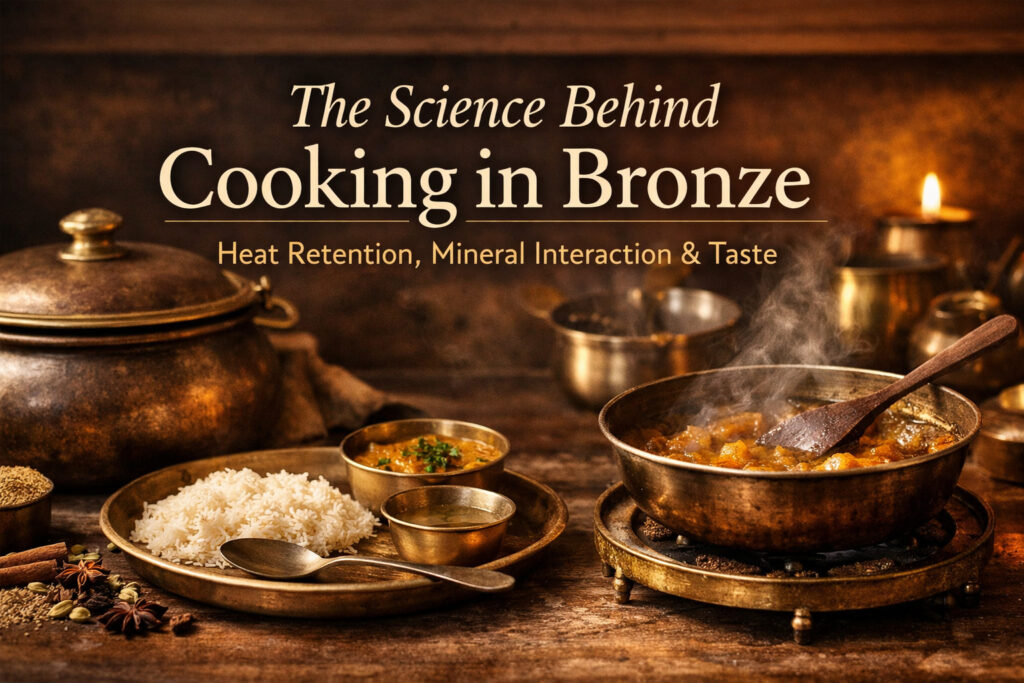
Cooking in bronze is often described as “traditional,” but its real value lies in material science, not cultural belief. Long before modern stainless steel or non-stick cookware existed, bronze was widely used because it delivered consistent heat, predictable cooking behavior, and long-term durability.
This article explains the science behind cooking in bronze—focusing on heat retention, mineral interaction, and taste—without exaggeration or mythology.
Why Bronze Retains Heat So Effectively
Bronze is an alloy made primarily from copper and tin. Copper is one of the best natural heat conductors, while tin adds structural stability.
When cooking in bronze:
-
Heat spreads evenly across the surface
-
Sudden temperature spikes are reduced
-
Food cooks gradually and consistently
This even heat distribution is especially useful for slow-cooked foods like dals, vegetables, and gravies, where uneven heat can ruin texture or flavor.
Unlike lightweight cookware that heats and cools rapidly, bronze maintains thermal stability, allowing better control over the cooking process.
Thermal Stability: How Bronze Protects Food Texture
A key advantage of cooking in bronze is its high thermal inertia. Once heated, bronze holds temperature longer and cools down slowly.
This means:
-
Less thermal shock to food
-
Better moisture retention
-
Reduced risk of burning spices or proteins
Traditional Indian cooking methods rely on gentle, sustained heat—something bronze naturally supports without artificial coatings or complex engineering.
Mineral Interaction: Separating Fact From Assumption
A common concern around metal cookware is mineral leaching. With bronze, this topic is often misunderstood.
When properly made and maintained:
-
Bronze is chemically stable at cooking temperatures
-
There is no aggressive reaction with food
-
Any interaction is trace-level and non-harmful
This stability is why bronze utensils were historically trusted for daily cooking, not occasional or ceremonial use.
For example, well-crafted bronze cooking utensils used in Indian kitchens were designed for long-term functionality, not short-term convenience.
Does Cooking in Bronze Affect Taste?
Bronze does not add flavor to food. Instead, it helps preserve natural taste.
Because heat is evenly distributed:
-
Spices cook without scorching
-
Sugars caramelize uniformly
-
Aromas remain intact
Uneven heat is one of the biggest reasons food tastes bitter or flat. Cooking in bronze minimizes that issue by maintaining steady cooking conditions throughout the utensil.
This is why many households still prefer bronze utensils for cooking traditional recipes that rely on layered flavors rather than high heat.
Why Bronze Utensils Were Used for Generations
Bronze cookware was chosen historically because it:
-
Lasted decades
-
Withstood repeated heating cycles
-
Did not chip, peel, or degrade
-
Delivered consistent cooking results over time
Unlike modern cookware optimized for speed or aesthetics, bronze prioritized reliability and longevity.
Today, brands like Raj Gharana Metals continue this tradition by crafting pure bronze utensils and kansa cookware designed for everyday use rather than decoration.
When Cooking in Bronze Makes Practical Sense Today
Cooking in bronze is ideal for:
-
Slow cooking and simmering
-
Boiling grains, lentils, and vegetables
-
Traditional Indian meals
-
Daily household cooking with controlled heat
It is not meant for extremely high-flame frying—just like cast iron or clay cookware. Used correctly, bronze offers a balance of performance, safety, and durability that modern materials often struggle to replicate.
Final Takeaway
Cooking in bronze works because of physics, not folklore.
Its heat retention, thermal stability, and neutral interaction with food explain why it has remained relevant for centuries. When understood scientifically and used properly, bronze cookware remains one of the most dependable choices for consistent, flavorful cooking.