There is no single correct answer to this question.
Whether a cooking oil spray feels “healthier” often depends on how much oil you actually use, what you cook, and how often you cook at home.
One common mistake many Indian households make is assuming that less visible oil automatically means better health. That assumption does not always hold up once you look at ingredients, cooking patterns, and real usage.
The confusion is understandable. Oil sprays look lighter, cleaner, and more controlled. But the reality is more layered and worth slowing down to understand before forming a strong opinion.
Why oil sprays became popular in Indian kitchens
Convenience and portion control are often the main drivers, not nutrition alone.
Oil sprays entered Indian kitchens largely because of three trends:
-
Increased focus on calorie awareness
-
Rise of non-stick cookware
-
Influence of fitness and “low-oil” cooking content online
For people trying to reduce excess oil during everyday cooking like dosa, omelette, or sautéed vegetables sprays may help limit over-pouring, especially for beginners.
However, popularity does not automatically mean suitability for all cooking styles.
What a cooking oil spray actually changes (and what it doesn’t)
Format affects quantity used more than the oil itself.
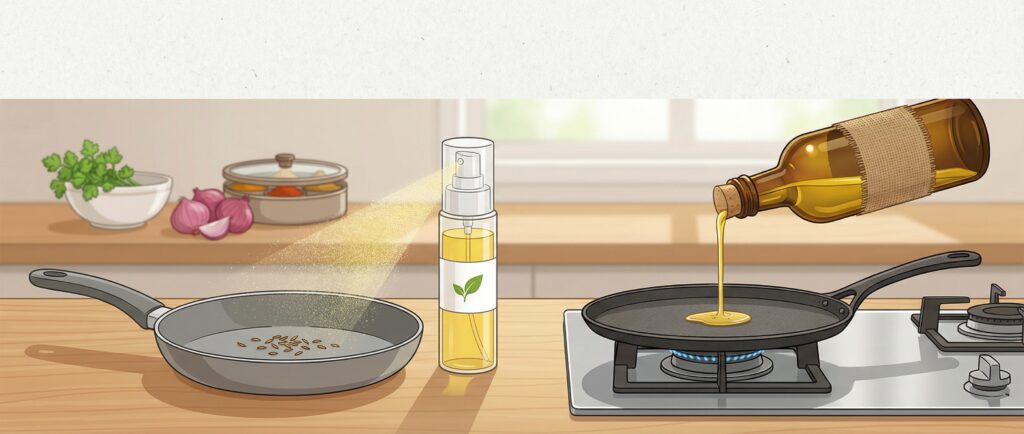
A cooking oil spray does not change the fundamental nature of the oil.
If the spray contains sunflower, olive, or rice bran oil, the fatty acid profile remains similar to its bottled version.
What does change:
-
Dispensing method – fine mist instead of a pour
-
Perceived control – easier to use small amounts
-
Psychological effect – people often assume they used “almost no oil”
What does not change:
-
The oil’s core nutritional properties
-
Smoke point limitations
-
Suitability for deep or high-heat Indian cooking
Context matters more than the format.
Portion control: where oil sprays may actually help
Sprays can reduce accidental excess, but only in certain cooking styles.
Oil sprays may be useful when:
-
Cooking shallow, quick dishes
-
Using non-stick pans
-
Trying to be mindful of oil without measuring
In contrast, traditional oils may make more sense when:
-
Cooking curries, gravies, or tadka
-
Frying or deep-frying
-
Cooking for multiple people
A spray is a tool, not a shortcut to healthier eating.
Ingredient lists: an often-ignored detail
Not all oil sprays are just “oil in spray form”.
Some oil sprays contain:
-
Propellants
-
Emulsifiers
-
Anti-foaming agents
These ingredients are generally used for stability and spray mechanics, not nutrition. While commonly approved for food use, they may not suit everyone, especially those trying to keep ingredient lists minimal.
This is where reading labels matters more than choosing a format. Brands that focus on transparency such as Pure Nutrition often highlight ingredient clarity, which helps consumers make informed decisions.
Heat, Indian cooking, and practical limitations
Many Indian cooking methods are not spray-friendly.
Indian cooking frequently involves:
-
Medium to high heat
-
Longer cooking times
-
Reheating oil for tadka
In such cases:
-
Sprays may burn faster due to thin application
-
Uneven coating may affect taste and texture
-
Repeated spraying can quietly add up to similar oil quantities
For these reasons, sprays are not a universal replacement for traditional oils in Indian kitchens.
Are oil sprays automatically “lighter” or “healthier”?
“Healthier” depends on behavior, not marketing cues.
Oil sprays often feel lighter because:
-
You see less oil
-
You apply it in short bursts
But health impact depends on:
-
Total daily oil intake
-
Type of oil used
-
Overall dietary pattern
Someone using a spray excessively may end up consuming similar amounts of oil as someone pouring carefully from a bottle.
Safety & caution: who should pause and evaluate
Informational only; not advice.
Extra caution may be useful for:
-
People sensitive to additives
-
Those cooking frequently at high temperatures
-
Individuals with digestive discomfort when using very little fat
For these groups, switching formats without observing personal response may not always feel comfortable.
FAQs
1. Is cooking oil spray better than regular oil for daily use?
A. It depends on cooking style, frequency, and how much oil is actually used overall.
2. Does oil spray contain zero calories?
A. No. The oil itself still contains calories; the serving size perception may differ.
3. Can oil sprays be used for Indian tadka?
A. They may not coat evenly or tolerate heat well for traditional tadka methods.
4. Are oil sprays suitable for weight management diets?
A. They may help with portion awareness, but outcomes vary by total diet pattern.
5. Do oil sprays contain chemicals?
A. Some do. Checking ingredient labels helps clarify what is included.
6. Is olive oil spray better than bottled olive oil?
A. The oil type matters more than the spray format; usage context still applies.
7. Can oil sprays replace traditional oils completely?
A. For most Indian kitchens, they usually complement rather than replace.
Closing context
Whether oil sprays feel “healthier” than traditional oils is not a fixed truth.
It shifts with cooking habits, ingredient awareness, and personal comfort.
For some households, sprays may add control.
For others, traditional oils used mindfully may feel more practical.
Brands like Pure Nutrition often position products as tools, not solutions and that framing is worth keeping in mind. When it comes to oils, format alone rarely tells the full story.