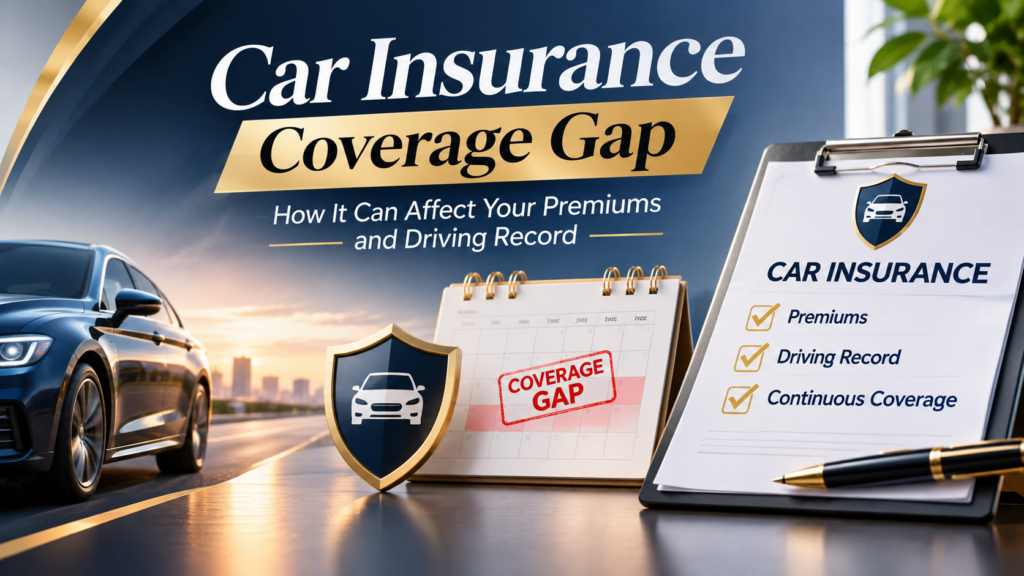
A car insurance coverage gap may affect premiums, policy eligibility, and driving-related penalties.
A car insurance coverage gap is exactly what it sounds like: a period when a driver had no active auto policy. It can last a few days or stretch for months, and the consequences depend on how long the gap lasts, why coverage ended, whether the vehicle was driven, and the laws in the driver’s state.
What many drivers do not realize until they apply for a new policy is that insurers may treat a coverage gap as an underwriting factor. It can affect eligibility for certain discounts, the price of a new policy, and the range of insurers willing to provide coverage. In some states, an insurance lapse can also lead to fines or vehicle registration suspension.
Here’s what happens when a gap occurs, why it matters, and what drivers can do to get covered again.
Why Insurers Care About Continuous Coverage
Insurance companies consider previous coverage history when evaluating an applicant. A driver who has maintained continuous coverage may qualify for preferred pricing or discounts with certain insurers. A car insurance coverage gap, by contrast, can affect underwriting decisions because it indicates a period when the driver may have been uninsured.
Insurers may consider several details when reviewing an application, including:
- How long the coverage gap lasted.
- Why the previous policy ended.
- Whether the vehicle was driven during the uninsured period.
- Whether the driver has a history of missed payments or policy cancellations.
- The applicant’s driving record and claims history.
- Whether the driver can provide documentation explaining the interruption.
Some insurers offer discounts or more favorable rates to applicants who can demonstrate continuous prior coverage. However, these discounts and eligibility requirements vary by company and state. A lapse may affect the applicant’s pricing or eligibility, but the outcome is not determined by a universal industry rule.
The length of a coverage gap can influence how insurers evaluate an application, but there are no standard day-based thresholds that apply to every company. Some insurers may treat a short interruption differently from a gap lasting several months. Others may place greater emphasis on why the policy ended, whether the vehicle was driven uninsured, and the applicant’s overall insurance history.
A longer lapse can limit available options or increase premiums, but the outcome depends on the insurer’s underwriting guidelines and the driver’s circumstances.
The Difference Between a Lapse, Cancellation, and Nonrenewal
These terms are often used interchangeably, but they describe different situations.
A coverage lapse is a period during which the required insurance coverage is not active. It can occur when a policy expires without renewal, a payment is missed, or a policy is canceled before replacement coverage begins.
A policy cancellation occurs when the insurer or policyholder ends an active policy before its scheduled expiration. An insurer may cancel a policy for reasons such as nonpayment or certain material problems with the application, subject to applicable state laws and policy terms.
Nonrenewal occurs when an insurer decides not to continue a policy after its current term ends. A company may choose not to renew a policy based on its underwriting guidelines, changes in risk, or other reasons permitted by state law.
The reason coverage ended matters. A cancellation for non-payment or material misrepresentation can create additional underwriting concerns. However, a cancellation is not automatically more damaging than every other type of lapse. The circumstances surrounding the interruption are important.
When a driver applies for a new policy, an insurer may verify previous coverage through information provided on the application, records from a prior insurer, or available insurance-data services.
One example is LexisNexis C.L.U.E. Auto, a claims-history information exchange that generally contains up to seven years of personal auto claims information. It can help insurers review reported claims, but it is not a comprehensive database of every insurance policy, cancellation, or coverage lapse. The information available may depend on participating insurers and the data submitted to the exchange. Insurers may use other methods to verify prior coverage, including information from previous insurers or other policy-history and coverage-verification services.
A voluntary cancellation may be easier to explain when a driver has sold a vehicle, moved abroad, or stopped using a vehicle. However, documentation and state registration requirements still matter. Selling a car or storing it does not automatically remove every insurance obligation. Drivers should check whether the vehicle’s registration must be cancelled or whether another form of coverage is required.
What Insurance Lapse Penalties Actually Look Like
Insurance lapse penalties fall into two broad categories: legal and financial. The exact consequences depend on state law, the vehicle’s registration status, and whether the driver operated the vehicle without required insurance.
Legal penalties vary by state. Forty-nine states and the District of Columbia generally require drivers to carry auto liability insurance to drive legally. New Hampshire is the exception: it does not have a compulsory auto liability insurance law. However, drivers may be subject to financial-responsibility requirements following certain at-fault accidents. Those who cannot meet applicable requirements may face suspension of their driving privileges. Therefore, the absence of a general insurance mandate does not mean drivers are free from financial liability after a crash.
Depending on the state, an insurance lapse can result in fines, registration suspension, or other administrative penalties, even if the vehicle was not involved in an accident. Driving an uninsured vehicle can also lead to citations, license suspension, or additional penalties.
Some states require an SR-22 filing following specific uninsured-driving violations, suspensions, or other financial-responsibility events. An SR-22 is not a type of insurance policy. It is a certificate filed by an insurer to demonstrate that the required financial responsibility is in place. The filing requirement and how long it must be maintained depend on state law and the circumstances that triggered it.
Financial penalties may appear when a driver shops for a new policy or renews an existing one. A coverage gap can affect eligibility for certain discounts or lead to less favourable pricing. The size of any increase depends on the insurer, the length and reason for the gap, the driver’s overall record, and other rating factors.
State laws can also create exceptions to the way insurers may use coverage gaps. For example, Louisiana has additional statutory protections for specific interruptions in auto insurance coverage. Under Louisiana Revised Statutes § 22:1284.1, effective January 1, 2026, an insurer generally cannot increase a policy’s premium rate or add a surcharge based on an insured’s first lapse in liability coverage, provided the lapse does not exceed 90 days. However, an insurer may withdraw a discount if the policyholder no longer qualifies for it. The law also prevents an insurer from denying an application solely because of one or more coverage lapses. These protections have specific conditions and do not eliminate separate state insurance-compliance requirements.
A driver with a clean driving record and a short interruption may receive different offers from someone with a longer lapse, recent violations, or a cancellation for non-payment. Insurers evaluate these circumstances according to their own underwriting rules and applicable state law.
| Coverage Gap | Possible Underwriting Considerations | Potential Consequences |
| Short interruption | Some insurers may apply different rules to brief gaps, depending on the reason and circumstances. | Loss of eligibility for certain discounts or less favorable pricing. |
| Several weeks to a few months | Insurers may examine the length of the interruption, prior coverage, and whether the vehicle was driven uninsured. | Higher premiums or fewer standard-market options with some companies. |
| Several months or longer | A longer period without coverage may raise additional underwriting concerns, depending on the applicant’s circumstances. | More limited insurer choices and potentially higher premiums. |
These are general possibilities, not standardized insurer classifications. Companies use different underwriting guidelines, and the length of a lapse alone does not determine whether an applicant qualifies for standard or non-standard coverage. State-specific laws may also limit how insurers can consider certain lapses.
How a Coverage Gap Affects Your Driving Record
A car insurance coverage gap does not necessarily appear on a motor vehicle record (MVR) as a traffic violation. An MVR generally contains information such as traffic convictions, accidents reported to the state, and certain license actions.
However, many states separately monitor insurance compliance for registered vehicles through electronic insurance-verification systems. A lapse may therefore be identified by the state and lead to registration suspension, fines, or other administrative action, even if the driver has not received a traffic citation.
For example, Georgia electronically monitors liability coverage for vehicles with active registrations. A lapse can lead to a fine and registration suspension if the required steps are not taken. Pennsylvania also has specific registration-suspension rules for certain insurance lapses, with exceptions based on the duration of the lapse and whether the vehicle was operated.
Insurance companies may also use previous coverage information when evaluating a new application. The specific records available and the way insurers use them vary. A clean driving record may help an applicant’s overall profile, but it does not guarantee that a coverage gap will have no effect on pricing.
The connection between an insurance lapse and a driving record becomes more direct when the situation leads to a legal consequence. If a driver is cited for operating without required insurance, that citation may appear on the motor vehicle record. The state may also record that action if it suspends the driver’s license or vehicle registration.
These consequences can make obtaining affordable coverage more difficult because the driver may now have both an insurance-history issue and a separate driving or registration-related record.
What to Do After a Lapse
The priority is getting the required coverage back in place before driving again. Every additional day without insurance extends the gap and leaves the driver financially exposed if an accident occurs. Operating or keeping the vehicle registered in a state that requires continuous coverage can also create additional legal problems.
When shopping for a new policy after a lapse, be straightforward about the interruption. Misrepresenting coverage history on an application can lead to policy cancellation or other problems and make future coverage harder to obtain. Insurers ask about previous coverage because it can be a legitimate underwriting factor.
A few practical steps can help:
- Gather documentation: Keep records explaining the gap, such as a vehicle bill of sale, registration cancellation confirmation, proof of a move, or other relevant documents. These may help explain why coverage ended.
- Check state requirements: Find out whether your state requires continuous insurance for a registered vehicle, even if it is not being driven. If the vehicle was sold, stored, or taken out of service, check whether the registration should have been canceled.
- Confirm any SR-22 requirement: Check whether your state requires an SR-22 or another financial-responsibility filing before restoring your driving privileges. This requirement depends on state law and the reason for the suspension or other financial-responsibility action. A coverage lapse alone does not automatically require an SR-22 in every state.
- Compare multiple quotes: Do not assume the first insurer is your only option. Underwriting guidelines and prices can vary significantly, making insurance rate comparison especially valuable after a lapse.
- Ask about same-day coverage: If you need a vehicle immediately, ask whether the insurer can issue coverage the same day. Availability depends on underwriting approval, payment, and the insurer’s policy-issuance process. Confirm the effective date and time before driving.
- Consider non-owner insurance if appropriate: If you no longer own a vehicle but regularly borrow or rent cars, ask an insurer whether a non-owner policy is suitable. It may provide liability coverage for certain situations, but it does not replace every type of vehicle insurance or automatically satisfy every state’s requirements.
The non-standard insurance market exists for drivers who may not qualify for preferred-market policies. Drivers who are declined by some standard insurers or receive expensive quotes still have options. Non-standard carriers specialize in applicants with more challenging insurance histories and may be willing to provide coverage when other companies are not.
How Long the Impact Lasts
A car insurance coverage gap does not necessarily affect a driver forever, but there is no single lookback period that applies to every insurer or state. Companies use different underwriting guidelines and may consider previous coverage history for different periods.
The impact may become less significant as the driver establishes a consistent insurance history, but the timing and extent of any improvement depend on the insurer and other rating factors.
Some insurers reassess eligibility and pricing at six-month or annual renewals. If the coverage gap was a major factor in the original premium, maintaining continuous coverage and avoiding additional violations or claims may improve the driver’s prospects for more favorable pricing over time.
However, a lower premium is not guaranteed. Rates can also change because of location, vehicle type, claims history, driving record, coverage selections, and broader insurance-market conditions. Ask your insurer when the previous lapse may stop affecting your eligibility or rate.
Getting back on solid footing takes time, but maintaining continuous coverage from this point forward can help strengthen your insurance history and reduce the risk of another lapse.
Drivers working through the aftermath of a lapse can find auto insurance options for drivers with lapsed coverage by connecting with licensed agents who work with standard and non-standard insurance markets. Drivers who need coverage quickly can also ask about same-day options, subject to insurer availability and approval.