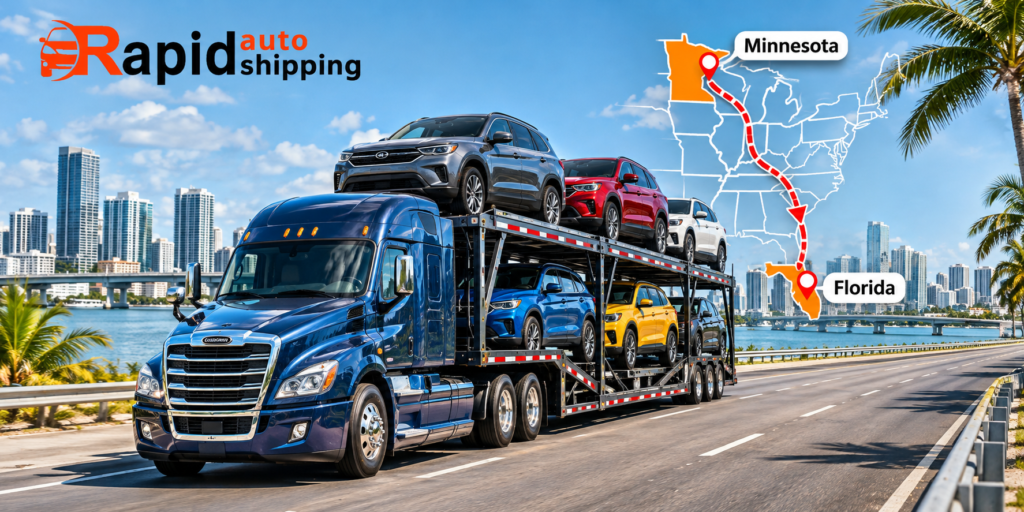
Minnesota to Florida auto shipping is one of the most popular long-distance vehicle transport routes in the country. Every year, thousands of snowbirds, relocating families, college students and vehicle buyers move cars from the Upper Midwest to the Sunshine State. If you are one of them, you probably want to know two things first: how much will it cost, and how long will it take?
This guide answers both. Below, you will find realistic price ranges, typical transit times, the factors that move your quote up or down, and practical tips for a smooth pickup and delivery. At Rapid Auto Shipping, we handle this route regularly, so the numbers and advice here reflect how it actually works.
How Much Does Minnesota to Florida Auto Shipping Cost?
For a standard sedan on an open carrier, most customers should expect to pay roughly $1,000 to $1,500 for Minnesota to Florida auto shipping. SUVs, trucks and larger vehicles usually fall between $1,200 and $1,800, and enclosed transport typically adds 40% to 60% on top of open carrier pricing.
These are general estimates, not guaranteed prices. Your actual quote depends on the specifics of your shipment, which we cover next.
| Vehicle / Service | Typical Price Range |
|---|---|
| Standard sedan, open carrier | $1,000 – $1,500 |
| SUV or pickup, open carrier | $1,200 – $1,800 |
| Sedan, enclosed carrier | $1,500 – $2,300 |
| Luxury, classic or exotic, enclosed | $1,800 – $2,800+ |
Long-distance routes are priced per mile, but the rate per mile drops as distance increases. That is why shipping a car 1,800 miles does not cost twice as much as shipping it 900 miles.
How Long Does It Take to Ship a Car From Minnesota to Florida?
The drive from Minnesota to Florida covers roughly 1,500 to 2,100 miles, depending on your exact pickup and drop-off cities. For example, Minneapolis to Orlando is shorter than Duluth to Miami.
Most shipments on this route take 5 to 9 days from the moment your vehicle is picked up. Here is a rough breakdown:
- Pickup window: Typically 1 to 5 days after you book, depending on carrier availability and how flexible your dates are.
- Transit time: Usually 5 to 9 days on the road. Carriers legally limit how many miles a driver can cover per day, and they make multiple stops to load and unload other vehicles.
- Delivery: The driver will contact you to confirm timing before arrival.
Winter weather, heavy snowbird traffic, road construction and hurricane-season disruptions can add a day or two. A reputable company will tell you this upfront rather than promise a date it cannot control.
What Affects Your Minnesota to Florida Auto Shipping Rate?
Two quotes for the same route can look very different. Here is why.
1. Pickup and Delivery Locations
Major metro areas such as Minneapolis, St. Paul, Orlando, Tampa, Jacksonville and Miami sit on busy carrier corridors, which keeps pricing competitive. Rural pickups, or locations far from main interstates, can cost more because the driver has to detour.
2. Vehicle Size and Weight
A compact sedan takes up less space and weight on a carrier than a full-size truck or a lifted SUV. Heavier and larger vehicles reduce the number of cars a driver can haul, so they cost more to ship.
3. Open vs. Enclosed Transport
Open carriers are the standard choice and are used for the majority of shipments. Your vehicle is exposed to the elements, much like it would be on the highway. Enclosed carriers protect against weather, road debris and dust. They are the better choice for luxury, classic, collectible or high-value vehicles.
4. Vehicle Condition
A car that runs and drives is the simplest to load. If your vehicle is inoperable, the driver needs a winch and extra handling time, and you should expect an added fee.
5. Season and Demand
This route is strongly seasonal. Demand to Florida spikes from October through January as snowbirds head south, and demand to Minnesota spikes from March through May as they return. Booking during peak months usually means higher prices and tighter scheduling. Shipping outside those windows often saves money.
6. Booking Timeline
Booking at least two to three weeks ahead gives you the best chance at a competitive rate and a pickup date that fits your plans. Last-minute shipments are possible, but they can come at a premium.
Open vs. Enclosed Carrier: Which Is Right for Your Minnesota to Florida Shipment?
For most everyday vehicles, an open carrier is safe, reliable and cost-effective. Millions of cars, including new vehicles going to dealerships, travel this way every year.
Choose enclosed transport if:
- Your vehicle is a luxury, exotic, classic or collector car
- You want maximum protection from weather and road debris
- The vehicle has low ground clearance or custom modifications
- You are shipping during a season when you expect rough weather along the route
If you are unsure, ask for quotes on both. Seeing the price difference side by side makes the decision easier.
Door-to-Door vs. Terminal-to-Terminal Shipping
Door-to-door is the most common option. The driver picks up your vehicle as close to your address as a large truck can safely get, and delivers it as close to your destination as possible. If your street is too narrow for a full-size carrier, the driver will arrange a nearby meeting point such as a large parking lot.
Terminal-to-terminal means you drop off and pick up your vehicle at a storage facility. It can sometimes be cheaper, but it is less convenient and may involve storage fees if you are late to collect it. For most customers on this route, door-to-door is the better value.
How to Prepare Your Car for Shipping
A little preparation prevents most problems. Before pickup day:
- Wash your vehicle. A clean car makes it easier to spot and document existing scratches or dents.
- Document its condition. Take clear photos of every side, the roof, the interior and the odometer. Date-stamped photos are ideal.
- Remove personal items. Carriers are not insured for belongings left inside, and extra weight can cause problems at weigh stations.
- Keep about a quarter tank of fuel. This is enough for loading and unloading without adding unnecessary weight.
- Disable toll tags and alarms. An alarm that goes off in transit can drain your battery, and a toll tag can rack up charges on the way.
- Secure or remove loose parts. Take off custom accessories, retract antennas and fold in mirrors if possible.
- Note any mechanical issues. Tell your shipping coordinator about leaks, battery trouble or anything else the driver should know.
Winter tip for Minnesota departures: if your car has been sitting in the cold, check your tire pressure and battery before pickup. Cold weather affects both, and a dead battery can delay loading.
What Happens on Pickup and Delivery Day
At pickup, you or a trusted representative will meet the driver and inspect the vehicle together. The driver records its condition on a document called the Bill of Lading. Review it carefully, confirm it matches what you see, and keep your copy.
At delivery, repeat the process. Walk around the vehicle, compare its condition to the Bill of Lading, and note any new damage before signing. This document is the foundation of any insurance claim, so do not skip the inspection, even if you are in a hurry.
Is Your Vehicle Insured During Transport?
Legitimate auto transport carriers are required to carry cargo insurance that covers damage that occurs during transit. Coverage limits vary by carrier, so always ask for proof of insurance and find out what the policy covers and what the deductible is. Your personal auto policy may also offer additional protection, so check with your insurer before shipping.
Rapid Auto Shipping works with vetted, licensed and insured carriers, so you are not left guessing who is handling your vehicle.
How to Get the Best Rate on Minnesota to Florida Auto Shipping
You do not need to sacrifice quality to save money. These practical steps can lower your cost:
- Be flexible with your dates. A pickup window of a few days gives carriers room to fit you into their route.
- Avoid peak snowbird weeks if your schedule allows.
- Choose open transport unless your vehicle truly needs enclosed protection.
- Ship from or to a major city or a location near an interstate.
- Book early. Two to three weeks of lead time gives you more options.
- Be wary of quotes that look too good to be true. An unusually low price is often a bait-and-switch. Carriers will not pick up a car at a rate that does not cover their costs, so the delay, or a surprise price increase, comes later.
Why Choose Rapid Auto Shipping?
Choosing a transport company is a trust decision. You are handing over one of your most valuable assets to people you may never have met. At Rapid Auto Shipping, we focus on making that decision easy:
- Clear, upfront quotes so you know what to expect before you commit
- Vetted and insured carriers who meet our standards
- Door-to-door service across Minnesota and Florida
- Open and enclosed options to match your vehicle and budget
- Real communication from booking to delivery, so you are never left wondering where your car is
Whether you are a snowbird heading south for the winter, a family relocating, or a buyer picking up a car from a Florida dealer, we make Minnesota to Florida auto shipping straightforward.
Ready to Ship Your Car From Minnesota to Florida?
Skip the 1,800-mile drive, the fuel, the hotel nights and the wear and tear on your vehicle. Request your free, no-obligation quote from Rapid Auto Shipping today, and get a clear price, a realistic timeline and a team that stays with you from pickup to delivery.
Frequently Asked Questions (FAQs)
How much does it cost to ship a car from Minnesota to Florida?
Most standard sedans shipped on an open carrier cost roughly $1,000 to $1,500, while SUVs and trucks typically run $1,200 to $1,800. Enclosed transport costs more. Your final price depends on distance, vehicle size, season, carrier type and how flexible your dates are.
How long does Minnesota to Florida auto shipping take?
Transit usually takes 5 to 9 days after pickup. Weather, traffic, seasonal demand and your exact pickup and delivery cities can shorten or extend that window. Pickup itself is typically scheduled within a few days of booking.
What is the cheapest time of year to ship a car from Minnesota to Florida?
Prices are generally lower in late spring through early fall, outside the snowbird rush. Demand and rates tend to climb from October through January for southbound shipments.
Is open or enclosed transport better for this route?
Open transport works well for most vehicles and is the more affordable option. Enclosed transport is a smart choice for luxury, classic or high-value cars, or if you want extra protection from winter weather and road debris.
Do I need to be present for pickup and delivery?
You or a trusted adult you designate should be present at both ends to inspect the vehicle and sign the Bill of Lading. This protects you if you ever need to file a damage claim.
Can I ship a car that does not run?
Yes, in most cases. Inoperable vehicles require a winch and extra handling, so there is usually an added fee. Let your shipping coordinator know upfront so the right carrier is assigned.
Can I pack personal belongings in my car?
It is best not to. Carriers are generally not insured for personal items, and extra weight can cause compliance problems on the road. Remove valuables and loose items before pickup.
Is my car insured while it is being shipped?
Licensed auto carriers carry cargo insurance that covers damage during transit. Ask for proof of coverage and confirm the limits and deductible before booking. You may also want to check whether your personal auto policy adds protection.
How far in advance should I book?
Two to three weeks ahead is ideal, and earlier during peak snowbird months. Shorter notice is often possible, but it may cost more and offer fewer pickup options.
How do I get a quote from Rapid Auto Shipping?
Contact Rapid Auto Shipping with your pickup and delivery locations, vehicle year, make and model, whether it runs, and your preferred shipping date. We will provide a clear, no-obligation quote for your Minnesota to Florida auto shipping needs.