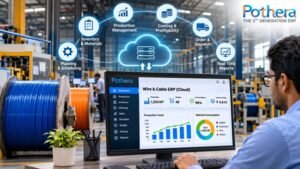
An ERP for TMT bar manufacturers in India should track billets by heat number, record yield and scale loss through the rolling mill, calculate cost per tonne for every grade, and handle GST, e-invoicing and dispatch in one system. Pothera ERP, built by Bsquare Solutions, connects inventory, production, quality and finance for Indian manufacturers, and can run on cloud or on-premise.
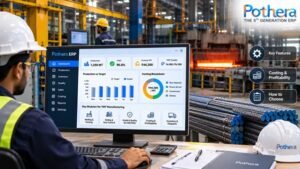
Why do TMT bar manufacturers need an ERP?
TMT margins depend on small percentages, such as yield, fuel per tonne and billet price, and tools like Tally or Excel cannot show these by heat or by grade. A TMT mill buys billets (or makes them), reheats and rolls them, quenches the bars, cuts them to length and sells by weight. A 1% change in yield or a ₹300 change in fuel cost per tonne is easy to miss on paper but moves profit visibly over a month.
An ERP gives you one record that follows the material from billet purchase to dispatch.
What does a TMT bar manufacturing process look like?
A typical TMT line runs through six stages, and each one is a place where weight, cost or quality can be lost:
- Billet receipt: billets arrive with a heat number and test details
- Reheating furnace: fuel use and scale loss begin here
- Rolling: the billet becomes a bar of the required diameter
- Quenching and self-tempering (TMT process): gives the bar its strength grade
- Cooling bed and cutting: bars are cut to length, and end-cuts are generated
- Bundling, tagging and dispatch: bars go out against a sales order and invoice
An ERP that records each stage lets you see where the loss is, not just that it exists.
What features should an ERP for TMT bar manufacturers have?
Look for eight capabilities, and test each one in a demo.
| Feature | Why it matters for TMT | |
| 1 | Heat-wise billet and batch traceability | Links every bundle to its billet heat for quality queries |
| 2 | Yield and scale loss tracking | Shows loss at each stage, by shift and by grade |
| 3 | Cost per tonne by grade and diameter | Reveals which sizes make money |
| 4 | Weight-based inventory | Handles tonnes, kg, bars and bundles together |
| 5 | Fuel and power costing | Ties furnace and electricity cost to production |
| 6 | Quality records and test certificates | Keeps strength, elongation and weight-per-metre results against batches |
| 7 | Dealer and sales order management | Tracks orders, credit limits and dispatch |
| 8 | GST, e-invoicing and e-way bill | Keeps every dispatch compliant |
How does an ERP calculate cost per tonne for TMT bars?
Cost per tonne equals total material and conversion cost divided by good output in tonnes. Conversion cost includes fuel, power, labour, rolls, consumables and overheads. Good output excludes scale loss, end-cuts and rejected bars.
Illustrative example (not actual client data):
| Item | Value |
| Billets consumed | 1,000 tonnes at ₹40,000 per tonne = ₹4,00,00,000 |
| Conversion cost (fuel, power, labour, rolls, overheads) | ₹3,200 per tonne of input = ₹32,00,000 |
| Total cost | ₹4,32,00,000 |
| Yield 97% → good output | 970 tonnes |
| Cost per tonne at 97% yield | ₹44,536 |
| Yield 95% → good output | 950 tonnes |
| Cost per tonne at 95% yield | ₹45,474 |
(₹4,32,00,000 ÷ 970 = ₹44,536; ₹4,32,00,000 ÷ 950 = ₹45,474.) A 2-point drop in yield adds about ₹938 per tonne, and across 1,000 tonnes that is roughly ₹9.4 lakh. This is the number an ERP helps you catch early.
How does ERP help with heat-wise traceability in TMT production?
ERP links each billet heat to the batches rolled from it and the bundles dispatched, so you can trace any customer complaint back to a heat in minutes. Without this link, mills dig through registers and gate passes. With it, one search returns the heat, the production shift, the test results and the invoices.
Ask any vendor to demonstrate this live: pick a dispatched bundle and trace it back to its billet heat.
How does ERP reduce scale loss, end-cuts and rejections?
ERP does not reduce loss by itself. It shows where the loss occurs so that you can act. By recording input and output weight at each stage, it separates scale loss (furnace), cutting loss (cooling bed) and rejections (quality). Compare these by shift, by heat and by diameter. A furnace problem looks different from a cutting problem, and only stage-wise data can tell them apart.
How does ERP manage stock of billets, finished bars and consumables?
ERP gives one live stock position across billets, in-process material, finished bars and spares. Use Pothera’s inventory management module to track weight-based stock and reduce mismatch between the yard and the books. This matters in a TMT mill, where stock is heavy, stored outdoors and moved in large lots.
How does ERP plan production in a rolling mill?
ERP converts sales orders and stock levels into a rolling plan, so the mill changes section sizes less often and misses fewer deliveries. With production and planning management, planners can see order demand, billet availability and mill capacity together. Fewer changeovers means less downtime.
How does ERP handle GST, e-invoicing and e-way bills for TMT dispatch?
ERP generates the tax invoice, e-invoice and e-way bill from the dispatch record, so the weight on paper matches the weight on the truck. Pothera ERP supports Indian GST compliance, including e-invoicing and e-way bills. Confirm the current setup in a demo, and have your CA review the configuration.
What does an ERP for a TMT mill cost?
Cost depends on users, modules and whether you choose cloud or on-premise. For a quick range, use the Bsquare ERP cost estimator. Most mid-size implementations take about 8 to 12 weeks, depending on data readiness.
How does Pothera ERP compare with other options for TMT manufacturers?
| Option | Best for | Watch out for |
| Pothera ERP | Small and mid-size Indian mills wanting one integrated system | Verify TMT-specific reports in a demo |
| SAP Business One | Larger groups and multi-plant setups | Higher cost and longer rollout |
| Odoo / ERPNext | Teams with in-house IT | Steel-specific setup often needs customisation |
| TallyPrime / Busy | Accounting and trading | No production, yield or batch costing |
For a broader comparison across steel segments, read our guide to the best ERP software for steel manufacturers in India (replace with the live URL of that post once published).
How should a TMT manufacturer choose an ERP? (5 steps)
- List your process stages: billet, furnace, rolling, quenching, cutting, dispatch.
- Score two or three vendors on the eight features above.
- Ask for a demo using one real heat from your own records.
- Check references from steel or other process manufacturers.
- Compare three-year total cost, including support and upgrades.
To see the full platform, visit Pothera ERP or Bsquare Solutions.
Frequently asked questions
- What is the best ERP for TMT bar manufacturers in India?
The best choice is the one that tracks heat-wise traceability, yield and cost per tonne, and fits your budget. Mid-size mills often shortlist integrated, India-focused systems like Pothera ERP. - Can ERP track heat numbers from billet to dispatch?
A TMT-ready ERP links billet heat to batch, bundle and invoice. Ask the vendor to demonstrate it live. - How does ERP calculate cost per tonne in a rolling mill?
It divides total material and conversion cost by good output in tonnes, after removing scale loss, end-cuts and rejections. - Is Tally enough for a TMT bar manufacturer?
Tally handles accounts and GST, but it does not do production, yield or batch-wise costing. Growing mills usually move to a full ERP. - How much does ERP cost for a TMT mill in India?
It varies with users, modules and deployment. The ERP cost estimator gives a range. - How long does ERP implementation take?
About 8 to 12 weeks for most mid-size manufacturers, depending on data readiness. - Should a TMT mill choose cloud or on-premise ERP?
Cloud suits owners who want remote access to several sites. On-premise suits plants with weak internet. Pothera supports both. - Does ERP reduce scale loss?
It does not reduce it directly, but it shows scale loss by heat, shift and diameter, so you can fix the cause.
See it on your own heat data
Bring one real heat to a demo of Pothera ERP, or get a quick budget range from the ERP cost estimator.