You shipped the new generative AI feature ahead of schedule. User engagement is up, product managers are thrilled, and the launch was a resounding success. Then, the first end-of-month invoice from your LLM provider arrives, and the excitement quickly evaporates.
For many SaaS founders, engineering leaders, and CTOs, the transition from a highly controlled AI proof-of-concept to a production-scale application brings a brutal financial wake-up call. Large Language Models (LLMs) operate on a pay-per-compute model measured in tokens. When left unoptimized, features like persistent chat history, excessive system prompts, and default routing to flagship models can turn a profitable software product into a financial liability overnight.
Fortunately, reining in runaway AI costs does not require ripping out your AI features or severely downgrading user experience. By shifting from a naive “send everything to GPT-4o” approach to a mature, architecturally sound AI pipeline, teams can drastically reduce their token footprint.
In this guide, we will break down the practical engineering strategies—ranging from semantic caching to dynamic routing and unified gateways—that can help you slash your AI API costs by up to 60%.
Understanding the Token Economy
Before writing any optimization code, engineering teams must deeply understand token economics. Providers like OpenAI, Anthropic, and Google structure their pricing around input tokens (the prompt and context you send) and output tokens (the response the model generates).
Historically, output tokens are significantly more expensive—often 3x to 5x higher than input tokens—because generation requires intensive, sequential GPU compute. However, input tokens are where most applications bleed money silently.
When a user interacts with an AI chatbot, standard implementations append the entire previous conversation history to every new message to maintain context. By the tenth message, you are re-sending (and paying for) the first nine messages all over again. Multiply this by thousands of daily active users, and you are burning capital on redundant context.
The Context Window Trap
Modern models boast massive context windows (up to 2 million tokens in some cases). While this is a technical marvel, it is also a financial trap. Just because you can send a 100-page PDF with every API call does not mean you should. Establishing strict bounds on what context is genuinely necessary for a given transaction is the foundational step of AI cost optimization.
Strategy 1: Implementing Semantic Caching
One of the highest-leverage architectural changes you can make is implementing a semantic cache. In typical SaaS applications, user queries follow a power-law distribution. A large percentage of users will ask the exact same, or semantically identical, questions—especially in customer support, documentation query, or onboarding use cases.
Sending every repetitive query to a frontier LLM is a waste of compute and money. Semantic caching solves this by intercepting the prompt before it hits the expensive LLM.
How Semantic Caching Works in Production
Instead of matching exact text strings (which fails if a user adds a typo or changes a word), semantic caching uses fast, cheap embedding models.
- The user submits a prompt.
- An embedding model (like
text-embedding-3-small) converts the prompt into a vector representation. - The system queries a vector database (such as Pinecone, Qdrant, or Redis) to find similar past queries.
- If a match exceeds a predefined similarity threshold (e.g., 0.95), the system returns the cached response instantly.
This process reduces the API cost for a repeated query from fractions of a cent to practically zero. Furthermore, it slashes latency from seconds to milliseconds, drastically improving the perceived performance of your application.
Strategy 2: Dynamic Model Routing
The most common mistake teams make when integrating AI is hardcoding a single, flagship model—like Claude 3.5 Opus or GPT-4o—for every single task in their application. Using a frontier model to extract a date from a string of text is the equivalent of using a supercomputer to calculate a restaurant tip.
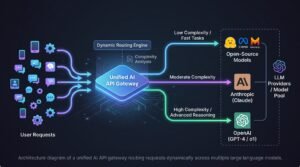
Dynamic model routing (often referred to as an LLM Cascade) introduces an intelligent orchestration layer that analyzes the complexity of an incoming request and routes it to the most cost-efficient model capable of handling it.
Building the LLM Cascade
A standard routing cascade categorizes tasks by cognitive demand:
- Tier 1 (Trivial Tasks): Formatting, sentiment analysis, basic entity extraction. Route these to extremely fast, cheap models like Llama 3 (8B) or Claude 3 Haiku.
- Tier 2 (Moderate Reasoning): Summarization, standard drafting, data transformation. Route these to mid-tier models like GPT-4o-mini or Gemini 1.5 Flash.
- Tier 3 (Complex Logic): Deep coding tasks, complex logical deduction, agentic workflows. Route these exclusively to flagship models like Claude 3.5 Sonnet or GPT-4o.
By cascading requests, you ensure that you are only paying premium rates when premium reasoning is actually required.
Strategy 3: Transitioning to a Unified API Gateway
As you implement dynamic routing, a new operational challenge arises: managing multiple API keys, disparate billing accounts, and different SDKs across OpenAI, Anthropic, Google, and open-source hosting providers. This fragmentation creates significant overhead for DevOps and finance teams.
Furthermore, when buying directly from primary providers, you are paying standard retail prices for tokens. For startups, negotiating custom enterprise discounts directly with OpenAI or Anthropic is impossible without committing to millions of dollars in upfront spend.
This is where architectural aggregation becomes a massive financial advantage. By migrating your endpoint to a unified AI API gateway by Oxyy, you can consolidate access to over 200 different AI models through a single SDK integration and one unified billing account.
The Economics of Wholesale Routing
Because unified gateways aggregate massive volumes of traffic from thousands of developers, they secure wholesale compute rates. They pass these discounts down to the end-user. By simply swapping your base URL and API key to route through a gateway, you can access the exact same underlying models (from OpenAI, Meta, Anthropic, etc.) at deeply discounted rates.
This approach often yields direct savings of up to 60% on raw token costs without requiring you to change your prompt engineering logic or rewrite your application architecture.
https://share.gemini.google/mMd85PHDHiWr
Strategy 4: Strict Payload and Prompt Compression
If you are paying by the token, every word in your system prompt is a recurring tax on your application. Engineering teams often treat system prompts as dumping grounds for every edge case they discover during beta testing.
- “Be polite.”
- “Never mention you are an AI.”
- “If the user asks X, do Y.”
- “Here is our entire 5,000-word company policy.”
When this bloated system prompt is appended to every single user interaction, it acts as a massive multiplier on your cloud bill.
Refactoring for Efficiency
To optimize payloads, treat prompt engineering with the same rigor as code refactoring.
- Zero-Shot over Few-Shot: If a model can perform a task reliably with zero-shot prompting, do not include five extensive examples (few-shot) in the payload just to be safe.
- Dynamic Context Injection: Instead of hardcoding all company knowledge into the system prompt, use Retrieval-Augmented Generation (RAG). Only inject the specific paragraphs of documentation relevant to the user’s exact question into the context window.
- Prompt Minification: Remove unnecessary pleasantries and conversational filler from your backend prompts. Models do not require “please” and “thank you” to function effectively.
Strategy 5: Intelligent Auto-Failover to Prevent Downtime Costs
Cost optimization is not strictly about the price of compute; it is also about mitigating the financial loss of downtime. When a major provider experiences an outage, or when a sudden spike in user activity causes your application to hit an API rate limit, the resulting failure cascades down to your users.
Building custom retry logic and manual fallback routes is brittle and requires constant maintenance. Modern AI gateways inherently solve this. If your primary request to a specific model fails, a robust Oxyy AI endpoint will automatically execute an auto-failover protocol, instantly rerouting the prompt to a comparable backup model from a different provider.
This ensures your application maintains 99.9% uptime. You protect your revenue stream and user trust without dedicating expensive engineering hours to writing custom error-handling infrastructure.
Strategy 6: Observability and Tenant-Level Tracking
You cannot optimize what you cannot measure. Many teams have a single API key hardcoded into their backend, meaning their monthly bill is just one massive, opaque number. When costs spike, they have no idea if the spike was caused by a specific power user, a newly released feature, or a bug in a background task.
Proper API cost management requires granular observability. Every API call should be tagged with metadata:
user_idortenant_idfeature_name(e.g., “summary_generator”, “chatbot”)environment(staging vs. production)
By logging token usage against specific tenants, you can identify accounts that are abusing the system and implement intelligent rate limits. If a specific feature is operating at a negative gross margin, you can immediately identify it and apply the dynamic routing or caching strategies discussed above.
The Bottom Line
Scaling an AI product does not have to mean accepting exponentially scaling infrastructure costs. The era of recklessly throwing frontier models at every minor text processing task is over.
By taking a disciplined engineering approach—implementing vector-based semantic caching, setting up an intelligent LLM routing cascade, strictly compressing payloads, and leveraging the wholesale pricing of a unified AI API gateway—teams can easily reduce their API expenditures by 40% to 60%.
The tools for optimization are already available. The next step is simply implementing them into your stack, turning your AI capabilities from a cost center into a sustainable, scalable driver of business growth.