A move from California to Texas can change your monthly expenses, commute, housing costs, and daily routine. But if you are bringing your car along, there is one more number to investigate before finalizing your relocation budget: the cost of getting your vehicle to your new address.
Someone moving from San Diego to Austin may have different transport needs from a family relocating from Sacramento to Dallas or Los Angeles to Houston. That is why comparing auto transport companies California to Texas involves more than collecting three prices and choosing the lowest one. The questions you ask can help you understand what each quote includes, what might change the final cost, and which service fits your circumstances.
Start With the Questions That Reveal the Real Price
Before discussing discounts or delivery estimates, ask a potential carrier to explain its quote in plain language. A reliable estimate should reflect the vehicle, route, transport method, and requested schedule.
Use these questions to start the conversation:
- Does this quote represent the expected total transportation cost?
- Could pickup or delivery conditions lead to additional charges?
- How are booking payments and the remaining balance handled?
- What is the cancellation or rescheduling policy?
- What insurance coverage applies during transportation?
- Is the quoted pickup date confirmed or part of an estimated window?
These questions help you compare equivalent services. One company may quote a lower amount but offer a different schedule or payment arrangement. Another may charge more because it includes a transport option that better suits your needs.
Ask for important terms in writing. If an explanation is unclear, resolve it before making a booking rather than assuming the details will work out later.
Why the Same Route Can Produce Different Quotes
Distance matters, but it is only one part of the calculation. Carriers also consider available trailer space, vehicle dimensions, route demand, scheduling flexibility, and access at both ends of the shipment.
For example, transporting a compact sedan from Los Angeles to Houston may involve different logistics from moving a large pickup truck from a remote part of Northern California to a residential address outside Dallas. The second shipment may require more carrier space or additional coordination.
Your budget may also be affected by:
Vehicle size and condition: Larger vehicles can occupy more trailer space. A car that does not run may require specialized loading equipment and should be disclosed before booking.
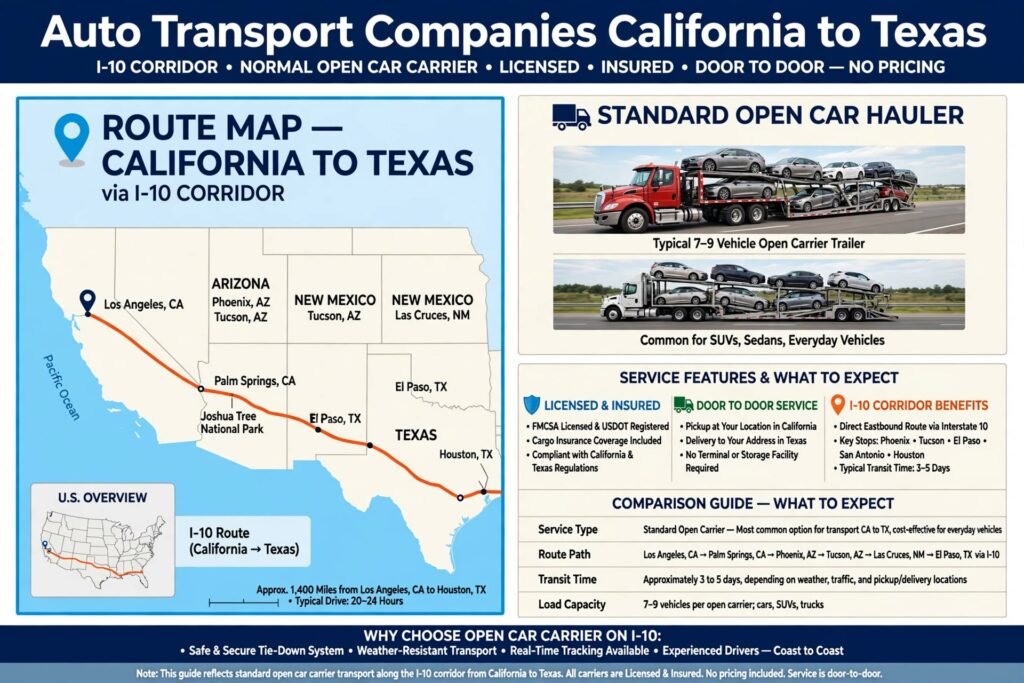
Transport type: Open carriers are commonly used for everyday cars and are generally more economical. Enclosed transport costs more but provides a covered environment for vehicles that need additional protection.
Pickup and delivery access: Tight streets, gated communities, low-clearance entrances, and restricted truck access can require an alternative meeting location.
Timing: A narrow pickup window may limit available arrangements. Flexible dates can give a carrier more scheduling options, although savings are not guaranteed.
Market conditions: Seasonal relocation patterns, carrier availability, and demand along a particular route can influence pricing.
When evaluating auto transport companies from California to Texas, provide the same information to every provider. That makes their estimates more meaningful and helps you identify differences in service rather than differences caused by incomplete details.
The Open-Carrier Decision: Spend Less or Add Protection?
Your vehicle’s value and condition should guide the choice of carrier.
Open transport carries vehicles on an uncovered trailer. It is a common option for standard sedans, SUVs, and daily drivers. Although the vehicle is exposed to ordinary outdoor conditions during transit, open transport remains a widely used method for interstate vehicle shipping.
Enclosed transport places the vehicle inside a covered trailer. Owners of classic cars, collectible models, luxury vehicles, or freshly restored automobiles may prefer this option for its additional protection from weather and road debris.
Neither option is automatically right for every shipment. If you are moving a regular commuter car from Fresno to Fort Worth, open transport may meet your needs. If you are relocating a rare classic vehicle, the added expense of enclosed service may be worth considering.
Ask each provider to explain the differences in price, availability, and coverage. Also confirm how the vehicle’s condition will be documented at pickup and delivery.
Don’t Let Your Moving Calendar Dictate the Wrong Booking
Car transport is easier to coordinate when it is included in your relocation schedule instead of being treated as a last-minute task.
Suppose your Texas lease begins on the first of the month, but you must leave your California home several days earlier. Decide whether you need the vehicle immediately upon arrival or can manage temporarily without it. That decision may give you more flexibility when comparing pickup and delivery arrangements.
Before booking, confirm the dates you can accommodate, the addresses involved, and whether someone will be available to release and receive the vehicle. If you are flying to Texas, arrange for a trusted person to handle pickup or delivery when needed, and verify the carrier’s requirements.
Rapid Auto Shipping helps customers arrange vehicle transportation across the United States. You can request a quote using your route, vehicle details, and preferred schedule, then discuss available options before deciding which arrangement works for your move.
A Few Checks Before You Commit
Price is important, but the company’s communication and booking terms matter too. Look for clear answers, written documentation, and realistic explanations of pickup and delivery expectations.
Review customer feedback, confirm the provider’s role in arranging transportation, and ask who will be responsible for communicating schedule updates. Understand what insurance applies and how to report any damage. Be cautious if a representative pressures you to pay immediately or refuses to explain the quoted amount.
After booking, keep the confirmation and payment records accessible. Before pickup, remove personal belongings unless explicitly permitted, follow the carrier’s fuel instructions, and take photographs of the car. Review the inspection report with the driver and retain a copy.
These steps cannot eliminate every possible delay, but they make it easier to understand your responsibilities and address problems if they arise.
Build Your Budget Around Clear Answers
A cross-country move already comes with enough unknowns. Asking detailed questions before booking makes vehicle transportation easier to compare and helps you avoid choosing a service based on price alone.
When reviewing auto transport companies from California to Texas, focus on transparent quotes, suitable carrier options, realistic scheduling, and clear written terms. Rapid Auto Shipping can help you explore transport arrangements based on your vehicle and route. With the right information in hand, you can plan your California-to-Texas move with greater confidence and fewer financial surprises.
Frequently Asked Questions
- How much does California-to-Texas car shipping cost?
The price depends on the exact route, vehicle dimensions, transport type, timing, and pickup or delivery conditions. Request a current quote with accurate details rather than relying on a broad estimate.
- How far ahead should I contact auto transport companies?
Start researching several weeks before your planned move when possible. Early research gives you time to compare terms and availability, although a particular pickup date is not guaranteed until confirmed.
- Is open transport suitable for a daily driver?
For many standard vehicles, yes. Open transport is widely used for routine interstate shipments. Consider enclosed service if your vehicle has special protection needs.
- Can the quoted price change after booking?
It may change if important shipment details were inaccurate or the requested arrangements change. Ask which circumstances can affect the quote and get any agreed changes documented in writing.
- Should I choose the cheapest company?
Not automatically. Compare the total expected cost, service details, payment terms, insurance information, communication, and cancellation policy before making your decision.