KA02 Assessment
Preparing for a professional engineering assessment requires more than collecting documents and completing an application form. You need to understand what the assessment is designed to evaluate, organize evidence of your education and experience, and present your professional knowledge clearly. For applicants working toward professional recognition through Engineering New Zealand, understanding the KA02 Assessment process can make preparation more structured and manageable.
The IPENZ KA02 terminology is still commonly used by applicants and in older guidance and references to Engineering New Zealand’s assessment processes. The IPENZ KA02 Knowledge Assessment focuses on demonstrating that your engineering knowledge is appropriate for the relevant professional pathway. Because the assessment can involve detailed evidence and supporting documentation, preparing early can help you avoid incomplete information and unnecessary delays.
This guide explains how to prepare for your application, what information you should organize, how to approach your supporting evidence, and how to make your submission clear and consistent.
Understanding the KA02 Assessment
Before preparing your application, it is important to understand what the KA02 Assessment is intended to establish. An engineering knowledge assessment is concerned with whether an applicant has the required level and breadth of engineering knowledge for the relevant professional recognition pathway.
The IPENZ KA02 Knowledge Assessment should therefore not be treated as simply an administrative application. Your academic background, engineering knowledge, supporting documents, and professional information need to work together to demonstrate your suitability.
Applicants with engineering qualifications obtained outside New Zealand may need to provide additional information about their education. The assessment may require reviewers to understand what you studied, the level of your qualification, and how your academic preparation relates to engineering practice.
Why Preparation Matters
A carefully prepared application allows the assessor to understand your background without having to interpret incomplete or inconsistent information. If important documents are missing or information is unclear, you may be asked for clarification or additional evidence.
Preparation also gives you an opportunity to identify potential gaps before submitting your application. Rather than discovering missing information after submission, you can gather relevant academic records, course information, identification documents, translations, and other evidence beforehand.
For this reason, preparation for the IPENZ KA02 process should begin well before you intend to submit the application.
Check the Requirements Before You Apply
The first step is to establish exactly which assessment pathway applies to your circumstances. Engineering qualifications and professional recognition pathways can differ depending on your academic history, engineering discipline, and intended professional registration or membership route.
Do not rely entirely on information from older websites, discussion forums, or previous applicants. Terminology and procedures can change over time. The term IPENZ KA02 may appear in older material, while current Engineering New Zealand processes and terminology may differ.
Review Your Engineering Qualification
Start by reviewing your engineering degree or other relevant qualification. Make a record of the institution, qualification title, study period, engineering discipline, and country where the qualification was awarded.
You should also identify whether your qualification was completed in an accredited program and whether you have documentation that confirms the award.
If your qualification was obtained internationally, consider how easily an assessor will be able to understand the academic structure. Course titles that are obvious in one country may not provide enough information to someone reviewing the qualification in another educational system.
Confirm Your Academic Records
Academic records are an important part of preparing for the KA02 Assessment. Collect official transcripts, degree certificates, academic statements, and other relevant educational records.
Your transcript should ideally provide enough information to establish the subjects you studied and the results you achieved. If the transcript contains abbreviations or unfamiliar course codes, additional documentation may be useful.
Keep original documents available and prepare high-quality digital copies where the application process requires electronic submission.
Organize Your Supporting Documents
One of the most useful things you can do before beginning the application is create a document checklist. This reduces the possibility of overlooking a required item.
Academic Documents
Academic documentation may include your degree certificate, academic transcript, course descriptions, and evidence relating to the structure or level of your engineering education.
If you completed multiple qualifications that contribute to your engineering background, organize them separately. Make sure the names and dates are consistent across your documents.
For the IPENZ KA02 Knowledge Assessment, academic information should be presented in a way that makes it easy for the assessor to understand your educational pathway.
Identification Documents
You may also need identification documentation or other personal information required by the relevant application process. Check the current requirements rather than assuming that documents used for another professional application will automatically be accepted.
Make sure your name is consistent across your identification documents and academic records. If different versions of your name appear, determine whether additional documentation is needed to explain the difference.
Translations
If your documents are not in English, check the current requirements concerning translations. Avoid relying on informal translations when an official or certified translation is required.
Keep both the original-language document and its English translation together. This allows the assessor to compare the translated information with the original record if necessary.
Review Your Engineering Knowledge
Preparing for the KA02 Assessment is not only about gathering paperwork. You should also review the engineering knowledge represented by your academic and professional background.
Think about the major areas of engineering knowledge you developed during your studies. Depending on your discipline, these could include engineering mathematics, technical science, engineering fundamentals, design, analysis, materials, systems, risk, project considerations, or other discipline-specific subjects.
Identify Your Strongest Areas
Review your academic transcript and course history and identify the areas in which you have substantial knowledge.
For example, a civil engineering applicant might have studied structural engineering, geotechnical engineering, transportation, water resources, construction, and engineering design. A mechanical engineering applicant might have a background involving thermodynamics, fluid mechanics, machine design, manufacturing, and materials.
The purpose of this review is not to create a simple list of subjects. Instead, consider how your education developed your ability to understand and apply engineering principles.
Identify Potential Knowledge Gaps
A self-review can also help identify areas where your academic background may need further explanation.
If your qualification is specialized, for example, your transcript may contain relatively few subjects outside your specialization. Understanding this before submitting your IPENZ KA02 application allows you to prepare relevant supporting information.
Where appropriate, gather course outlines, subject descriptions, syllabi, or other educational evidence that provides additional context.
Prepare a Clear Application History
Your educational and professional history should tell a consistent story.
Create a timeline showing your education, qualifications, employment, major engineering responsibilities, and other relevant activities. Check the dates carefully.
Keep Dates Consistent
Inconsistencies between your CV, application form, academic records, and supporting documents can create unnecessary questions.
For example, if your CV states that you graduated in one year but your academic documentation shows another date, explain the difference where appropriate rather than leaving the assessor to determine why the information conflicts.
The same principle applies to employment dates, job titles, employers, and engineering responsibilities.
Explain Changes Clearly
Career changes, employment gaps, additional qualifications, and changes in engineering discipline are not necessarily problems. What matters is that your application explains your professional and academic history accurately.
A clear chronological structure can make the KA02 Assessment application easier to review.
Understand the Difference Between Education and Experience
One important part of preparation is distinguishing academic knowledge from professional experience.
Engineering experience can demonstrate how you have applied knowledge in real situations, but your IPENZ KA02 Knowledge Assessment may require evidence concerning your underlying engineering knowledge as well.
Use Experience as Supporting Context
Your professional experience can help provide context for your technical development. For instance, a project in which you applied structural analysis principles can demonstrate how academic concepts were used in practice.
However, avoid presenting professional responsibilities as a substitute for academic evidence when the assessment specifically requires evidence of engineering knowledge.
Your application should clearly distinguish what you learned through formal education from what you developed through professional practice.
Prepare Your Course Information Carefully
Course descriptions can be especially useful when an assessor needs more information than the transcript provides.
If your academic transcript lists a course such as “Advanced Engineering Analysis” without explaining its content, a course outline could help establish what topics were covered.
Include Relevant Technical Content
Where course information is required, focus on substantive engineering content. Information about learning outcomes, technical topics, laboratory work, design activities, mathematics, analysis methods, and assessment methods can help provide context.
Do not overwhelm the application with irrelevant university information. The objective is to provide useful evidence that helps the assessor understand your engineering education.
Review Your Application for Consistency
Before submitting your KA02 Assessment application, perform a detailed consistency check.
Compare your application against your academic records and supporting documentation. Verify names, dates, qualification titles, institutions, engineering disciplines, and employment information.
Check Technical Terminology
Use consistent terminology throughout the application. If your degree has an official title, use that title rather than repeatedly changing its wording.
Similarly, use recognized names for engineering disciplines and avoid unnecessary abbreviations unless you define them first.
Clear terminology helps prevent misunderstandings during the IPENZ KA02 assessment process.
Prepare for Questions About Your Qualification
International applicants may need to provide additional context about their qualifications. Consider what an assessor who is unfamiliar with your university or education system would need to know.
Explain the Educational Structure
If your qualification is part of a multi-stage degree system, explain the structure where relevant. For example, if you completed a bachelor’s degree followed by a specialized master’s degree, make sure the relationship between the qualifications is clear.
You may also need to explain whether a qualification represents an undergraduate engineering degree, postgraduate engineering study, or another form of technical education.
The more clearly the educational pathway is presented, the easier it is to understand your background during the IPENZ KA02 Knowledge Assessment.
Avoid Common Application Mistakes
Several avoidable mistakes can make an assessment application more difficult to review.
One common issue is submitting incomplete documentation. Before submitting, compare every required document with your personal checklist.
Another issue is providing unclear scans. Documents should be readable, complete, and appropriately oriented.
Applicants can also create problems by providing conflicting information across different sections. Always review the complete application rather than checking individual sections independently.
Do Not Exaggerate Your Background
Your application should accurately describe your education and engineering experience. Avoid overstating responsibilities, qualifications, technical expertise, or professional achievements.
The KA02 Assessment is intended to evaluate your actual engineering knowledge and background. Accurate information provides a stronger foundation for assessment than exaggerated claims.
Do Not Add Unnecessary Information
More information does not automatically make an application stronger. Large amounts of irrelevant material can make important evidence harder to identify.
Focus on information that directly helps establish your education, engineering knowledge, qualifications, and relevant professional background.
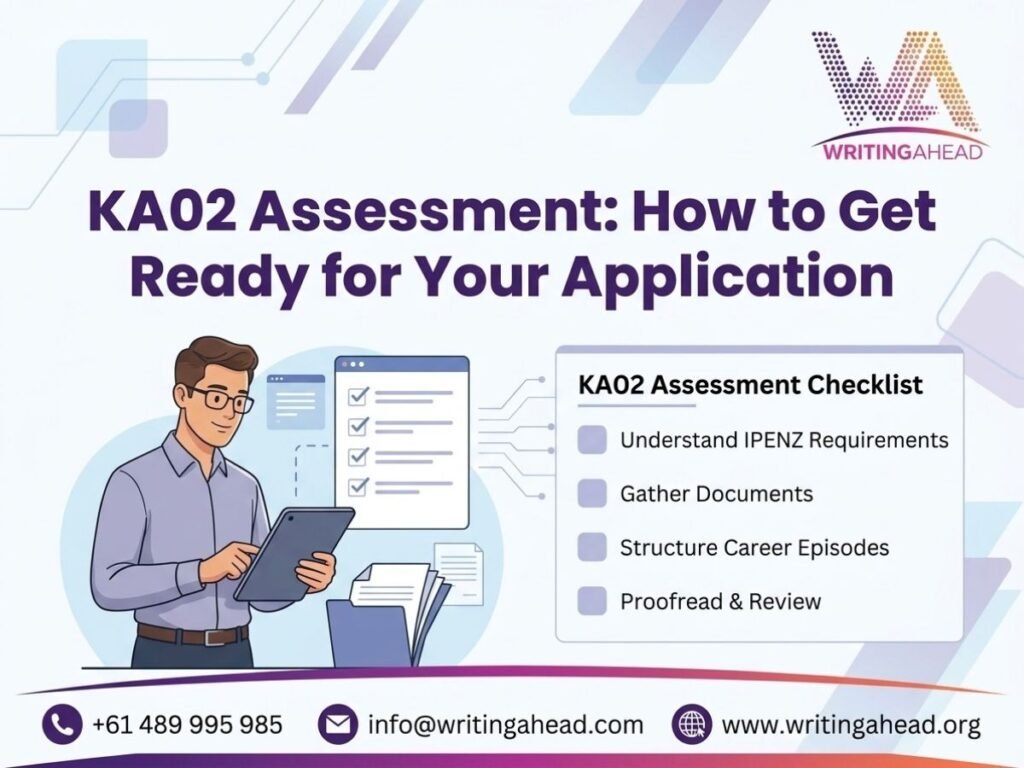
Create a Final KA02 Assessment Checklist
Before submitting your application, complete a final review.
Confirm that your qualification documents are available and readable. Check that academic transcripts are included where required. Verify that translations meet the applicable requirements. Review your identification information and make sure names are consistent.
Then review your engineering education and professional history. Make sure the application clearly communicates your engineering discipline and educational pathway.
Finally, review every uploaded file and confirm that the correct document has been attached to the appropriate section.
What to Do If You Are Unsure About Your Evidence
If you are uncertain whether a particular document demonstrates the required information, first review the current official guidance for the relevant Engineering New Zealand pathway.
Older references to IPENZ KA02 can sometimes create confusion because Engineering New Zealand and its assessment terminology have evolved. Always prioritize current official requirements when they differ from historical references.
If clarification is necessary, prepare a concise question that identifies the exact document or requirement you are unsure about. This is generally more useful than asking a broad question about the entire application.
Final Preparation Before Submission
The final stage of preparing for the IPENZ KA02 Knowledge Assessment should involve a complete quality check rather than last-minute document collection.
Read your application from the perspective of an assessor who has never seen your educational or professional history before. Ask whether the information is clear, whether important evidence is easy to locate, and whether your documents support the information you have provided.
Check spelling, dates, qualification names, institution names, and technical terminology. Confirm that documents are readable and that required translations or supporting evidence are included.
Most importantly, make sure the application presents a consistent account of your engineering education and knowledge.
Conclusion
Preparing for a KA02 Assessment is easier when you approach it as an evidence-based professional application rather than simply a form-filling exercise. Start by understanding the current assessment requirements, then organize your academic records, qualification documents, identification information, translations, and relevant supporting evidence.
Review your engineering education carefully and identify how your studies developed your technical knowledge. Where course titles or qualifications require additional explanation, prepare appropriate documentation. Keep your education and professional history consistent across every part of the application.
The term IPENZ KA02 may still appear in older resources, while current applicants should rely on the latest information from Engineering New Zealand. Similarly, the IPENZ KA02 Knowledge Assessment should be understood in the context of the current professional assessment pathway rather than relying exclusively on historical descriptions.
With organized documentation, accurate information, clear explanations, and careful final checking, you can approach your application with a much clearer understanding of what needs to be prepared.
Frequently Asked Questions
What is the KA02 Assessment?
The KA02 Assessment refers to an engineering knowledge assessment associated with professional engineering assessment terminology historically used by IPENZ, now Engineering New Zealand. Applicants should check the current Engineering New Zealand requirements for the applicable pathway.
What documents should I prepare for an IPENZ KA02 application?
Depending on the current pathway and your circumstances, you may need academic qualifications, official transcripts, identification documents, translations, course information, and other supporting evidence. Always verify the current document requirements before submission.
Is the IPENZ KA02 Knowledge Assessment only for New Zealand engineering graduates?
The IPENZ KA02 Knowledge Assessment terminology has historically been associated with assessment of engineering knowledge, including circumstances involving overseas qualifications. Current eligibility and assessment requirements depend on the relevant Engineering New Zealand pathway.
How can I prepare my academic documents for the KA02 Assessment?
Collect your degree certificates, official transcripts, relevant course information, and required translations. Check that documents are complete, readable, and consistent with the information provided in your application.
What should I do if my qualification does not clearly show my engineering subjects?
Consider preparing additional academic evidence such as course descriptions, syllabi, subject outlines, or other official university documentation where appropriate. The objective is to provide enough information for the assessor to understand your engineering education.