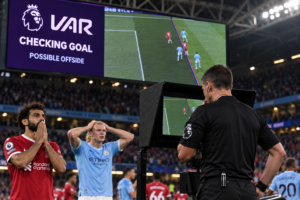
There’s a moment that every football fan now knows by heart. The ball hits the net, the stadium erupts, you’re hugging a stranger, and then you notice the referee has his finger pressed to his ear. The celebrations freeze halfway. Nobody sits down. Nobody knows whether to keep cheering. Two minutes later a graphic appears on the big screen, and half the ground is either delirious or furious.
That’s VAR in the Premier League. Since it arrived in 2019, it has fixed plenty of genuine mistakes, created a few new ones and started more arguments than any rule change in modern memory. Some fans want it scrapped. Others want it used more. Most of us sit somewhere in the middle, grumbling.
So how does it actually work, what can it look at, and why does it still divide people so sharply?
What VAR can and cannot review
VAR stands for video assistant referee. In the Premier League, a team of officials sits in a central hub at Stockley Park in west London, watching every match on multiple screens with access to all the broadcast camera angles.
Their job is not to referee the game again. It’s to step in only when the on field referee has made a clear and obvious error in a small number of key situations, or has missed a serious incident entirely. That phrase, “clear and obvious”, is the heart of the whole system and the source of most of the arguments. If a decision is a matter of opinion and the referee’s call was reasonable, VAR is supposed to leave it alone.
Plenty of things are outside VAR’s reach. It doesn’t review ordinary fouls in midfield, throw ins or most free kicks. It won’t advise a referee to show a yellow card. And this season, the Premier League has chosen not to use a new optional rule that would let VAR check wrongly awarded corners, arguing it would slow matches down too much.
The laws that govern all of this are written by the International Football Association Board, the body responsible for football’s rules worldwide. Leagues then decide exactly how to apply them.
The four match changing situations
Traditionally, VAR could only get involved in four kinds of incidents.
- Goals. Was there an offside, a foul, a handball or the ball out of play in the build up?
- Penalty decisions. Should a penalty have been given, or was one given wrongly?
- Direct red cards. Was a straight red card clearly wrong, or was a serious offence missed?
- Mistaken identity. Did the referee book or send off the wrong player?
For 2026/27, there’s an important addition. Following a change to the laws approved earlier this year, VAR can now review a red card that comes from a second yellow, but only when the second yellow has actually been shown. It can’t recommend a second yellow that the referee didn’t give. That closes one of the most frustrating gaps of recent years, when players were sent off for a soft second booking and nothing could be done about it.
When the VAR thinks there may be an error on a subjective decision, like a penalty or a red card, it recommends an on field review. The referee goes to the pitchside monitor, watches the replay and makes the final call. For factual decisions, like offside or whether the ball crossed the line, the VAR simply tells the referee and the decision is changed without a trip to the monitor.
Semi automated offside
Offside was VAR’s biggest headache in its early years. Officials would freeze the footage, draw lines across the pitch by hand and sometimes take several minutes to decide whether an attacker’s shoulder or armpit was ahead of a defender’s knee. Goals were ruled out by margins you couldn’t see with the naked eye, and fans hated it.
The Premier League introduced semi automated offside technology in April 2025. It uses multiple cameras around the stadium to track players’ body positions, then creates a 3D model showing exactly where everyone was when the ball was played. The system flags the position automatically, and the officials confirm it.
The main benefits are speed and clarity. Checks that once dragged on can be done much faster, and the 3D animation shown to supporters is easier to understand than a pair of wobbly lines. It hasn’t ended every argument, and some fans still feel that being offside by a toenail isn’t what the rule was meant for. But most people agree it’s an improvement.
Controversial moments and debates
Every club has its own VAR grievance, and every fan can recite theirs.
The most notorious example came in September 2023, when Liverpool had a perfectly good goal against Tottenham ruled out for offside. The VAR team misunderstood the on field decision and failed to correct it in time. The refereeing body later admitted it was a significant human error. Liverpool lost the match, and the incident became a symbol of everything people dislike about the system.
There have been endless debates over handball, too. The rules have changed several times since VAR arrived, and many fans still can’t say with confidence what counts as a handball and what doesn’t. Penalty decisions for contact in the box cause similar confusion, because what looks like a foul in slow motion can look very different at full speed.
Some clubs have gone further than complaining. In 2024, Wolves proposed scrapping VAR in the Premier League entirely. The other clubs voted overwhelmingly to keep it, but the fact the vote happened at all shows how deep the frustration runs.
There’s also the atmosphere question. Many supporters say VAR has taken the spontaneity out of celebrating a goal. You can’t fully let go anymore, because you know there might be a check. For a sport built on emotion, that’s a real cost, even if it doesn’t show up in any statistic.
If you want balanced coverage of the big incidents each weekend, BBC Sport often breaks down key VAR decisions and explains the relevant laws, which helps separate genuine mistakes from decisions that were simply unpopular.
Impact on results and the table
So does VAR actually change who wins the league or who goes down?
On balance, it corrects far more errors than it creates. Before VAR, clear mistakes, like offside goals or penalties for dives, regularly decided matches, and nobody could do anything about it. The Premier League says the number of correct key decisions has risen since the system was introduced, and independent panels now review major incidents each week to assess whether officials got them right. You can read about how the process works on the official Premier League website.
But the errors that remain feel worse, because fans know the footage was there. A mistake made in real time by a referee running at full speed is forgivable. A mistake made after replays in a quiet room is much harder to accept.
The effect on the table can be significant. A single wrong decision can turn a win into a draw, which is two points gone. Over a season, a few of those can be the difference between Europe and mid table, or between survival and relegation. Keep an eye on the live standings on Valioliiga.org after a weekend with a big VAR call, and you’ll often see how much one decision can shift a club’s position, especially near the top four or the bottom three where the gaps are tiny.
It’s also worth remembering that decisions tend to even out a little over a long season. Most clubs benefit from some calls and suffer from others. The trouble is that fans only really remember the ones that went against them. I’m no different.
Where VAR goes from here
VAR isn’t going anywhere. The debate now is about how to make it better rather than whether to keep it.
The changes this season point in a clear direction: a slightly wider scope for serious errors, like wrong second yellows, and a determination not to slow the game down with more minor checks. Faster offside technology has helped. Better communication with supporters in the stadium would help even more, because much of the anger comes from fans being left in the dark while a decision is made.
Will it ever satisfy everyone? Of course not. Football fans will argue about refereeing until the end of time, with or without screens. But if VAR can keep fixing the obvious mistakes while getting out of the way the rest of the time, most of us will learn to live with it. We’ll probably still wait a second or two before celebrating, though. Just in case.